


Is Dropshipping 3D Printing Lamp Profitable? A Complete Analysis of Gross Margins, Personalization, Advertising Costs, Market Demand, and Scalability

From a pure margin perspective, dropshipping 3D printed lamps is considerably more profitable than many traditional dropshipping categories.
The combination of premium pricing, low material costs, strong emotional value, and high differentiation creates a business model capable of sustaining healthy gross margins.
While operational challenges such as production lead times and quality control still exist, the economics of the niche remain attractive.
For sellers seeking products with gross margins above 60% and average order values exceeding $70, 3D printed lamps represent one of the stronger opportunities currently available in the personalized home decor market.
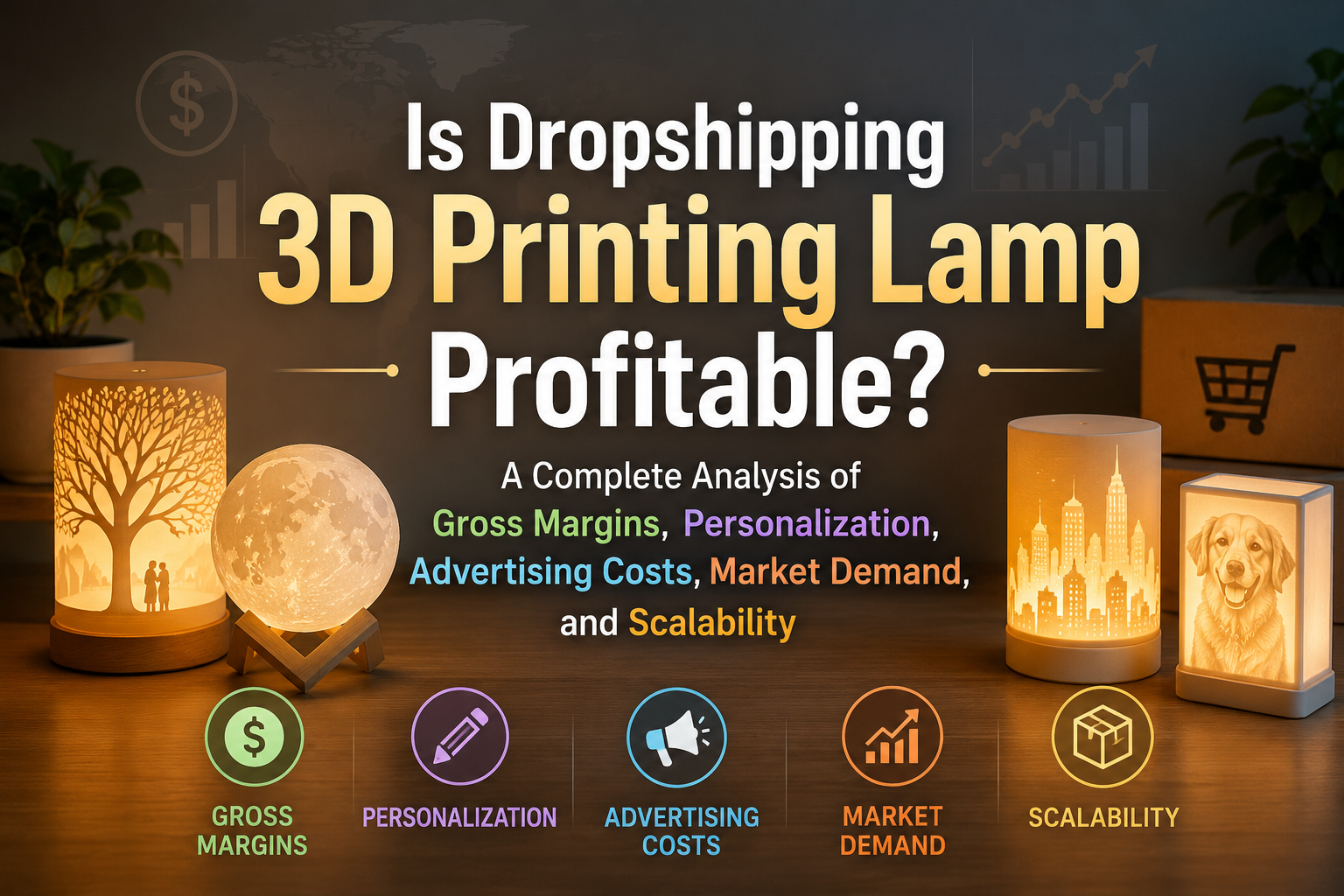
Is Dropshipping 3D Printing Lamps Profitable? Dive into Gross Margins, Selling Prices, and Production Costs
The growing popularity of personalized home decor has created a favorable environment for niche products that combine functionality with emotional value. Among these products, 3D printed lamps have emerged as one of the most interesting opportunities for dropshipping sellers. Whether it is moon lamps, city skyline lamps, anime lamps, lithophane photo lamps, or custom star map lamps, consumers are increasingly willing to pay premium prices for products that feel unique and personalized.
However, profitability in dropshipping is rarely determined by product popularity alone. The real question is whether the economics of 3D printing lamps provide enough margin to support advertising costs, logistics expenses, and business growth.
The Average Selling Price of 3D Printed Lamps
Unlike generic LED desk lamps that compete heavily on price, 3D printed lamps occupy a premium position within the home decoration and gift markets.
According to pricing data from Shopify stores, Etsy sellers, and independent brands, standard 3D printed lamps typically sell within the following ranges:
- Basic moon lamps: $39 to $49
- Anime character lamps: $59 to $79
- Custom photo lithophane lamps: $69 to $99
- Personalized star map lamps: $79 to $129
- City skyline lamps: $89 to $139
The average selling price across most categories falls between $59 and $85, significantly higher than many traditional dropshipping products.
This higher average order value is one of the primary reasons many sellers are attracted to the niche.
the True Production Cost
Many new sellers overestimate the manufacturing cost of 3D printed products because they assume the printing process is expensive. In reality, the raw material cost of most lamps is surprisingly low.
A typical medium-sized lamp weighing 350 to 500 grams requires approximately:
PLA material cost: $2 to $4
Electricity consumption during printing: $0.50 to $1.00
Printer depreciation and maintenance allocation: $1 to $2
Assembly and quality inspection labor: $4 to $8
Packaging materials: $2 to $4
International shipping cost: $7 to $15
As a result, the total fulfillment cost for most products falls between $18 and $30 depending on destination country and customization complexity.
For products selling at $69, the gross profit before advertising expenses is often around $39 to $45 per order.
Gross Margin Comparison with Traditional Lighting Products
Gross margin is arguably the most important metric when evaluating a dropshipping niche.
Traditional lighting products sold through AliExpress suppliers often generate gross margins between 25% and 40%. Competition is intense, product differentiation is minimal, and consumers can easily compare prices across multiple stores.
3D printed lamps operate under very different market conditions.
A lamp sold for $79 with a fulfillment cost of $26 generates:
Gross Profit = $53
Gross Margin = 67%
Even if fulfillment costs rise to $32 due to customization or expedited shipping, gross margins still remain above 59%.
For comparison:
Traditional LED lamp gross margin: 30% to 40%
Consumer electronics accessories: 20% to 35%
Fashion accessories: 45% to 55%
3D printed lamps: 55% to 72%
This margin advantage provides significantly more room for customer acquisition and business scaling.
Why Consumers Accept Premium Pricing
The strongest pricing advantage of 3D printed lamps comes from perceived uniqueness rather than production complexity.
Customers are rarely purchasing a light source alone. Instead, they are buying decoration, personalization, gifting value, and emotional attachment.
A customer comparing a generic desk lamp and a personalized moon lamp with their family photo embedded inside is not making a purely functional purchasing decision.
This emotional component dramatically reduces price sensitivity.
Products with lower price sensitivity generally experience healthier margins and less aggressive competition.
How Order Volume Changes Unit Economics
One overlooked advantage of the niche is the improvement in unit economics as order volume increases.
Shipping providers often offer discounted rates once merchants reach certain monthly thresholds. Packaging can be purchased in bulk, reducing material costs by 15% to 25%. Production partners operating multiple printers can further reduce labor allocation per unit.
For example, a seller processing 50 orders per month may have an average fulfillment cost of $29.
At 300 monthly orders, the same product may cost only $24 to fulfill.
On a product selling for $79, this difference alone increases gross margin from 63% to nearly 70%.
Is Dropshipping Personalized 3D Printing Lamps More Profitable Than Selling Standard Designs?
The rise of personalization has fundamentally changed consumer behavior in the gift and home decor industries. Products are no longer evaluated solely based on utility or design quality. Increasingly, consumers are willing to pay significantly higher prices for products that reflect personal memories, emotions, or identity.
This trend has created a major opportunity for sellers of personalized 3D printed lamps. The key question, however, is whether customization genuinely improves profitability or simply adds operational complexity.
A closer examination of pricing power, customer acquisition efficiency, and margin performance suggests that personalized products often outperform standard designs in almost every major business metric.
The Pricing Advantage of Personalized Products
The most immediate difference between standard and personalized lamps is selling price.
A standard 3D printed moon lamp typically sells for between $39 and $49 in most Western markets.
By comparison:
Custom photo lithophane lamps often sell for $69 to $99.
Personalized star map lamps generally sell for $79 to $119.
Custom family portrait lamps frequently reach prices of $89 to $129.
Pet memorial lamps can exceed $100 due to their emotional significance.
The manufacturing cost increase associated with personalization is surprisingly small.
Adding a customer image, date, coordinates, or text engraving usually increases production cost by only $2 to $5 per unit.
In many cases, a seller can increase retail pricing by $30 to $50 while increasing fulfillment costs by less than 10%.
This pricing asymmetry creates a powerful margin advantage.
Gross Margin Expansion Through Customization
Consider two products with similar manufacturing requirements.
A standard moon lamp:
Selling price: $45
Fulfillment cost: $21
Gross profit: $24
Gross margin: 53%
A personalized photo lamp:
Selling price: $85
Fulfillment cost: $27
Gross profit: $58
Gross margin: 68%
The personalized version generates more than double the gross profit despite only increasing production cost by approximately $6.
This difference becomes even more important when advertising expenses are introduced.
A higher gross profit per order provides more room for customer acquisition while maintaining profitability.
Why Consumers Accept Higher Prices
The economic logic behind personalized products is rooted in behavioral psychology rather than manufacturing economics.
Consumers purchasing personalized lamps are rarely comparing prices against alternative lamps.
Instead, they compare the product against other gifts, sentimental purchases, or memorable experiences.
A personalized anniversary lamp may compete with flowers, jewelry, or restaurant experiences rather than with lighting products.
This changes the purchasing decision entirely.
Price comparison becomes less important because emotional value becomes the primary purchase driver.
Research within the personalized gift industry consistently shows that consumers demonstrate lower price sensitivity when products include personal information, photographs, or memories.
This allows sellers to maintain premium pricing even during periods of aggressive competition.
Personalization Often Improves Conversion Rates
Higher prices do not necessarily lead to lower conversion rates.
In many cases, personalized products convert better than generic alternatives.
Several e-commerce studies have found that personalized products can increase conversion rates by 20% to 40% compared with non-customized versions of the same product category.
There are several reasons for this phenomenon.
First, personalization creates uniqueness and urgency because customers know the product is being created specifically for them.
Second, personalized products are difficult to compare across competing stores.
Third, emotional purchases are often driven by impulse rather than extensive research.
This combination frequently leads to stronger conversion performance despite premium pricing.
Competition Is Usually Lower
Standard products are easy to replicate.
If one seller launches a successful moon lamp, dozens of competitors can offer the identical product within weeks.
Personalized products create natural barriers to entry.
The seller must build customization workflows, image upload systems, production templates, and customer approval processes.
These operational requirements discourage many competitors.
As a result, personalized niches often experience lower pricing pressure and healthier long-term margins.
Lower competition can be just as important as higher selling prices when evaluating profitability.
Customer Satisfaction and Refund Risk
One concern frequently raised by new sellers is the possibility of increased refunds due to customization errors.
While mistakes can occur, personalized products often experience lower voluntary return rates than standard products.
Many countries limit returns on customized goods because the products cannot be resold.
In addition, customers generally perceive personalized products as more valuable and are more willing to tolerate minor imperfections.
This can reduce return-related losses compared with generic home decor products.
However, quality control becomes significantly more important because production mistakes directly affect customer sentiment.
Is Facebook Advertising for 3D Printing Lamps Still Profitable
For most dropshipping businesses, profitability is determined less by product cost and more by customer acquisition cost. A product with excellent gross margins can quickly become unprofitable if advertising expenses consume most of the contribution margin.
This concern is especially relevant for Facebook advertising. Rising CPMs over the last five years have made many traditional dropshipping products difficult to scale profitably.
The question for sellers considering 3D printed lamps is whether their pricing structure and market positioning can absorb modern advertising costs while still generating sustainable profits.
The answer depends largely on average order value, product differentiation, and creative performance.
Current Facebook Advertising Costs
Advertising costs vary significantly across countries and product categories, but home decor products generally fall into a moderately competitive segment.
Based on data from Shopify stores and media buyers targeting North America, Europe, and Australia during 2025 and early 2026, average advertising metrics often fall within the following ranges:
CPM: $8 to $18
CPC: $0.50 to $1.20
CTR: 1.5% to 3.5%
Landing page conversion rate: 2% to 4%
Purchase conversion rate: 1.5% to 3%
These numbers are considerably healthier than highly saturated niches such as beauty products, fashion accessories, or consumer electronics.
The visual nature of decorative lighting products tends to perform well in image and video advertising environments, which helps maintain relatively efficient click costs.
Calculating Customer Acquisition Cost
Customer acquisition cost can be estimated using conversion rates and click costs.
Assume the following campaign metrics:
Average CPC: $0.85
Website conversion rate: 2.5%
The expected acquisition cost becomes:
40 clicks × $0.85 = $34 CPA
If creative quality improves and conversion rates increase to 3.5%, customer acquisition costs fall substantially:
29 clicks × $0.85 = $24.65 CPA
This demonstrates how sensitive profitability is to product presentation and landing page optimization.
Unlike commodity products, 3D printed lamps often benefit from strong visual storytelling, making conversion rate improvements more achievable.
Break-even ROAS for 3D Printed Lamps
Break-even return on ad spend is one of the most useful metrics when evaluating advertising viability.
Consider a personalized lamp with the following economics:
Selling price: $79
Product fulfillment cost: $27
Payment processing fees: $3
Gross contribution before advertising: $49
Break-even ROAS calculation:
79 ÷ 49 = 1.61
This means advertising remains profitable as long as campaigns generate ROAS above 1.61.
Many experienced Facebook advertisers consider a break-even ROAS below 2.0 to be highly attractive because it provides flexibility during scaling periods.
By comparison, many consumer electronics products require ROAS above 3.0 simply to avoid losses.
The high margin structure of personalized lighting products creates a significant advantage.
Average Profitability Scenarios
Consider a realistic advertising scenario for a personalized photo lamp.
Selling price: $85
Fulfillment and shipping cost: $29
Transaction fees: $3
Customer acquisition cost: $27
Net operating profit:
$26
Net profit margin:
30.5%
If optimization efforts reduce acquisition cost to $22, profitability improves dramatically:
Net profit:
$31
Net margin:
36.5%
At a selling price above $90, profit margins exceeding 40% become increasingly achievable.
These economics compare favorably with many traditional dropshipping categories where advertising frequently consumes over half of gross profit.
Why 3D Printed Lamps Perform Better Than Commodity Products
The largest challenge in Facebook advertising is creative fatigue.
Products that look identical to hundreds of competitors quickly lose effectiveness as consumers become accustomed to seeing similar advertisements.
3D printed lamps possess several characteristics that help counter this problem.
First, the products are highly visual and demonstrate well in short-form video.
Second, personalization creates emotional engagement that generic products struggle to replicate.
Third, many products have a strong gifting angle, allowing advertisers to target birthdays, anniversaries, weddings, Mother’s Day, Father’s Day, and holiday campaigns.
Seasonal relevance often improves advertising efficiency because purchase intent is naturally higher.
This creates more opportunities to refresh creative assets without changing the core product.
The Role of Average Order Value
Advertising economics improve dramatically as average order value increases.
Suppose two stores operate with identical customer acquisition costs of $28.
Store A sells a generic lamp for $45.
Store B sells a personalized lamp for $89.
The customer acquisition cost consumes:
62% of revenue for Store A.
31% of revenue for Store B.
This simple comparison explains why many experienced advertisers prioritize products with average order values above $70.
Higher order values provide more room for testing, scaling, and market fluctuations.
Is the Market for 3D Printing Lamps Saturated or Still Growing?
One of the biggest concerns for new dropshipping sellers is entering a market too late. A niche may appear attractive on social media, only for sellers to discover that competition has already compressed margins and eliminated opportunities for growth.
The same question is frequently asked about 3D printed lamps. Products such as moon lamps, lithophane photo lamps, anime lamps, and custom star map lamps have existed for several years, leading many entrepreneurs to assume that the market has reached saturation.
However, market saturation is often misunderstood. A mature product category does not necessarily imply a saturated market. The more important question is whether demand growth continues to outpace competition and whether new subcategories continue to emerge.
Current market data suggests that the 3D printed lamp industry remains in an expansion phase rather than a maturity phase.
The Personalized Home Decor Market Continues to Expand
3D printed lamps belong primarily to two rapidly growing sectors: personalized gifts and home decoration.
The global personalized gifts market was valued at approximately $31 billion in 2024 and is projected to exceed $45 billion before 2030, representing annual growth rates of around 6% to 8%.
Meanwhile, the global home decor market is expected to surpass $900 billion before the end of the decade.
Consumers increasingly view decorative products as expressions of personality rather than purely functional purchases.
This shift benefits products that combine utility with emotional or artistic value.
3D printed lamps fit this trend particularly well because they operate simultaneously as lighting products, decorations, and personalized gifts.
Consumer Adoption of 3D Printing Products Is Increasing
Several years ago, 3D printing was viewed primarily as a hobbyist technology.
Today, consumer perception has changed considerably.
Customers are becoming more comfortable purchasing products manufactured through additive production methods, especially when personalization is involved.
Industry forecasts estimate that the consumer segment of the global 3D printing market could maintain annual growth rates between 20% and 25% throughout the remainder of the decade.
By comparison, traditional lighting markets are expected to grow at only 4% to 6% annually.
This difference matters because fast-growing industries often create room for multiple winners rather than forcing sellers into price wars.
Growth can absorb competition more effectively than stagnant markets.
Search Demand Remains Strong Across Multiple Niches
One indication of market health is the diversification of search demand.
Early demand for 3D printed lamps focused heavily on moon lamps.
Today, search activity has expanded into numerous subcategories including:
Custom photo lamps.
Anime-themed lamps.
Pet memorial lamps.
Gaming setup lamps.
Architectural skyline lamps.
Constellation and star map lamps.
Children’s night lights.
Wedding and anniversary gifts.
This diversification reduces dependence on a single product trend and creates opportunities for sellers to specialize in underserved segments.
Markets approaching saturation usually experience consolidation around a small number of products. The opposite is currently occurring within the 3D printed lighting space.
Competition Exists, But Fragmentation Creates Opportunities
Competition has undoubtedly increased.
Platforms such as Etsy, Shopify, and Amazon contain thousands of listings for decorative lamps and personalized gifts.
However, competition within the 3D printed lamp market remains fragmented rather than consolidated.
Most sellers focus on only one or two product categories.
Few businesses have established dominant market positions across multiple personalization niches.
Unlike commodity electronics, where manufacturing scale often determines success, personalized products reward creativity, design capabilities, and niche positioning.
This allows smaller businesses to compete effectively against larger sellers.
A well-positioned niche store targeting pet owners or anime communities can outperform general home decor stores despite operating with smaller budgets.
Emerging Niches Continue to Appear
Perhaps the strongest evidence against saturation is the speed at which new categories continue to emerge.
Several rapidly growing opportunities include:
Minimalist architectural lamps.
Topographic terrain lamps.
Custom gaming room decor.
Wedding memory lamps.
Corporate branding lamps.
Sports stadium skyline lamps.
AI-generated artistic lithophane lamps.
Many of these products barely existed several years ago.
The ability to generate new designs digitally means the product innovation cycle remains extremely fast compared with traditional manufacturing industries.
Continuous innovation is usually incompatible with true market saturation.
Geographic Expansion Provides Additional Growth
Many sellers focus almost exclusively on the United States market.
However, demand for personalized decor products is increasing rapidly across Europe, Australia, the Middle East, and parts of Asia.
Countries such as Germany, France, Canada, Australia, and the United Kingdom continue to show strong demand for customized gifts and home accessories.
As international fulfillment infrastructure improves, geographical expansion creates additional opportunities for growth.
This international demand reduces dependence on a single market and extends the lifecycle of successful products.
The Real Risk Is Product Commoditization
The greatest threat facing sellers is not market saturation but commoditization.
Stores selling generic moon lamps sourced from identical suppliers often compete primarily on price.
Margins compress quickly in these environments.
By contrast, stores focused on proprietary designs, customization, and strong branding face significantly less pricing pressure.
The future winners in the market are likely to be companies that emphasize uniqueness rather than scale alone.
Which 3D Printing Lamp Niches Generate the Highest Profit Margins?
Not all 3D printed lamps generate the same level of profitability. While the manufacturing technology may be identical, differences in customer psychology, emotional value, customization complexity, and competitive intensity can produce dramatically different financial outcomes.
Many new sellers make the mistake of evaluating niches solely by search volume or product popularity. In reality, the most profitable categories often exist where emotional attachment and personalization justify premium pricing while production costs remain relatively stable.
Photo Lithophane Lamps: The Margin Leader
Among all major categories, personalized photo lithophane lamps often generate the strongest unit economics.
These products transform customer photographs into illuminated three-dimensional images, creating a highly personalized product that competitors cannot easily replicate.
Average selling price:
$79 to $109
Typical fulfillment cost:
$24 to $31
Average gross margin:
65% to 74%
The key advantage is that customization adds very little manufacturing cost.
Whether a customer uploads a family photo, wedding image, or baby portrait, the additional design work usually requires only a few minutes of processing time.
Consumers are not purchasing lighting functionality alone. They are purchasing memories and emotional significance.
This dramatically reduces price sensitivity and allows sellers to maintain premium pricing.
Pet Memorial Lamps: Exceptional Emotional Value
The pet memorial market has become one of the fastest-growing personalized gift categories.
Many pet owners view memorial products as emotional keepsakes rather than decorative purchases.
This shifts purchasing decisions away from cost comparisons and toward sentimental value.
Average selling price:
$89 to $129
Typical fulfillment cost:
$28 to $35
Average gross margin:
68% to 76%
Unlike traditional gifts, memorial products often face very limited direct competition because customers search for highly specific emotional solutions rather than generic products.
The emotional nature of the purchase frequently leads to higher conversion rates despite premium pricing.
Star Map Lamps: High Margins with Broad Audience Appeal
Star map lamps display the night sky from a specific date and location, such as weddings, anniversaries, or birthdays.
Their appeal spans multiple demographics and gifting occasions.
Average selling price:
$79 to $119
Typical fulfillment cost:
$26 to $32
Average gross margin:
64% to 72%
The market benefits from recurring demand throughout the year because customers continuously celebrate milestones and anniversaries.
This creates more stable sales patterns than trend-dependent categories.
The ability to market products around specific life events also improves advertising efficiency.
Anime Character Lamps: Strong Demand but Higher Competition
Anime fans are often willing to spend heavily on collectibles and room decoration.
This creates significant revenue potential for character-themed lamps.
Average selling price:
$59 to $89
Typical fulfillment cost:
$24 to $30
Average gross margin:
58% to 67%
However, profitability is somewhat constrained by intellectual property considerations and increasing competition.
Unauthorized use of copyrighted characters can create legal risks and platform enforcement issues.
Sellers who focus on original fan-inspired designs or licensed partnerships generally achieve more sustainable results.
City Skyline and Architecture Lamps: Premium Positioning
Architectural lamps featuring city skylines, landmarks, or custom buildings appeal strongly to travelers, homeowners, and gift buyers.
Average selling price:
$89 to $139
Typical fulfillment cost:
$30 to $38
Average gross margin:
65% to 73%
The perceived craftsmanship of these products often allows sellers to position themselves closer to premium home decor brands rather than traditional gift stores.
This category also experiences less direct competition than photo products or moon lamps.
Gaming Setup Lamps: Fast Growth Potential
Gaming room decor has become a rapidly expanding segment of the creator economy.
Customized gamer tags, RGB-compatible desk lamps, and game-inspired room accessories continue gaining popularity.
Average selling price:
$59 to $95
Typical fulfillment cost:
$25 to $32
Average gross margin:
57% to 66%
Although margins are slightly lower than memorial or personalized products, the category benefits from younger demographics and strong social media sharing behavior.
This can reduce customer acquisition costs and improve organic growth potential.
Moon Lamps: Large Market but Lower Margins
Moon lamps remain one of the most recognizable 3D printed products.
Their popularity helped introduce many consumers to 3D printed decor.
Average selling price:
$39 to $55
Typical fulfillment cost:
$20 to $26
Average gross margin:
45% to 58%
The problem is commoditization.
Large marketplaces contain thousands of nearly identical products competing primarily on price.
As a result, customer acquisition costs consume a larger percentage of revenue compared with premium niches.
Moon lamps remain viable as entry-level products but rarely represent the most profitable long-term opportunity.
Comparing Profitability Across Niches
| Niche | Average Selling Price | Typical Gross Margin |
| Photo Lithophane Lamps | $79-$109 | 65%-74% |
| Pet Memorial Lamps | $89-$129 | 68%-76% |
| Star Map Lamps | $79-$119 | 64%-72% |
| City Skyline Lamps | $89-$139 | 65%-73% |
| Anime Lamps | $59-$89 | 58%-67% |
| Gaming Lamps | $59-$95 | 57%-66% |
| Moon Lamps | $39-$55 | 45%-58% |
The pattern is clear: products with stronger emotional value consistently produce higher margins than products competing primarily on aesthetics.
Can You Build a Brand Around Dropshipping 3D Printing Lamps?
Many dropshipping businesses fail because they rely entirely on temporary product trends. Once advertising costs rise or competitors enter the market, margins disappear and growth stalls.
The long-term winners in ecommerce are usually businesses that successfully transition from selling products to building brands.
This raises an important question for entrepreneurs entering the personalized lighting market: can a dropshipping business built around 3D printed lamps evolve into a valuable and defensible brand?
Compared with many traditional dropshipping categories, the answer is surprisingly positive.
Why Most Dropshipping Businesses Struggle to Become Brands
Many classic dropshipping products share several characteristics that make branding difficult.
Products are often sourced from public supplier catalogs.
Competitors sell identical items using the same images and descriptions.
Customers remember the product but rarely remember the store that sold it.
As a result, customer loyalty remains weak and repeat purchases are limited.
Businesses built entirely on commodity products frequently become dependent on paid advertising for survival.
Once customer acquisition costs rise, profitability disappears.
This is one reason why many generic dropshipping stores sell for less than one year’s annual profit when owners attempt to exit.
Personalized Products Naturally Support Branding
3D printed lamps operate under different market dynamics.
Customers purchasing personalized products often interact more deeply with the buying process.
They upload photographs.
They select names, dates, coordinates, or custom messages.
They often purchase products connected to important moments such as weddings, anniversaries, birthdays, graduations, or memorials.
This additional engagement creates stronger emotional associations with the brand itself.
Unlike commodity products, customers frequently remember where they purchased meaningful gifts.
Brand recall becomes significantly stronger when products are linked to personal memories.
Higher Customer Lifetime Value Improves Economics
Customer lifetime value is one of the most important metrics in ecommerce.
A store selling generic gadgets may never see the customer again after the first purchase.
Personalized gift brands often perform differently.
A customer purchasing a wedding lamp today may later purchase:
Birthday gifts.
Children’s room decorations.
Pet memorial products.
Holiday gifts.
Anniversary products.
Home decoration upgrades.
The same customer can generate revenue across multiple life events over many years.
This increases lifetime value and reduces dependence on constant customer acquisition.
Many successful personalized product brands report customer lifetime values that are two to three times higher than average single-product dropshipping stores.
Email Marketing Becomes More Effective
One hidden advantage of personalized product businesses is email performance.
Because purchases are often connected to important dates, stores can create highly relevant follow-up campaigns.
Examples include:
Anniversary reminders.
Holiday gift recommendations.
Pet remembrance campaigns.
Birthday promotions.
New family milestone products.
Triggered campaigns built around customer history often achieve significantly higher engagement rates than generic promotional emails.
Higher repeat purchase rates improve overall profitability without increasing advertising budgets.
Premium Branding Creates Pricing Power
Branding is fundamentally about reducing price sensitivity.
Consumers purchasing a generic lamp often compare multiple sellers before making a decision.
Customers purchasing from a trusted personalized gift brand behave differently.
Strong branding allows businesses to justify higher prices through:
Superior packaging.
Storytelling.
Premium presentation.
Customer service.
Customization expertise.
Many established personalized gift brands successfully maintain prices that are 15% to 30% higher than unbranded competitors while maintaining similar conversion rates.
Over time, this pricing power compounds into a significant competitive advantage.
Brand Assets Increase Business Valuation
The difference between a product business and a brand business becomes most visible during acquisition or exit events.
Generic dropshipping businesses often trade at:
0.8x to 1.5x annual net profit.
Businesses with strong repeat purchase behavior and recognizable branding often achieve:
2.5x to 4x annual net profit.
Premium ecommerce brands with subscription revenue, loyal customer bases, and diversified acquisition channels sometimes achieve valuations above:
5x EBITDA.
For founders considering a future sale, brand development directly affects enterprise value.
Community Building Creates Defensibility
Another advantage of the niche is the ability to build communities around shared interests.
Examples include:
Anime fan communities.
Pet owner communities.
Gaming room enthusiasts.
Travel and city lovers.
Family memory preservation markets.
Communities create organic referrals and user-generated content that commodity businesses struggle to replicate.
Organic growth reduces long-term dependence on paid advertising and improves margins.
Operational Challenges Still Exist
Brand building does not eliminate operational complexity.
Personalized products require:
Reliable production partners.
Quality control systems.
Customer approval workflows.
Consistent fulfillment performance.
Production errors can damage customer trust more severely than in generic product categories.
Maintaining quality standards becomes increasingly important as order volume grows.
However, these operational barriers also discourage low-quality competitors from entering the market.





No Comments