


How to Start Dropshipping from Turkey: Everything You Need to Know to Build a Profitable Store

Turkey is unlikely to replace China as the world’s largest manufacturing center in the near future. However, it does not need to. Its value comes from serving specific market opportunities where speed, quality, and geographic proximity matter more than achieving the absolute lowest production cost.
Entrepreneurs targeting European customers, premium product categories, or brand-oriented business models may find Turkey to be one of the most attractive sourcing alternatives available in 2026.
For anyone exploring how to start dropshipping from Turkey, the country’s location, manufacturing capabilities, export competitiveness, and growing international reputation suggest that its role in global e-commerce will continue to expand over the coming years.
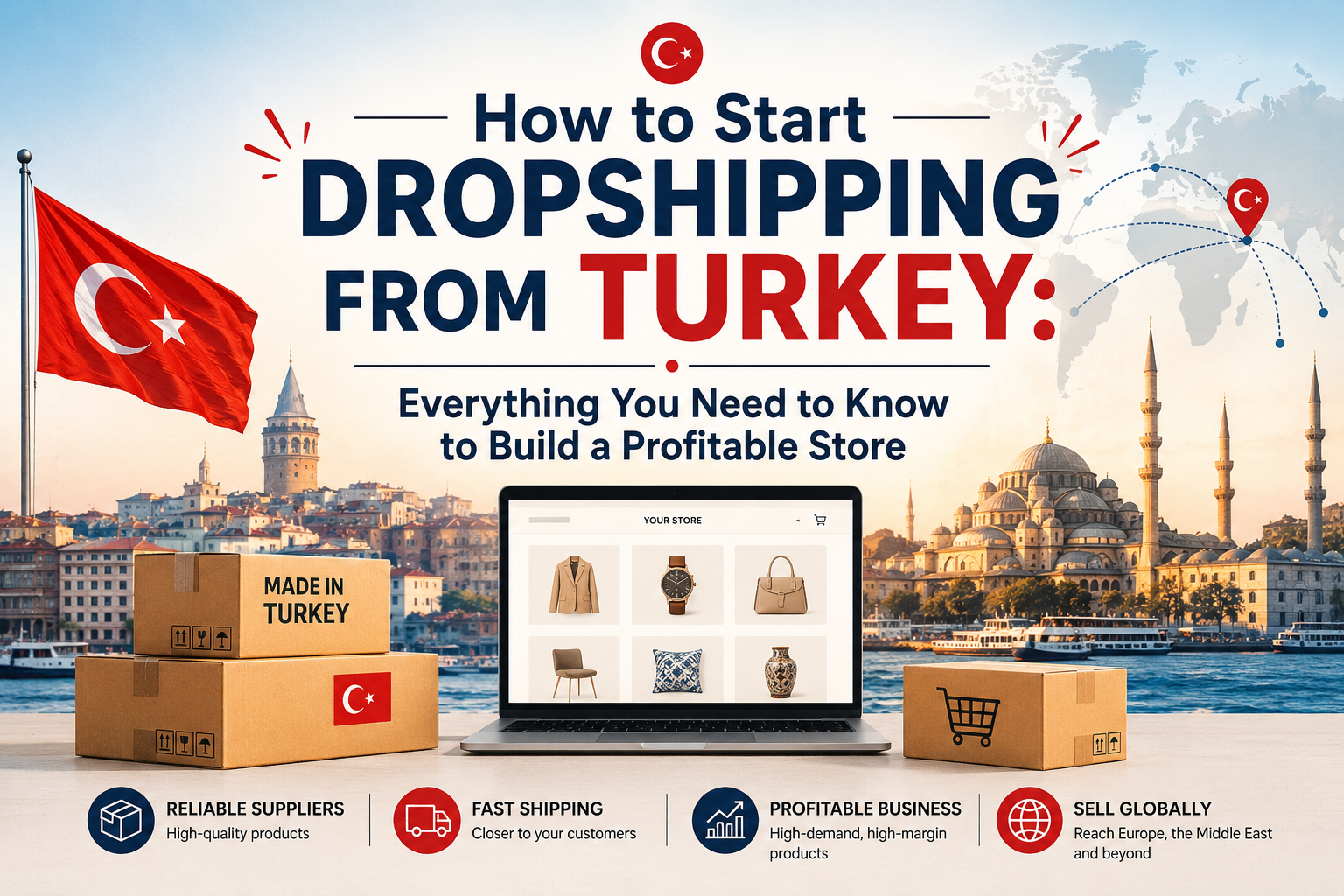
Why Turkey Is Emerging as a Powerful Alternative for Global Dropshipping in 2026
For more than a decade, China has dominated the global dropshipping industry due to its manufacturing scale and low production costs. However, rising shipping costs, geopolitical uncertainty, increasing import restrictions, and longer delivery times have encouraged many e-commerce entrepreneurs to search for alternative sourcing regions. As a result, Turkey has started to attract significant attention as a new dropshipping hub capable of serving Europe, the Middle East, and North Africa more efficiently.
Turkey’s Geographic Position Creates a Major Competitive Advantage
Turkey occupies one of the most valuable logistical positions in global trade. Located between Europe and Asia, Turkish suppliers can reach most European destinations within several days instead of several weeks. This geographical advantage significantly reduces delivery times compared with traditional Asian supply chains.
Consumers in Germany, France, Italy, Spain, and the United Kingdom have become increasingly sensitive to shipping speed. Long delivery windows often lead to lower conversion rates and higher refund requests. Turkish fulfillment networks can shorten delivery times enough to improve customer satisfaction while reducing operational risks associated with delayed shipments.
For dropshipping businesses targeting European consumers, logistics speed has gradually become as important as product price.
Turkish Manufacturing Has Matured Beyond Traditional Industries
Turkey is no longer simply a textile-producing country. Over the past twenty years, Turkish manufacturing capabilities have expanded across multiple industries and developed strong export competitiveness.
The country has built internationally recognized expertise in fashion apparel, home textiles, furniture, jewelry, leather products, kitchenware, and decorative products. Many European retailers already source products from Turkish factories due to their balance between quality and production costs.
Unlike ultra-low-cost manufacturing models, Turkish products often compete through design quality, material standards, and shorter production cycles. This positioning allows sellers to operate in higher-margin market segments rather than competing exclusively on price.
For dropshippers interested in building brands instead of operating short-term stores, this represents an important strategic advantage.
Currency Conditions Continue to Support Export Growth
Another factor increasing Turkey’s attractiveness is the depreciation of the Turkish lira over recent years. Currency weakness has significantly improved the international competitiveness of Turkish exports.
For international sellers purchasing in foreign currencies such as euros or dollars, Turkish products have become increasingly affordable while maintaining relatively high manufacturing standards. This creates opportunities for stronger gross margins compared with sourcing from some European countries.
Although exchange rates can fluctuate over time, the current environment continues to support Turkish export growth and international e-commerce expansion.
European Consumers Are Comfortable Buying Turkish Products
Consumer perception plays an important role in cross-border e-commerce success. Products manufactured in certain countries often carry stronger trust signals than others.
Turkish products generally enjoy a positive reputation among European consumers, especially in categories such as clothing, textiles, ceramics, leather goods, and home decoration. Many buyers already associate Turkey with craftsmanship and premium textile manufacturing.
This existing consumer familiarity can reduce purchase hesitation and improve conversion performance compared with unknown manufacturing origins.
As European customers become more focused on quality and sustainability rather than simply low prices, Turkish suppliers may benefit from changing consumer preferences.
Diversification Is Becoming a Risk Management Strategy
Recent global events have demonstrated the risks of relying entirely on a single sourcing country. Supply chain disruptions, port congestion, trade disputes, and regulatory changes can severely impact dropshipping operations.
Many successful e-commerce businesses now view supplier diversification as a form of operational risk management rather than merely a cost optimization strategy.
Turkey offers sellers an opportunity to build additional sourcing channels while reducing dependency on Asian production networks. Even businesses that continue sourcing from China increasingly consider Turkey as a complementary supply base for selected product categories or regional markets.
How to Find Reliable Turkish Suppliers for Dropshipping Businesses
Many new dropshippers focus heavily on advertising strategies and product research while underestimating the importance of supplier quality. In reality, supplier performance often determines customer satisfaction, refund rates, review scores, and long-term profitability.
For entrepreneurs learning how to start dropshipping from Turkey, finding reliable suppliers should be treated as a strategic investment rather than a simple sourcing task. Turkey offers access to thousands of manufacturers and exporters, but not all suppliers are prepared to support modern e-commerce fulfillment models.
The challenge is not finding suppliers. The challenge is identifying suppliers capable of supporting scalable international operations.
the Difference Between Manufacturers and Trading Companies
One of the first decisions buyers face is whether to work directly with factories or through trading companies.
Turkish manufacturers generally offer lower product costs, greater customization flexibility, and better control over production quality. However, many factories remain focused on wholesale export businesses and may not have experience handling small daily orders or individual parcel shipments.
Trading companies often act as intermediaries between factories and international sellers. While this introduces an additional margin layer, these businesses frequently provide services that factories do not, including multilingual communication, lower minimum order quantities, and support for dropshipping operations.
For smaller stores or businesses in the validation stage, experienced trading companies may provide a smoother operational experience despite slightly higher product costs.
Evaluate Export Experience Instead of Production Capacity Alone
Large production capacity does not automatically make a supplier suitable for dropshipping.
Many Turkish manufacturers have decades of experience supplying retail chains or distributors but have never processed single-item international shipments. Their internal systems are often designed for pallet shipments rather than direct-to-consumer fulfillment.
When evaluating potential partners, international export experience should receive equal attention alongside manufacturing capabilities.
Suppliers familiar with international markets typically understand packaging requirements, product labeling standards, customs documentation, and customer expectations in different regions. These operational details often become more important than production volume as a business scales.
Communication Speed Is an Early Indicator of Reliability
The quality of supplier communication often predicts future operational performance.
A supplier that requires several days to answer simple questions during the sales process is unlikely to become more responsive after receiving orders. Delayed communication can quickly create inventory issues, order fulfillment problems, and customer service challenges.
Fast response times, clear answers, and proactive communication usually indicate stronger internal management systems.
Entrepreneurs should pay attention not only to response speed but also to the supplier’s ability to provide detailed product information, production timelines, and realistic expectations regarding capabilities and limitations.
Professional communication reduces uncertainty throughout the partnership.
Request Samples Before Making Strategic Commitments
Product images and catalog descriptions rarely provide sufficient information for evaluating supplier quality.
Physical samples remain one of the most effective methods for assessing manufacturing standards, packaging quality, materials, and consistency. Even when sample costs appear high, they are usually insignificant compared with the cost of customer complaints and product returns.
Sampling also allows sellers to evaluate shipping preparation, packaging protection, and attention to detail.
Many successful dropshipping businesses treat sample testing as a mandatory stage before launching any new product category or supplier relationship.
This process may slow initial launch timelines but significantly improves long-term operational stability.
Flexibility Often Matters More Than Pricing
New sellers frequently focus on securing the lowest possible purchase price. However, the cheapest supplier is rarely the most profitable partner over time.
Supplier flexibility often creates more value than marginal cost savings.
Flexible suppliers may be willing to support branded packaging, customized inserts, private labeling, inventory reservations, or product modifications as sales volumes increase. These capabilities become increasingly valuable as businesses transition from generic dropshipping stores into recognizable brands.
Choosing suppliers based exclusively on unit price can limit future growth opportunities.
Many successful e-commerce businesses willingly accept slightly higher product costs in exchange for operational reliability and growth flexibility.
Verify Long-Term Scalability Early
A supplier capable of fulfilling ten orders per week may struggle to process several hundred orders per day during promotional periods or seasonal demand spikes.
Scalability should therefore be evaluated long before rapid growth occurs.
Questions regarding production expansion, inventory planning, quality control systems, and staffing capacity can help identify potential limitations before they become operational bottlenecks.
Suppliers with established export infrastructure generally scale more smoothly than businesses operating with informal processes.
Planning for growth during the supplier selection phase often prevents major disruptions later.
Best Products and Niches to Start Dropshipping from Turkey
When entrepreneurs explore how to start dropshipping from Turkey, many immediately focus on finding suppliers or comparing shipping costs. However, long-term profitability is often determined much earlier by product selection.
Turkey cannot compete with Asia in every manufacturing category, nor should it try to. Its competitive advantage lies in industries where local expertise, manufacturing traditions, and regional supply chains create natural barriers to entry.
Fashion Apparel Remains Turkey’s Strongest Export Industry
Turkey has spent decades building one of the world’s largest textile and apparel manufacturing ecosystems. Numerous international fashion brands already rely on Turkish factories due to their combination of quality standards, flexible production capabilities, and relatively fast turnaround times.
For dropshipping businesses, this creates opportunities in premium apparel segments rather than low-cost fast fashion.
European consumers increasingly value fabric quality, durability, and ethical production practices. Turkish clothing manufacturers are often better positioned to meet these expectations than suppliers competing primarily through ultra-low prices.
Categories such as women’s fashion, modest clothing, premium basics, loungewear, and boutique collections can perform particularly well when combined with strong branding strategies.
Unlike highly commoditized products, fashion also offers stronger pricing power and customer retention potential.
Home Textiles Offer High Perceived Value
Few countries have a stronger reputation in home textiles than Turkey.
Products such as towels, bedding, blankets, table linens, decorative cushions, and bath accessories have long represented an important segment of Turkish exports. Consumers in Europe and the Middle East often associate Turkish textiles with durability and premium materials.
This reputation creates an advantage that extends beyond manufacturing costs.
Home textile products also benefit from relatively stable consumer demand compared with trend-driven categories. Buyers may purchase multiple units, return rates tend to remain manageable, and products can often support premium positioning.
For entrepreneurs seeking sustainable rather than viral products, this category deserves serious consideration.
Home Decor Products Benefit from Design Differentiation
One challenge facing many dropshipping stores is the inability to differentiate products that are widely available from hundreds of suppliers worldwide.
Turkish home decoration products often avoid this problem.
Ceramics, decorative lighting, handmade ornaments, wall decorations, and traditional design-inspired products frequently carry unique visual characteristics that are difficult to replicate through mass manufacturing models.
Consumers purchasing home decor products often make decisions based on emotional appeal rather than strict price comparisons. This behavior supports higher margins and lowers direct competition.
Unique aesthetics can become a significant advantage in advertising performance and social media marketing.
Jewelry and Accessories Support Strong Margins
Turkey has developed a globally recognized jewelry industry supported by generations of craftsmanship and manufacturing expertise.
Fashion jewelry, minimalist accessories, bracelets, necklaces, and premium handmade pieces often provide attractive opportunities for dropshipping businesses due to their favorable shipping economics and strong perceived value.
Lightweight products reduce transportation costs while maintaining healthy retail margins.
In addition, accessories typically experience lower return rates than categories such as apparel because sizing issues are less common.
For businesses seeking products with efficient logistics and scalable advertising economics, jewelry remains one of the most attractive options available.
Leather Goods Continue to Hold International Appeal
Turkey has historically maintained a strong position in leather manufacturing.
Wallets, handbags, belts, backpacks, and travel accessories often combine craftsmanship with premium material quality. These products fit particularly well within mid-market and premium market positioning strategies.
Consumers purchasing leather products generally prioritize quality and durability over finding the absolute lowest price.
This allows sellers to compete through branding, storytelling, and customer experience rather than entering price wars with mass-market competitors.
As private label strategies become increasingly important in e-commerce, leather goods offer strong opportunities for long-term brand building.
Products Serving the Middle Eastern Market Present Additional Opportunities
Turkey occupies a unique cultural and geographical position between Europe and the Middle East.
This creates opportunities for product categories that appeal specifically to Middle Eastern consumers while remaining accessible to international sellers.
Products associated with modest fashion, premium home goods, hospitality products, and gift categories often perform well across Gulf countries and surrounding regions.
Many Western sellers overlook these markets despite their relatively high purchasing power and strong e-commerce growth rates.
Entrepreneurs using Turkish suppliers may therefore gain access to customer segments that remain less competitive than traditional Western markets.
How to Manage Shipping and Fulfillment for Turkish Dropshipping Stores
Many entrepreneurs entering the dropshipping industry focus heavily on advertising performance and product selection while treating logistics as a secondary consideration. In reality, shipping speed and fulfillment reliability often determine customer satisfaction more than the product itself.
Delayed deliveries increase refund requests, chargebacks, negative reviews, and customer support costs. As customer expectations continue to rise, logistics performance has become a core competitive factor rather than simply an operational function.
Turkey’s Location Creates Faster Delivery Times to Europe
One of Turkey’s biggest advantages is its proximity to major European consumer markets.
Traditional Asian supply chains often require delivery windows of two to four weeks depending on customs processing and carrier congestion. Turkish fulfillment operations can frequently reduce this timeline to several business days for many European destinations.
Shorter delivery times improve conversion rates because customers increasingly expect faster shipping options. Consumers are also less likely to request refunds or cancel orders when delivery expectations align with marketplace standards established by major e-commerce platforms.
For stores targeting Europe, logistics speed can become a meaningful differentiator even when product pricing is slightly higher.
Market Prioritization Should Influence Fulfillment Strategy
Not every international market requires the same logistics approach.
European customers generally prioritize delivery speed and shipment visibility. Tracking accuracy and predictable arrival dates often influence purchasing decisions as much as shipping costs.
Customers in the Middle East may accept slightly longer delivery windows if products offer stronger differentiation or premium positioning. Meanwhile, North American consumers frequently expect service levels similar to domestic e-commerce businesses, creating additional pressure on international fulfillment operations.
As a result, logistics planning should begin with target market selection rather than carrier selection.
The most efficient fulfillment strategy for Germany may not be suitable for the United States or Gulf countries.
Carrier Diversification Reduces Operational Risk
Many new sellers make the mistake of depending entirely on a single shipping provider.
International logistics networks are vulnerable to weather disruptions, customs delays, labor shortages, and seasonal congestion. A single carrier failure can rapidly affect customer satisfaction across an entire business.
Diversifying shipping options creates operational flexibility and improves resilience during peak demand periods.
Successful international sellers often maintain multiple shipping channels and allocate orders according to destination country, package dimensions, delivery urgency, and transportation costs.
This approach reduces dependency risks while improving overall service consistency.
Inventory Visibility Is More Important Than Many Sellers Realize
One of the most common operational challenges in dropshipping is inventory synchronization.
A product that appears available during the sales process may become unavailable before fulfillment occurs, leading to cancellations and frustrated customers. These problems become increasingly costly as order volumes grow.
Real-time inventory visibility helps prevent overselling while improving forecasting accuracy.
Businesses operating through manual inventory updates often experience growing operational inefficiencies as they scale internationally. Automation and inventory transparency therefore become increasingly important as sales volumes increase.
The ability to maintain accurate stock information frequently separates sustainable businesses from short-term projects.
Returns Management Should Be Planned Before Orders Begin
Many entrepreneurs treat returns as a future problem rather than an immediate operational requirement.
International returns can become expensive very quickly if clear procedures are not established in advance. Return shipping costs, customs fees, and product inspection expenses can significantly reduce profitability.
European consumers in particular have become accustomed to transparent return policies and efficient refund processes.
Businesses serving international markets should therefore determine how returned products will be processed before launching advertising campaigns.
Some businesses choose local consolidation solutions while others implement regional return addresses to minimize customer friction and operational costs.
Ignoring return logistics usually becomes more expensive than planning for them early.
Scaling Requires Fulfillment Systems Rather Than Manual Processes
A fulfillment process that works for ten daily orders often becomes unsustainable at one hundred daily orders.
Manual order forwarding, spreadsheet inventory management, and fragmented communication workflows eventually create bottlenecks that limit growth potential.
As businesses expand, fulfillment systems become more important than fulfillment labor.
Order automation, shipping rule management, inventory synchronization, and centralized tracking systems reduce operational complexity while improving accuracy.
The transition from small business operations to scalable e-commerce infrastructure usually occurs much earlier than new entrepreneurs expect.
Planning for this transition from the beginning reduces future disruption.
How to Legally Start a Dropshipping Business in Turkey
Many entrepreneurs enter the dropshipping industry with the assumption that legal compliance can be addressed later once sales begin to grow. While this approach may appear practical during the early stages, delayed compliance often creates unnecessary operational risks as businesses expand internationally.
For anyone researching how to start dropshipping from Turkey, understanding the legal framework from the beginning can simplify future scaling, improve financial management, and reduce the likelihood of regulatory complications.
The objective is not simply to satisfy local requirements but to build a business structure capable of supporting international operations.
Choosing the Right Business Structure Matters
One of the first decisions entrepreneurs face is selecting an appropriate legal entity.
Small businesses often begin with simpler structures due to lower administrative requirements and reduced operating costs. However, as revenue increases, these models may create limitations in areas such as liability protection, international partnerships, and access to financial services.
Limited liability companies generally provide stronger legal separation between personal assets and business activities. They also tend to be viewed more favorably by payment providers, suppliers, and financial institutions.
The ideal structure depends on expected revenue, growth objectives, and the target markets being served rather than on minimizing short-term registration costs alone.
Building for scalability often proves more efficient than restructuring later.
International Payments Require Early Planning
Payment infrastructure is one of the most overlooked components of cross-border e-commerce operations.
A business may have competitive products and reliable suppliers, but without stable payment processing capabilities, growth quickly becomes difficult.
International sellers operating from Turkey often need to evaluate payment solutions based on customer location, settlement currencies, transaction fees, and platform compatibility.
European customers may prefer different payment methods than customers in North America or the Middle East. Supporting local payment preferences can significantly improve checkout conversion rates.
Entrepreneurs should therefore view payment strategy as part of market localization rather than purely as a financial function.
Tax Compliance Becomes More Complex in Cross-Border Commerce
Domestic taxation is generally straightforward compared with international e-commerce taxation.
Dropshipping businesses frequently operate across multiple jurisdictions involving suppliers, customers, payment providers, and fulfillment partners located in different countries. As sales volumes increase, tax obligations may become more complex.
Consumption taxes, import duties, digital invoicing requirements, and reporting obligations often vary depending on customer location and product category.
Businesses targeting international markets should monitor these obligations carefully rather than assuming that local tax registration alone is sufficient.
Regulatory complexity tends to increase alongside business success.
Selling into Europe Requires Additional Compliance Awareness
Europe remains one of the most attractive export destinations for Turkish e-commerce businesses due to geographic proximity and strong purchasing power.
However, European markets also maintain some of the world’s most comprehensive consumer protection regulations.
Transparency requirements regarding pricing, delivery timelines, refund policies, and customer rights can influence both website design and operational procedures.
Failure to align with local regulations may increase disputes, chargebacks, and customer complaints regardless of product quality.
Businesses entering European markets benefit from treating compliance as a customer experience issue rather than solely a legal requirement.
Documentation and Record Keeping Become Strategic Assets
Many entrepreneurs underestimate the importance of documentation during the early stages of business development.
Accurate financial records support tax reporting, profitability analysis, inventory planning, and future financing opportunities. Documentation also simplifies relationships with suppliers, payment providers, and regulatory authorities.
As businesses expand internationally, transaction volumes increase rapidly and manual bookkeeping becomes difficult to maintain.
Structured record keeping therefore becomes an operational necessity rather than an administrative burden.
Businesses that establish strong financial processes early often scale more smoothly than competitors that postpone organization until complexity becomes unavoidable.
Compliance Can Improve Business Credibility
Legal compliance is often viewed purely as a cost center or regulatory obligation. In reality, compliance frequently strengthens commercial credibility.
Suppliers are generally more willing to prioritize businesses with formal legal structures. Payment providers may offer improved conditions to verified companies, and customers often place greater trust in businesses that operate transparently.
Professional business practices can therefore influence conversion rates, supplier relationships, and operational stability.
Compliance should be viewed as part of brand development rather than merely a legal requirement.
How to Scale a Turkish Dropshipping Business to Europe and the Middle East
Launching a dropshipping business and scaling a dropshipping business are fundamentally different challenges. During the early stages, entrepreneurs often focus on validating products, generating initial sales, and improving advertising performance. Once a store begins producing consistent orders, however, growth becomes less dependent on individual products and more dependent on systems, market expansion, and operational efficiency.
Europe Should Often Become the First Expansion Market
Turkey’s geographic position naturally creates advantages when targeting European consumers. Compared with sellers operating from distant manufacturing regions, Turkish businesses can often provide shorter delivery times and better customer experiences across Europe.
European markets also offer high purchasing power and mature e-commerce adoption. Consumers are generally comfortable purchasing from international stores if trust signals, delivery expectations, and customer service standards meet local expectations.
Rather than attempting to enter every market simultaneously, many successful businesses focus first on a small number of countries with similar consumer behavior and language requirements. Concentrating resources often produces stronger results than pursuing rapid geographic expansion without localization.
Market focus frequently accelerates growth more effectively than market diversification.
The Middle East Represents an Undervalued Opportunity
While many dropshipping businesses compete aggressively for customers in Western Europe and North America, Middle Eastern markets often receive less attention despite their strong purchasing power and rapidly growing online retail sectors.
Turkey’s cultural proximity and commercial relationships with the region create additional advantages for sellers seeking expansion opportunities.
Consumers across Gulf countries frequently demonstrate strong interest in premium products, lifestyle brands, home products, and fashion categories. Average order values in some markets can exceed those seen in many European countries.
Competition levels in several Middle Eastern markets also remain lower than in highly saturated Western advertising ecosystems.
For many Turkish businesses, the Middle East can become a profitable secondary growth engine.
Localization Improves Conversion Rates
International expansion rarely succeeds through direct duplication of a domestic business model.
Consumers in different countries respond to different messaging styles, pricing structures, payment preferences, and customer service expectations. A website that performs well in Germany may produce significantly weaker results in Saudi Arabia or the United Arab Emirates.
Localization therefore extends beyond simple language translation.
Pricing presentation, product positioning, promotional strategies, and customer communication should align with local purchasing behavior whenever possible.
Businesses that invest in localization often outperform competitors that rely on standardized global experiences.
Brand Building Creates Long-Term Advantages
Many dropshipping businesses remain trapped in highly competitive advertising environments because they operate without clear brand positioning.
Products can be copied, advertisements can be replicated, and pricing advantages can disappear quickly. Brand recognition, however, creates a more durable competitive advantage.
Turkey’s manufacturing strengths allow businesses to move beyond generic products and develop stronger brand identities around quality, craftsmanship, design, or regional specialization.
As customer acquisition costs continue to rise across digital advertising platforms, repeat purchases and customer loyalty become increasingly important for profitability.
Brand equity therefore becomes a financial asset rather than simply a marketing concept.
Customer Retention Becomes More Valuable as Advertising Costs Rise
The economics of e-commerce have changed significantly in recent years.
Customer acquisition costs across major advertising channels have increased while consumer attention has become more fragmented. Businesses that depend entirely on acquiring new customers often experience declining margins as they scale.
Retention strategies help offset these challenges.
Email marketing, loyalty programs, personalized recommendations, and post-purchase engagement can increase customer lifetime value without requiring proportional increases in advertising spending.
In many cases, improving retention metrics produces greater profitability than increasing traffic volumes.
Long-term growth is often driven by customer relationships rather than customer acquisition alone.
Systems Become More Important Than Individual Decisions
In small businesses, founders often manage advertising, customer service, supplier communication, and operational decisions personally.
As order volumes increase, this approach becomes increasingly difficult to maintain.
Scalable businesses rely on documented processes, automation tools, performance reporting, and clearly defined workflows rather than constant founder intervention.
The transition from entrepreneur-driven operations to system-driven operations often determines whether businesses can continue growing beyond their initial success.
Growth limitations are frequently operational rather than market related.
Many entrepreneurs view scaling simply as increasing sales volume. In reality, sustainable scaling involves creating assets that continue generating value over time.
A recognizable brand, repeat customer base, supplier relationships, proprietary customer data, and operational expertise all contribute to long-term business value.
Turkey’s location between Europe and the Middle East provides unique opportunities for international expansion, but long-term success depends on converting those advantages into durable competitive assets.





No Comments