


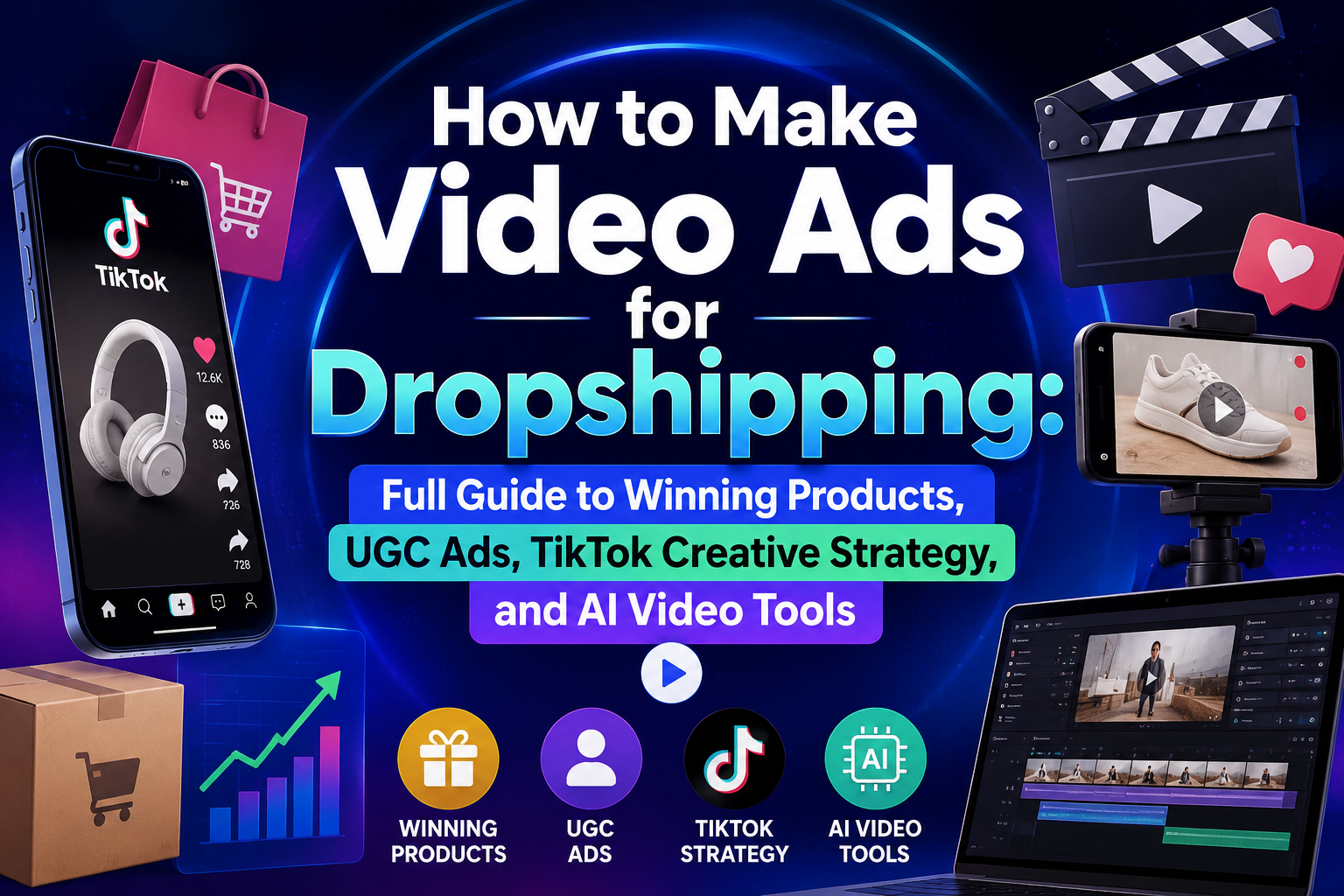
How to Make Video Ads for Dropshipping: Full Guide to Winning Products, UGC Ads, TikTok Creative Strategy, and AI Video Tools

Learning how to make video ads for dropshipping requires more than editing skills. It involves understanding consumer psychology, platform behavior, visual storytelling, and conversion strategy.
The most successful video ads are usually not the most expensive or cinematic. They are the ones that communicate value quickly, demonstrate clear benefits, create emotional engagement, and maintain viewer attention throughout the video.
As advertising costs continue to rise across major platforms, strong video creatives are becoming one of the few sustainable competitive advantages in modern dropshipping.
How to Make High-Converting Video Ads for Dropshipping Products
The dropshipping industry has become significantly more competitive over the past few years. As more stores enter the market, simple image ads and generic product photos are no longer enough to attract attention. Video advertising has gradually become one of the most important factors influencing click-through rates, customer engagement, and final conversions. For many successful ecommerce brands, a well-structured video ad often determines whether a product scales profitably or fails after a few days of testing.
Why Video Ads Perform Better Than Static Creatives
Modern consumers process information quickly, especially on platforms like TikTok, Instagram Reels, Facebook Feed, and YouTube Shorts. Video content allows sellers to demonstrate product functionality, emotional appeal, and real-life usage within seconds. Compared with static images, video ads create stronger engagement because they simulate real product experiences.
For dropshipping stores, this advantage is especially important. Since customers cannot physically touch the product before purchasing, the video becomes the closest substitute for an in-store demonstration. A strong product video reduces uncertainty and increases buyer confidence.
In addition, advertising algorithms increasingly prioritize watch time and interaction metrics. High-retention videos often receive lower CPMs and better audience distribution, making video creatives more cost-efficient over time.
The First Three Seconds Determine Everything
One of the biggest mistakes beginners make is spending too much time on introductions or branding. In reality, most users decide whether to continue watching within the first three seconds.
Successful dropshipping video ads usually begin with a strong visual hook. This could be a dramatic before-and-after comparison, a surprising product demonstration, an emotional reaction, or a problem-solving scenario. The goal is not to explain everything immediately. The objective is simply to interrupt scrolling behavior.
For example, if a product solves a common household frustration, the opening scene should show the frustration first. This creates instant curiosity and encourages viewers to keep watching.
Fast pacing is equally important. Modern short-form platforms reward momentum. Long transitions, slow logo animations, and excessive introductions often reduce retention rates.
Product Demonstration Is More Important Than Design
Many ecommerce sellers focus heavily on editing effects, cinematic transitions, or advanced animations. However, conversion-focused ads usually prioritize product clarity over visual complexity.
Customers want to quickly understand three things:
- What the product does
- Why it is useful
- How it improves daily life
This is why practical demonstrations consistently outperform overly polished advertisements in many dropshipping niches. Instead of trying to create luxury-style commercials, most successful advertisers focus on clear storytelling and realistic usage scenarios.
Showing the product from multiple angles, highlighting texture or functionality, and demonstrating actual results often increases trust more effectively than expensive editing techniques.
Emotional Triggers Increase Conversion Rates
High-converting dropshipping ads rarely rely only on product specifications. Instead, they connect the product with emotional outcomes.
Some products create convenience. Others create confidence, comfort, entertainment, or social status. The strongest video ads translate product features into emotional benefits.
For instance, a posture corrector is not simply about back support. It may represent confidence, improved appearance, or workplace comfort. A portable blender is not only about mixing drinks. It may symbolize a healthier lifestyle or time efficiency.
Why UGC-Style Content Continues to Dominate
In 2026, user-generated style videos remain one of the most effective formats for dropshipping ads. Consumers have become skeptical of highly polished commercials. Authentic-looking videos tend to feel more trustworthy and platform-native.
This does not necessarily mean brands must hire influencers. Many successful stores create simulated UGC content internally by using casual camera angles, natural lighting, subtitles, voiceovers, and realistic product reactions.
The objective is to make the advertisement feel like social content rather than traditional advertising.
Testing Creatives Is More Important Than Finding “Perfect” Ads
Many beginners spend excessive time trying to create one perfect advertisement before launching campaigns. In reality, successful ecommerce advertisers often rely on creative testing systems instead of single ads.
Different hooks, captions, thumbnails, and video structures can produce dramatically different results, even for the same product. Sometimes a small change in the opening scene can double conversion rates.
For this reason, experienced dropshipping brands continuously test multiple creative variations. The goal is not perfection. The goal is identifying which message resonates most effectively with the target audience.
How to Create TikTok Video Ads for Dropshipping That Actually Convert
TikTok has completely changed the way ecommerce brands advertise products online. Unlike traditional advertising platforms that reward polished corporate-style campaigns, TikTok prioritizes speed, authenticity, entertainment, and emotional engagement. This shift has created major opportunities for dropshipping sellers, especially those who understand how platform-native content influences user behavior.
For many beginners, the biggest misunderstanding is assuming TikTok ads work the same way as Facebook or YouTube advertising. In reality, TikTok users respond differently to content. They expect short-form videos that feel organic rather than aggressively promotional. Because of this, learning how to create TikTok video ads for dropshipping requires a different mindset compared with older advertising strategies.
Why TikTok Became the Most Powerful Product Discovery Platform
One of TikTok’s biggest advantages is its ability to create impulse buying behavior. Users often open the app without intending to shop, yet many products go viral simply because the content captures attention quickly.
This changes the entire customer journey. Instead of relying heavily on search intent, TikTok rewards discovery-based marketing. A product that visually demonstrates a strong transformation, solves an obvious problem, or creates curiosity can generate large amounts of traffic within a short period of time.
For dropshipping sellers, this creates opportunities to scale products rapidly without building large audiences beforehand. However, the platform also punishes low-quality or overly commercial content very quickly.
The First Seconds Matter More on TikTok Than Anywhere Else
TikTok users scroll extremely fast. If the opening scene fails to create curiosity immediately, the algorithm often reduces distribution because watch time drops.
Strong TikTok dropshipping ads usually begin with movement, emotion, or tension. Some effective examples include dramatic product demonstrations, surprising results, unusual scenarios, or emotionally relatable frustrations.
The purpose of the opening is not to explain the product completely. It is simply to stop the user from scrolling.
For example, instead of saying “This is the best portable blender,” a stronger opening may show someone making a smoothie inside a car, office, or gym. The visual immediately creates curiosity because it feels unexpected.
This type of pattern interruption is central to TikTok advertising performance.
TikTok Rewards Native Content, Not Traditional Commercials
Many brands fail on TikTok because their videos look like advertisements. Overly polished editing, excessive branding, studio lighting, and scripted acting often reduce performance because users associate them with interruption-based advertising.
The platform prefers content that blends naturally into the feed. This is why user-generated content styles continue to dominate TikTok ecommerce advertising.
Successful dropshipping ads often use:
- Smartphone-style filming
- Natural voiceovers
- Casual speaking patterns
- Fast captions
- Raw product demonstrations
- Imperfect but authentic reactions
Interestingly, videos that appear “too professional” sometimes perform worse because they reduce perceived authenticity.
Storytelling Creates Better Retention Than Product Features Alone
Many beginners focus only on showing product features. However, TikTok’s algorithm strongly favors watch time and viewer retention. This means storytelling structure is critical.
High-performing TikTok video ads often follow a simple psychological sequence:
- Introduce a relatable problem
- Create emotional tension
- Demonstrate the solution
- Show visible results
- End with a subtle call to action
This structure keeps viewers emotionally engaged rather than simply informing them about specifications.
For example, a cleaning product video becomes more effective when it first shows frustration, embarrassment, or inconvenience before revealing the solution. Emotional contrast increases viewer attention.
Sound Design and Captions Are Critical for Performance
Unlike traditional ecommerce platforms, TikTok is heavily influenced by sound and pacing. Trending audio, energetic music, and voiceovers significantly impact viewer retention.
At the same time, many users watch videos without sound during certain situations. This is why captions remain extremely important.
Strong captions help:
- Reinforce key benefits
- Increase retention
- Improve accessibility
- Maintain viewer attention during fast cuts
Most successful TikTok dropshipping ads use large, highly readable subtitles combined with quick scene transitions.
Shorter Videos Usually Perform Better
Although longer storytelling videos can work for some products, short-form content generally performs best for cold audiences. Many successful TikTok ecommerce ads remain between 15 and 35 seconds.
This forces advertisers to focus only on the most persuasive information. Unnecessary introductions and slow pacing usually reduce performance.
The objective is not to explain every detail. The objective is generating enough curiosity and emotional interest to drive clicks.
AI Tools Are Changing TikTok Ad Production
In 2026, AI video tools have significantly reduced production costs for dropshipping sellers. Platforms like CapCut, Runway, Canva AI, and AI voice generators allow advertisers to create multiple ad variations quickly.
This has shifted the competitive advantage away from expensive production teams toward rapid creative testing. Brands that consistently produce and test new content often outperform competitors with higher production quality but slower iteration cycles.
As TikTok trends evolve rapidly, speed has become a major factor in advertising success.
How to Make Facebook Video Ads for Dropshipping That Still Convert
For many ecommerce sellers, Facebook advertising remains one of the most reliable ways to scale a dropshipping business. Although platforms like TikTok have changed consumer behavior dramatically, Facebook and Instagram still offer powerful advantages in audience targeting, retargeting, and purchase intent. However, the strategies that worked several years ago are no longer enough today.
The modern Facebook advertising environment is far more competitive. Rising CPMs, audience saturation, and creative fatigue have forced advertisers to rethink how video ads are produced. In 2026, successful Facebook dropshipping campaigns depend less on aggressive targeting tricks and more on creative quality, emotional positioning, and conversion-focused storytelling.
Why Facebook Users Behave Differently From TikTok Users
One of the biggest mistakes advertisers make is using the exact same creative strategy across every platform. While TikTok rewards fast entertainment and impulsive engagement, Facebook users typically demonstrate slightly different browsing behavior.
Facebook and Instagram audiences often spend more time evaluating products before purchasing. This means ads must create trust in addition to attention. Users are more likely to analyze reviews, comments, product legitimacy, shipping expectations, and overall brand credibility.
As a result, Facebook video ads usually require stronger product explanations and more persuasive structure than TikTok creatives.
The Hook Still Matters, But Context Matters More
Attention remains critical on Facebook, especially in crowded feeds. However, unlike TikTok, Facebook users often tolerate slightly longer storytelling if the content feels useful or relevant.
Strong Facebook dropshipping ads usually open with:
- A relatable problem
- A visible product result
- A bold statement
- A surprising demonstration
- A clear customer pain point
The opening should immediately communicate why the viewer should care. However, after the initial hook, successful Facebook ads often spend more time building trust and explaining benefits compared with short-form TikTok content.
For example, products involving skincare, home improvement, fitness, or pet care often require deeper emotional explanation before users feel comfortable purchasing.
Facebook Video Ads Must Reduce Skepticism
Modern consumers have seen thousands of ecommerce advertisements. Many users now approach dropshipping products with skepticism, especially if the ad looks overly exaggerated or unrealistic.
This is why trust-building has become one of the most important components of Facebook advertising.
High-converting Facebook video ads often include:
- Realistic demonstrations
- Customer reactions
- Before-and-after comparisons
- Product close-ups
- Social proof elements
- Natural voiceovers
- User testimonials
Instead of relying purely on hype, successful advertisers focus on making products appear credible and practical.
Interestingly, ads that feel too aggressive or “salesy” often perform worse because they increase suspicion.
Longer Product Demonstrations Often Improve Conversion Rates
Unlike TikTok, where extremely short videos dominate, Facebook allows slightly longer educational content to perform effectively. Many successful ecommerce video ads on Facebook range between 30 and 90 seconds depending on the product category.
This additional time helps sellers:
- Explain product functionality
- Handle customer objections
- Demonstrate product quality
- Increase perceived value
- Build emotional connection
For example, a posture corrector ad may show office workers struggling with discomfort before explaining how the product improves daily posture habits. This creates stronger psychological investment than simply displaying the item.
The key difference is that Facebook users often need more context before purchasing.
Creative Fatigue Is One of the Biggest Problems in Facebook Advertising
One major challenge in Facebook dropshipping campaigns is creative fatigue. Even highly profitable ads eventually lose effectiveness after repeated exposure.
This happens because audiences become familiar with the content, reducing curiosity and emotional response. In competitive niches, ad fatigue can increase costs rapidly.
For this reason, experienced advertisers continuously test:
- New hooks
- Different opening scenes
- Alternative voiceovers
- Updated captions
- Faster editing styles
- New emotional angles
The goal is not simply finding one winning ad. The goal is building a repeatable creative testing system.
Brands that consistently refresh creatives usually outperform those relying on a single viral advertisement.
Mobile-First Editing Is Essential
Most Facebook and Instagram users consume content on mobile devices. Because of this, vertical or square video formats generally outperform traditional horizontal layouts for ecommerce advertising.
Successful dropshipping ads are optimized for mobile viewing through:
- Large captions
- Fast scene transitions
- Clear close-up shots
- Simple messaging
- Strong visual contrast
Complicated editing and excessive text often reduce clarity on smaller screens.
The most effective ads communicate value quickly without overwhelming the viewer.
Why Branding Matters More Than Before
Several years ago, many dropshipping stores relied entirely on direct-response advertising with little emphasis on branding. In 2026, this approach has become increasingly difficult to sustain.
Consumers now evaluate brand trust much more carefully. Stores that appear generic or low quality often struggle to convert, even with strong video ads.
As a result, many successful Facebook advertisers now combine performance-focused creatives with stronger brand presentation. Consistent visual identity, better product pages, professional packaging, and trustworthy messaging all contribute to higher conversion rates.
The video ad is no longer isolated from the overall customer experience. It has become part of the brand perception itself.
How to Make Video Ads for Winning Dropshipping Products
One of the most overlooked aspects of dropshipping advertising is the relationship between the product itself and the effectiveness of the video creative. Many beginners focus heavily on editing styles, transitions, or advertising platforms without first asking a more important question: is the product actually suitable for video marketing?
In reality, some products naturally perform well in video ads while others struggle to generate engagement regardless of production quality. A winning product is not simply something that looks interesting. It is a product that can communicate value visually within seconds.
Learning how to make video ads for winning dropshipping products therefore begins with understanding product psychology rather than editing software.
Why Some Products Perform Better in Video Ads
The most successful dropshipping products usually share one important characteristic: they demonstrate value immediately through visual interaction.
Products that solve obvious problems, create satisfying transformations, or trigger emotional reactions tend to perform exceptionally well in video-based advertising. This is because short-form platforms reward content that quickly captures attention and maintains viewer curiosity.
For example, cleaning tools that remove visible dirt, beauty products showing dramatic before-and-after results, or kitchen gadgets simplifying daily tasks often succeed because viewers understand the benefit instantly.
On the other hand, products that require lengthy explanations or abstract value propositions are typically harder to advertise through short-form video.
This is why product selection and creative strategy should always be connected.
Visual Demonstration Is More Powerful Than Verbal Explanation
Many ecommerce sellers make the mistake of describing products instead of demonstrating them. However, high-performing video ads rely heavily on visual proof rather than theoretical claims.
Consumers trust what they can see.
A successful dropshipping ad often answers key questions visually:
- What problem does the product solve?
- How does it work?
- Why is it better than alternatives?
- What result can the customer expect?
The faster these answers become visually clear, the higher the probability of maintaining viewer attention.
For example, a portable stain remover becomes far more persuasive when viewers immediately see a stain disappear in real time. The product no longer requires complicated explanation because the visual transformation communicates the value directly.
Emotional Reactions Drive Product Virality
Winning products often trigger emotional responses beyond simple utility. Some create surprise, satisfaction, convenience, curiosity, or even social identity.
This emotional dimension is extremely important in video advertising because modern social media algorithms reward engagement behaviors such as comments, shares, rewatches, and saves.
Products that generate reactions like:
- “I need this”
- “Why didn’t I find this earlier?”
- “This solves my problem perfectly”
- “That’s surprisingly useful”
usually perform better in paid advertising environments.
For this reason, successful advertisers frequently choose products that combine functionality with emotional appeal rather than relying solely on low pricing or technical specifications.
The “Problem-Solution” Structure Remains Highly Effective
One reason many winning dropshipping products scale successfully is because they fit naturally into problem-solution storytelling.
This structure works well because it mirrors how consumers process frustration and relief psychologically.
A typical high-converting product video may follow this sequence:
- Show a relatable problem
- Emphasize inconvenience or frustration
- Introduce the product naturally
- Demonstrate immediate improvement
- Reinforce emotional benefit
This format creates narrative momentum and keeps viewers engaged longer.
For example, a cable organizer advertisement becomes more compelling when it first shows messy tangled wires before introducing the organizational solution. Without the initial frustration, the product itself may appear less valuable.
The emotional contrast strengthens perceived usefulness.
Simplicity Usually Outperforms Complexity
Another important factor in selecting winning products for video advertising is simplicity. Products that can be understood within a few seconds generally perform better than products requiring technical explanation.
This is especially important on short-form platforms where users scroll rapidly.
Highly successful video ads often focus on:
- One core benefit
- One memorable transformation
- One emotional trigger
Trying to communicate too many features at once usually weakens the message.
In many cases, the strongest dropshipping ads appear surprisingly simple. Instead of overwhelming the audience with information, they focus on delivering a single persuasive visual experience.
Why Product Research and Creative Research Should Happen Together
Many beginners separate product research from advertising research. However, experienced ecommerce marketers often study successful creatives while researching products.
This provides valuable insight into:
- Which hooks repeatedly perform well
- What visual patterns attract attention
- Which emotional triggers increase engagement
- How competitors position similar products
By analyzing winning creatives, sellers can identify whether a product has strong advertising potential before investing heavily into inventory or testing budgets.
In modern ecommerce, a product’s “advertisability” is often just as important as the product itself.
User-Generated Style Content Works Especially Well for Winning Products
In 2026, user-generated style video ads continue to dominate dropshipping advertising because they make products feel more authentic and relatable.
Winning products often perform best when demonstrated casually rather than through polished studio-style commercials. Smartphone filming, natural reactions, and realistic usage environments increase trust and reduce perceived advertising pressure.
Consumers are increasingly drawn toward content that feels native to social platforms rather than traditional commercials.
This shift has made authenticity a competitive advantage.
AI Tools for Making Dropshipping Video Ads Faster and Cheaper
The economics of dropshipping advertising have changed dramatically over the last few years. Rising customer acquisition costs, shorter product life cycles, and increasing creative fatigue have forced ecommerce sellers to produce larger amounts of advertising content at much higher speeds. In this environment, artificial intelligence has become one of the most important tools for modern dropshipping brands.
Many sellers once relied on freelance editors, expensive agencies, or manual video production workflows. Today, AI-powered platforms can generate scripts, edit videos, create voiceovers, remove backgrounds, produce avatars, and even generate complete advertising concepts within minutes. As competition increases across TikTok, Facebook, Instagram, and YouTube Shorts, speed has become a major advantage.
Learning how to use AI tools for making dropshipping video ads is no longer optional for many ecommerce businesses. It is gradually becoming part of the standard advertising workflow.
Why AI Is Changing Ecommerce Advertising
Traditional ad production often required multiple stages, including scripting, filming, editing, captioning, voice recording, and formatting for different platforms. This process consumed time and increased operational costs, especially for sellers testing multiple products simultaneously.
AI tools have simplified many of these tasks.
Instead of spending days creating a single advertisement, sellers can now produce multiple creative variations within hours. This shift is especially important because modern advertising success depends heavily on creative testing rather than finding one “perfect” video.
Algorithms on TikTok and Meta platforms reward fresh creatives. Brands that rapidly test new hooks, captions, angles, and formats often outperform competitors that rely on slower production systems.
In this sense, AI is not simply reducing workload. It is fundamentally changing advertising strategy.
AI Video Editing Tools Have Reduced Production Barriers
One of the biggest changes in ecommerce advertising is the accessibility of advanced editing tools. Platforms like CapCut and Canva have made fast video production available even to beginners without professional editing experience.
These tools now offer:
- Automatic captions
- AI-generated transitions
- Background removal
- Template-based editing
- Auto-resizing for multiple platforms
- Music synchronization
- AI-powered effects
For dropshipping sellers, this means production speed matters more than mastering complicated editing software.
Interestingly, many high-performing ecommerce ads are no longer heavily polished. Short-form platforms increasingly reward authenticity and native-looking content rather than cinematic production quality.
AI Script Generators Accelerate Creative Testing
Writing effective video ad scripts consistently can become difficult when testing large numbers of products. AI writing tools now help sellers rapidly generate:
- Hooks
- Product descriptions
- Voiceover scripts
- Call-to-action variations
- Emotional storytelling angles
This does not mean AI replaces strategic thinking. Instead, it speeds up idea generation and iteration.
For example, advertisers can quickly test different emotional approaches for the same product:
- Problem-solving
- Luxury positioning
- Convenience-focused messaging
- Humor-based hooks
- Social proof angles
The ability to create multiple messaging variations rapidly improves testing efficiency significantly.
AI Voiceovers Are Replacing Traditional Narration
Professional voice recording once required expensive equipment or hired talent. Today, AI voice generators can create realistic narration with different tones, accents, and speaking styles.
This is especially useful for dropshipping brands running multilingual campaigns or testing international markets.
AI voiceover tools help sellers:
- Reduce production costs
- Localize content faster
- Create multiple ad variations
- Maintain consistent pacing
- Scale creative production efficiently
In many cases, casual conversational voiceovers now perform better than highly polished commercial narration because they feel more native to social media environments.
AI Avatars and Virtual Creators Are Becoming More Common
Platforms like HeyGen and other avatar-based systems are introducing new possibilities for ecommerce advertising. Sellers can generate virtual presenters capable of explaining products without hiring on-camera creators.
This approach offers several advantages:
- Faster production
- Lower creator costs
- Consistent branding
- Easier multilingual content generation
- Simplified scaling
However, fully AI-generated presentations still face challenges regarding authenticity. Consumers generally respond more positively to content that feels emotionally genuine and socially natural.
As a result, many successful brands combine AI efficiency with human-style storytelling instead of relying entirely on synthetic presentation.
AI Is Improving Product Footage Creation
One of the biggest challenges in dropshipping has always been obtaining high-quality product footage quickly. AI image and video generation tools are beginning to solve this problem.
Modern systems can now:
- Animate static product images
- Generate lifestyle backgrounds
- Create cinematic product showcases
- Enhance low-quality footage
- Produce mockup-style demonstrations
This is particularly valuable for sellers testing products before ordering physical samples.
Although real demonstrations still perform best for many niches, AI-assisted visuals can significantly accelerate the early testing phase.
The Competitive Advantage Has Shifted From Production Quality to Creative Speed
Several years ago, brands with expensive production capabilities often dominated advertising performance. In 2026, the situation has changed.
Because AI tools have lowered technical barriers, the new competitive advantage is often creative velocity. Brands that consistently test fresh ideas, new hooks, emotional angles, and storytelling formats usually scale faster than brands focused only on production perfection.
This has created a more dynamic advertising environment where adaptability matters more than studio-level editing.
The winners are often the brands capable of learning quickly from audience behavior and rapidly adjusting creative direction.
Human Psychology Still Matters More Than AI
Despite rapid technological progress, AI tools alone cannot guarantee profitable advertising. Many beginners assume automation automatically creates successful campaigns, but consumer psychology remains the core driver of conversion.
Strong dropshipping video ads still depend on:
- Emotional triggers
- Relatable storytelling
- Product-market fit
- Clear demonstrations
- Audience understanding
AI improves execution speed, but strategic thinking remains human-driven.
The most successful ecommerce brands use AI as a productivity multiplier rather than a replacement for creative judgment.
How to Make UGC Style Video Ads for Dropshipping Brands
Over the past few years, user-generated content has become one of the most influential formats in ecommerce advertising. While traditional commercials once dominated digital marketing, modern consumers increasingly prefer content that feels authentic, relatable, and socially natural. This shift has had a major impact on dropshipping brands, especially those advertising on TikTok, Instagram Reels, Facebook, and YouTube Shorts.
Today, many of the highest-performing ecommerce advertisements no longer look like advertisements at all. Instead, they resemble personal recommendations, product experiences, or casual social media videos.
UGC advertising is not simply a creative trend. It reflects a deeper change in consumer trust behavior.
Why UGC Ads Convert Better Than Traditional Commercials
Modern consumers are exposed to thousands of advertisements every day. As a result, people have developed strong resistance toward highly polished promotional content. Professional studio lighting, scripted corporate messaging, and aggressive sales tactics often trigger skepticism rather than interest.
UGC-style content works differently because it feels more personal and less intrusive.
When viewers see someone casually demonstrating a product in a realistic environment, the content appears more trustworthy. The psychological experience feels closer to receiving advice from another consumer rather than being targeted by a company.
This perceived authenticity is one of the main reasons UGC ads often outperform expensive commercial productions in dropshipping campaigns.
Authenticity Is More Important Than Production Quality
One of the biggest misconceptions about ecommerce advertising is the belief that higher production quality automatically leads to better performance. In reality, many successful UGC-style ads intentionally avoid looking overly polished.
This does not mean low quality is desirable. Instead, the goal is natural realism.
Successful UGC dropshipping ads often include:
- Smartphone-style filming
- Natural lighting
- Casual speaking
- Real-life environments
- Imperfect but believable reactions
- Handheld camera movement
- Simple editing
These elements make the content feel native to social platforms rather than artificially commercial.
Interestingly, videos that appear “too perfect” sometimes reduce conversion rates because audiences associate them with traditional advertising manipulation.
Emotional Relatability Drives Engagement
Strong UGC ads usually succeed because viewers emotionally relate to the person presenting the product.
Instead of focusing only on technical features, creators often discuss:
- Personal frustrations
- Daily routines
- Small life improvements
- Emotional reactions
- Real experiences
This storytelling style helps audiences imagine themselves using the product.
For example, a skincare product becomes more persuasive when someone explains their confidence struggles before demonstrating visible improvement. The emotional narrative creates stronger engagement than simply listing product ingredients.
Consumers buy emotional outcomes as much as functional solutions.
The “First-Person Experience” Format Works Extremely Well
Many high-converting UGC dropshipping ads use a first-person storytelling structure. This approach creates conversational intimacy and reduces perceived advertising pressure.
Common examples include:
- “I didn’t expect this product to work…”
- “I’ve been using this for two weeks…”
- “This solved a problem I’ve had for years…”
- “I saw this online and decided to try it…”
This style feels psychologically different from direct promotional claims made by brands.
The key advantage is credibility. Viewers often trust personal experiences more than official marketing language because they feel less scripted.
Product Demonstration Still Matters
Although authenticity is critical, UGC ads still need strong visual demonstrations. Emotional storytelling alone is usually not enough to drive conversions.
Successful UGC-style video ads combine:
- Relatable storytelling
- Clear product usage
- Visible results
- Emotional reactions
- Simple explanations
The audience must quickly understand what the product does and why it matters.
For example, a kitchen gadget advertisement works best when viewers immediately see how the product simplifies cooking tasks. Without visual clarity, even highly relatable content may struggle to convert.
Short-Form Platforms Changed Consumer Expectations
Platforms like TikTok and Instagram Reels have reshaped how consumers interact with advertising. Users now expect content that feels fast, personal, and visually engaging.
This is one reason UGC advertising has expanded so rapidly. It matches the content style users already consume daily.
Modern audiences prefer:
- Fast pacing
- Conversational tone
- Quick demonstrations
- Emotional realism
- Native social media aesthetics
Traditional commercial structures often feel outdated within these environments.
As a result, many dropshipping brands now design advertisements that intentionally resemble organic creator content instead of conventional ecommerce ads.
UGC Does Not Require Real Influencers
Many beginners assume UGC advertising requires expensive influencer partnerships. In reality, many successful dropshipping stores create UGC-style content internally.
Brands often simulate authentic creator videos by using:
- Casual filming angles
- Natural voiceovers
- Realistic scripts
- Lifestyle environments
- Everyday product usage scenarios
The objective is not celebrity influence. The objective is emotional authenticity.
Some brands also collaborate with small creators rather than large influencers because smaller creators often produce more believable and relatable content.
Why UGC Ads Are More Sustainable Long-Term
One advantage of UGC-style advertising is its adaptability. Because the format feels less corporate, brands can continuously produce new variations without requiring large production budgets.
This is especially important in dropshipping where creative fatigue happens quickly.
UGC content allows advertisers to test:
- Different personalities
- Emotional angles
- Storytelling styles
- Hooks
- Product experiences
- Audience segments
This flexibility makes creative iteration much faster and more cost-efficient.
In many cases, consistent testing matters more than producing one highly polished advertisement.



No Comments