


How to Make Big Money from Dropshipping with Custom Packaging: The Complete 2026 Blueprint to Turn Ordinary Products into High-Margin, Viral, Luxury Brands

Custom packaging should not be treated as an optional upgrade or aesthetic improvement. It functions as profit infrastructure—influencing pricing power, conversion rates, retention, and brand equity simultaneously.
For dropshippers aiming to scale beyond short-term product trends, investing in packaging is one of the most direct paths to building a sustainable and high-margin business model.
In the long run, it is not just about what you sell, but how your brand is experienced at every touchpoint. Custom packaging ensures that experience works in your favor.
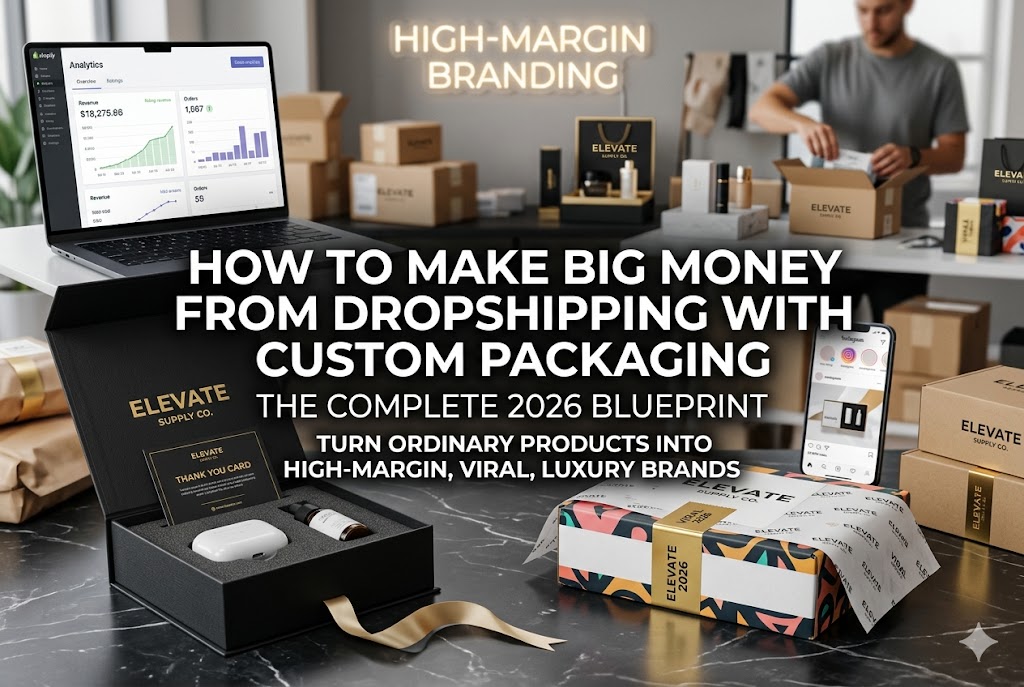
Why Custom Packaging Changes the Entire Dropshipping Model
Most dropshipping businesses fail to scale not because of traffic problems, but because of lack of differentiation. When every store sells the same product sourced from identical suppliers, price becomes the only competition factor. This creates shrinking margins and unstable growth.
Custom packaging changes this structure. Instead of competing on product cost alone, you begin competing on brand perception, which directly influences how much customers are willing to pay and whether they return.
In modern e-commerce, packaging is no longer a finishing detail—it is a strategic branding asset.
Packaging as the First Physical Touchpoint of Your Brand
In dropshipping, the customer experience is often digital until the moment the product arrives. This “first physical touchpoint” is extremely powerful.
Custom packaging transforms a generic product into a branded experience. Even if the product itself is sourced from the same manufacturer as competitors, the packaging creates a psychological separation in the customer’s mind.
A plain brown box signals commodity. A branded, thoughtfully designed package signals legitimacy, trust, and quality. This shift is subtle but has a measurable impact on perceived value.
From a behavioral standpoint, customers rarely evaluate the product in isolation. They evaluate the entire experience, and packaging becomes a major part of that evaluation.
Building Perceived Value Without Increasing Product Cost Significantly
One of the strongest advantages of custom packaging in dropshipping is its ability to increase perceived value without proportionally increasing unit cost.
For example, a product that costs $8 to source may sell for $25 in a standard dropshipping store. However, with branded packaging, storytelling inserts, and a premium unboxing experience, the same product can often be repositioned at $35–$45.
The key driver here is not functional improvement, but perceived exclusivity. Customers associate branded packaging with established companies, even when the business is still small.
This allows sellers to increase margins without changing suppliers or redesigning the product itself.
Brand Identity and Long-Term Customer Value
Custom packaging also plays a critical role in building brand memory. A customer may forget a generic store name, but they are far more likely to remember a brand that delivered a visually consistent and emotionally engaging experience.
This has direct implications for customer lifetime value (LTV). When customers recognize a brand, they are more likely to:
- Return for repeat purchases
- Recommend the product to others
- Engage with future marketing campaigns
In dropshipping, where acquisition costs are rising, improving retention is often more profitable than constantly scaling ads.
Custom packaging becomes a silent retention tool working beyond the initial sale.
Psychological Trust and Reduced Refund Rates
Another often overlooked benefit is trust reinforcement. Customers are more likely to trust a brand that invests in presentation. This reduces perceived risk at the moment of purchase and can lower refund rates.
When a product arrives in generic packaging, it reinforces the idea of “cheap resale.” When it arrives in branded packaging, it reinforces legitimacy—even if the product itself is identical.
This perception shift can significantly influence post-purchase satisfaction, which is a key driver of refund behavior in e-commerce.
Strategic Positioning: From Commodity Seller to Brand Owner
The biggest transformation custom packaging enables is not operational—it is strategic. It moves a dropshipping business from a commodity reseller model to a brand ownership model.
Commodity sellers compete in auctions: whoever offers the lowest price wins. Brand owners compete in perception: whoever creates the strongest identity wins.
This shift is what allows long-term scalability. Once a brand identity is established, it becomes easier to expand product lines, introduce upsells, and build a loyal customer base.
Without packaging differentiation, most dropshipping stores remain trapped in short-term arbitrage cycles.
Increase Profit Margins Through Premium Unboxing Experience
In dropshipping, most sellers focus heavily on product sourcing and ad performance while ignoring a key profitability lever: customer experience design. Specifically, the unboxing experience has become one of the most underutilized tools for increasing profit margins.
Custom packaging does not simply make a product look better. It reshapes how customers perceive value, which directly impacts how much they are willing to pay and how likely they are to recommend the product.
In a competitive market where product differentiation is minimal, experience becomes the main pricing advantage.
The Psychology Behind Premium Unboxing and Higher Pricing Power
Consumers rarely evaluate price in isolation. Instead, they compare what they pay with what they feel they receive. This is where custom packaging plays a critical role.
A premium unboxing experience creates a psychological effect known as value amplification. When a product arrives in carefully designed packaging, the brain automatically assigns higher worth to the item inside, even if the product itself has not changed.
This allows sellers to increase retail prices without significantly increasing product costs. The perceived upgrade in quality justifies the price difference in the customer’s mind.
In practical terms, packaging becomes a silent pricing strategy.
How Custom Packaging Directly Expands Profit Margins
The margin improvement in dropshipping usually comes from two sides: increasing selling price or reducing acquisition cost inefficiency. Custom packaging impacts both indirectly by strengthening conversion and reducing resistance to higher pricing.
When a store uses generic packaging, customers often benchmark the product against low-cost alternatives. However, when the packaging feels branded and intentional, the product is no longer compared purely on functionality.
This shift allows sellers to introduce:
- Higher base prices without reducing conversion rates
- Tiered pricing (standard vs premium bundles)
- Upsell opportunities at checkout or post-purchase
Over time, even a small price increase per order significantly improves total margin performance.
Unboxing Experience as a Viral Marketing Engine
One of the most powerful effects of custom packaging is its ability to generate organic content. In platforms like TikTok, Instagram Reels, and YouTube Shorts, unboxing videos consistently perform well because they deliver anticipation and visual satisfaction.
A well-designed package increases the likelihood that customers will:
- Record the unboxing experience
- Share it on social media
- Mention the brand in comments or reviews
This creates a secondary marketing channel that reduces dependency on paid advertising.
From a financial perspective, every user-generated video effectively lowers customer acquisition cost, which directly improves profit margins at scale.
Reducing Return Rates Through Perceived Quality
Profit margins in dropshipping are not only determined by sales revenue but also by post-purchase behavior. Returns and refund requests can significantly erode profitability.
Custom packaging reduces refund pressure by improving perceived product quality. When customers receive a product in a low-effort package, they are more likely to assume low value, even if the product functions correctly.
However, when the packaging feels premium, customers interpret the entire purchase as more trustworthy and professionally handled. This reduces dissatisfaction-driven returns, improving net margin per order.
Creating Tiered Product Value Without Changing Suppliers
One of the most efficient strategies enabled by custom packaging is product tiering. Instead of relying on different suppliers for different price points, sellers can create perceived tiers using packaging alone.
For example:
- Standard packaging for entry-level customers
- Premium branded packaging for mid-tier pricing
- Limited edition packaging for high-margin bundles
This approach allows sellers to extract more revenue from the same inventory without increasing operational complexity.
It effectively turns packaging into a scalable pricing architecture.
Dropshipping with Custom Packaging Using High-Converting Store Strategies
Many dropshipping sellers treat custom packaging as a post-purchase branding detail, but this is a strategic mistake. Packaging is not only about fulfillment—it should be integrated into the entire conversion system of the store.
When properly aligned with store design, pricing structure, and product positioning, custom packaging becomes a conversion driver rather than just a cost element. The result is not only stronger branding, but also higher conversion rates and more efficient scaling.
To make real money from dropshipping, packaging must be treated as part of the sales funnel.
Aligning Packaging with Product Positioning on the Store
A high-converting store starts with consistent positioning. If a product is presented as premium on the website but arrives in generic packaging, the experience breaks consistency, reducing trust and repeat purchase potential.
Custom packaging allows sellers to align the physical experience with the digital promise.
For example:
- A “luxury skincare” product must arrive in minimalist, elegant packaging
- A “tech gadget” should have structured, engineered-style packaging
- A “giftable product” should include presentation-focused design elements
When the packaging matches the product narrative, customers experience coherence, which improves satisfaction and reduces cognitive dissonance after purchase.
This alignment directly improves conversion performance over time because customers trust the brand more during checkout decisions.
Using Packaging as a Conversion Booster on Product Pages
Most dropshipping stores rely heavily on ads and product page optimization, but few integrate packaging into conversion messaging.
Displaying custom packaging visuals on product pages increases perceived professionalism and reduces purchase hesitation. Customers are not just buying a product—they are buying a complete experience.
High-converting stores often integrate packaging in:
- Product images showing unboxing scenarios
- Lifestyle visuals highlighting branded delivery
- Short video loops demonstrating packaging flow
This helps eliminate the “cheap dropshipping” perception, which is one of the biggest conversion killers in e-commerce.
The key principle is simple: customers convert faster when they can visualize the full delivery experience.
Increasing Average Order Value Through Packaging-Based Bundling
Custom packaging enables a powerful but underused strategy: value bundling through presentation.
Instead of selling a single product, sellers can group items into curated experiences and package them as a complete set. The packaging becomes the unifying element that justifies higher pricing.
For example:
- A skincare bundle presented in a branded box feels like a “routine set” rather than individual products
- A gadget kit with structured packaging feels like a “professional toolset”
- A gift package feels more valuable than the sum of its parts
This approach increases average order value without requiring additional ad spend. The conversion rate may remain stable, but revenue per customer increases significantly.
Reducing Friction in Checkout Decisions with Brand Consistency
Conversion rates are heavily influenced by perceived risk. In dropshipping, customers often hesitate due to uncertainty about product quality and shipping reliability.
Custom packaging reduces this friction by signaling professionalism and operational maturity. When customers see that a brand invests in presentation, they subconsciously assume the business is more reliable.
This perception reduces hesitation at checkout, especially for first-time buyers.
In high-performing stores, even subtle packaging cues can increase conversion rates because they reduce the mental gap between “online product” and “real-world brand.”
Integrating Packaging into Retargeting and Ad Strategy
High-converting dropshipping stores do not isolate packaging from marketing. Instead, they use it as part of their advertising narrative.
Packaging visuals can be used in:
- Retargeting ads to reinforce brand memory
- UGC ads showing unboxing reactions
- Email campaigns highlighting premium delivery experience
This creates consistency across all touchpoints, which increases trust and improves ad-to-purchase conversion efficiency.
When customers repeatedly see packaging as part of the brand identity, it strengthens recognition and shortens the decision-making cycle.
Dropshipping with Custom Packaging by Choosing the Right Suppliers and Cutting Costs
Most dropshipping businesses fail to scale profitably not because they cannot generate sales, but because their cost structure is unstable and poorly optimized. Custom packaging is often seen as an additional expense, but in reality, it is a supply chain decision that directly impacts margins.
The ability to make big money in dropshipping with custom packaging depends heavily on one core factor: whether your suppliers can support branding efficiently without destroying your cost advantage.
Finding Suppliers That Support Custom Packaging Without Complexity
Not all suppliers are capable of handling custom packaging, especially in standard dropshipping ecosystems where fulfillment is optimized for speed, not branding.
The most effective suppliers are those that offer:
- In-house packaging customization options
- Flexible MOQ (minimum order quantity) structures
- Integrated branding workflows (logo printing, inserts, box design)
Working with suppliers that already support packaging integration reduces operational friction. Instead of coordinating separate vendors for product and packaging, everything is handled within one fulfillment pipeline.
This simplification is critical for scaling because it reduces error rates, shipping delays, and communication overhead.
the Real Cost Structure of Custom Packaging
A common mistake is evaluating custom packaging only as a flat cost per unit. In reality, the cost structure is multi-layered and depends on order volume, material choice, and design complexity.
At low volumes, packaging may significantly reduce margins. However, at scale, the per-unit cost often decreases sharply, making packaging more economically viable.
The key is to evaluate packaging not as a fixed expense but as a scaling cost curve:
- Early stage: higher cost, used for validation
- Growth stage: optimized cost per unit
- Scale stage: negligible impact relative to increased AOV
Sellers who understand this structure are able to absorb initial costs strategically to unlock long-term profitability.
MOQ Strategy: Balancing Risk and Brand Control
Minimum order quantity (MOQ) is one of the biggest barriers to custom packaging in dropshipping. However, it is also one of the most important negotiation levers.
Instead of avoiding MOQ, successful sellers use it strategically:
- Start with small test runs to validate demand
- Use modular packaging that works across multiple products
- Negotiate phased scaling agreements with suppliers
This approach reduces upfront risk while still enabling brand consistency.
MOQ should not be viewed as a limitation, but as a tool for aligning supplier incentives with your growth trajectory.
Reducing Hidden Costs That Destroy Profit Margins
Many dropshipping stores underestimate hidden costs associated with custom packaging. These include:
- Increased shipping weight and dimensional pricing
- Storage and handling fees
- Design revision and sampling costs
- Packaging damage replacement costs
If not managed properly, these hidden costs can eliminate the margin gains from higher perceived value.
The key strategy is optimization at the design level:
- Use lightweight materials without sacrificing perception
- Standardize packaging sizes to reduce shipping complexity
- Avoid over-engineered designs that increase production failure rates
Profitability comes from system efficiency, not just aesthetic improvement.
Supplier Negotiation Strategy for Long-Term Scalability
The most profitable dropshipping brands do not constantly switch suppliers. Instead, they build long-term relationships that improve pricing over time.
Effective negotiation strategies include:
- Committing to projected volume growth instead of large upfront orders
- Offering long-term contracts in exchange for lower packaging costs
- Consolidating multiple SKUs under one supplier to increase leverage
Suppliers are more likely to reduce packaging costs when they see predictable order flow. This transforms packaging from a variable expense into a controlled operational advantage.
Why Virality Is Now a Packaging Problem, Not Just an Ad Problem
In modern dropshipping, winning products are no longer discovered only through paid ads. Platforms like TikTok and Instagram have shifted product discovery toward content-driven virality, where the visual experience matters as much as the product itself.
Custom packaging plays a direct role in this shift. It is not just a fulfillment detail—it is a content trigger. A well-designed package increases the likelihood that customers will record, share, and engage with your product publicly.
This turns packaging into a distribution engine rather than a cost center.
Unboxing as a Built-In Content Strategy
The most powerful content format in e-commerce today is the unboxing video. It is simple, authentic, and highly engaging because it captures anticipation and surprise in real time.
Custom packaging significantly increases the probability of unboxing content creation. When a package looks visually intentional, customers feel more compelled to document the experience.
This happens for three psychological reasons:
- The product feels more “gift-like”
- The experience feels more shareable
- The perceived value feels higher than expected
In dropshipping, where most brands struggle to generate organic content, packaging becomes a silent UGC generator.
Designing Packaging That Encourages Social Sharing
Not all packaging generates viral content. The design must be intentionally structured to perform well on camera and in short-form video environments.
High-performing packaging typically includes:
- Strong visual contrast for camera clarity
- Layered opening experience to build suspense
- Branded elements that are easy to recognize in thumbnails
- Small “surprise moments” inside the packaging
The goal is not just to impress the customer, but to create visually narratable moments that are easy to film and edit into short videos.
When packaging is designed with content creation in mind, it becomes part of the marketing system rather than just logistics.
Turning Customers into Content Creators Without Incentives
One of the most underestimated advantages of custom packaging is its ability to generate organic UGC without paying influencers or running campaigns.
Customers naturally become content creators when:
- The packaging feels premium enough to justify sharing
- The unboxing experience feels emotionally rewarding
- The product arrives in a way that exceeds expectations
This removes dependency on traditional influencer marketing and reduces customer acquisition costs over time.
Instead of paying for content, the product experience itself becomes the content source.
How TikTok Algorithm Amplifies Packaging-Driven Content
TikTok’s algorithm rewards content that maintains attention in the first few seconds. Unboxing videos are particularly effective because they create immediate curiosity.
Custom packaging enhances this effect by improving:
- Visual retention (people stay longer to see the reveal)
- Emotional engagement (anticipation builds naturally)
- Shareability (viewers imagine their own experience)
When multiple users post similar unboxing content, the algorithm interprets it as trend signals, increasing reach organically.
This is how packaging indirectly becomes a growth lever for organic traffic acquisition.
UGC Ads: Scaling Winning Content Created by Packaging
Once unboxing content exists, it can be repurposed into UGC advertising. This is where custom packaging directly impacts revenue at scale.
Instead of producing expensive ad creatives, brands can:
- Collect customer-generated videos
- Edit them into performance ads
- Use them for retargeting and cold traffic campaigns
Because the content is authentic, it typically outperforms traditional studio ads in engagement and conversion rate.
In this system, packaging is not just generating content—it is generating ad assets that monetize directly.
The Feedback Loop Between Packaging and Viral Growth
The most powerful aspect of custom packaging is the feedback loop it creates:
- Better packaging increases unboxing content
- More content increases organic reach
- Increased reach drives more sales
- More sales produce more content
This cycle compounds over time, reducing reliance on paid traffic and increasing brand scalability.
Unlike traditional dropshipping models that reset with every new product, packaging-driven virality builds cumulative brand momentum.
Dropshipping with Custom Packaging by Positioning Products as Luxury Brands
In dropshipping, most sellers compete in the same price-driven ecosystem, where products are treated as commodities. This creates downward pressure on margins and makes scaling difficult. However, the most profitable stores operate under a different logic: they do not sell products, they sell perceived luxury experiences.
Custom packaging is one of the most powerful tools to create this perception shift. It allows a standard or even low-cost product to be repositioned as a premium brand offering, without changing the core product itself.
In essence, luxury positioning is not about what you sell, but how the customer feels when receiving it.
How Packaging Changes Perceived Product Value Instantly
Luxury branding is fundamentally psychological. Customers rarely evaluate objective production cost; instead, they interpret signals of quality. Packaging is one of the strongest signals available in e-commerce.
When a product arrives in minimal, well-designed packaging, it immediately communicates:
- Attention to detail
- Higher production standards
- Brand legitimacy
Even if the product is identical to cheaper alternatives, the perceived value increases because the packaging reframes the entire experience.
This perception shift is what allows sellers to break away from price competition and move into higher-margin positioning.
Turning Commodity Products into Premium Offers
One of the most powerful applications of custom packaging is transforming commodity products into premium offers.
For example, a simple everyday product can be repositioned as:
- A “curated lifestyle item”
- A “gift-ready premium experience”
- A “limited brand edition product”
The packaging becomes the bridge between low-cost sourcing and high-end pricing.
This allows sellers to increase retail prices significantly without modifying the product itself or changing suppliers. The only change is how the product is presented and experienced.
In dropshipping, this is one of the fastest ways to unlock higher profit margins without increasing operational complexity.
The Role of Unboxing in Luxury Brand Perception
Luxury brands are defined not only by appearance, but by experience sequencing. The unboxing moment is where this experience becomes tangible.
Custom packaging enables structured unboxing flows:
- Layered reveal (building anticipation)
- Branded internal messaging
- Carefully designed visual consistency
These elements create emotional reinforcement that the product is premium, even before it is used.
In behavioral terms, the unboxing experience reduces skepticism and increases satisfaction, both of which directly influence willingness to pay higher prices.
Pricing Power: How Perception Allows Higher Margins
The most direct financial benefit of luxury positioning is pricing power. When a product is perceived as premium, customers become less sensitive to price differences.
This allows dropshipping stores to:
- Increase base product prices
- Introduce premium tiers for packaging upgrades
- Sell bundles at significantly higher margins
The key insight is that customers are not paying for materials—they are paying for status, experience, and emotional value.
Custom packaging enables all three without requiring product-level improvements.
Building a Consistent Luxury Brand System
Luxury positioning cannot rely on packaging alone. It must be consistent across the entire brand system, including:
- Website design and typography
- Product imagery and lifestyle positioning
- Customer communication tone
- Post-purchase experience
Custom packaging acts as the physical extension of this system. If the digital experience feels premium but the packaging does not, the illusion breaks. Conversely, if packaging reinforces a strong digital identity, the perceived brand value compounds.
Consistency is what transforms isolated sales into long-term brand equity.

No Comments