


Is Dropshipping Sweatshirts Profitable: 6 Proven High-Margin Models (Up to 80% Gross Profit) to Build a Scalable, Brand-Driven Ecommerce Empire

The biggest mistake beginners make is treating dropshipping as a transactional business. In the premium streetwear segment, long-term profitability comes from brand equity, not one-off sales. Customers are more likely to return, recommend, and even advocate for brands that feel authentic and exclusive.
By focusing on storytelling, limited releases, and strong visual identity, a dropshipping sweatshirt business can transition from a low-margin store into a high-margin fashion brand. Over time, this not only increases gross margins but also reduces dependency on paid traffic.
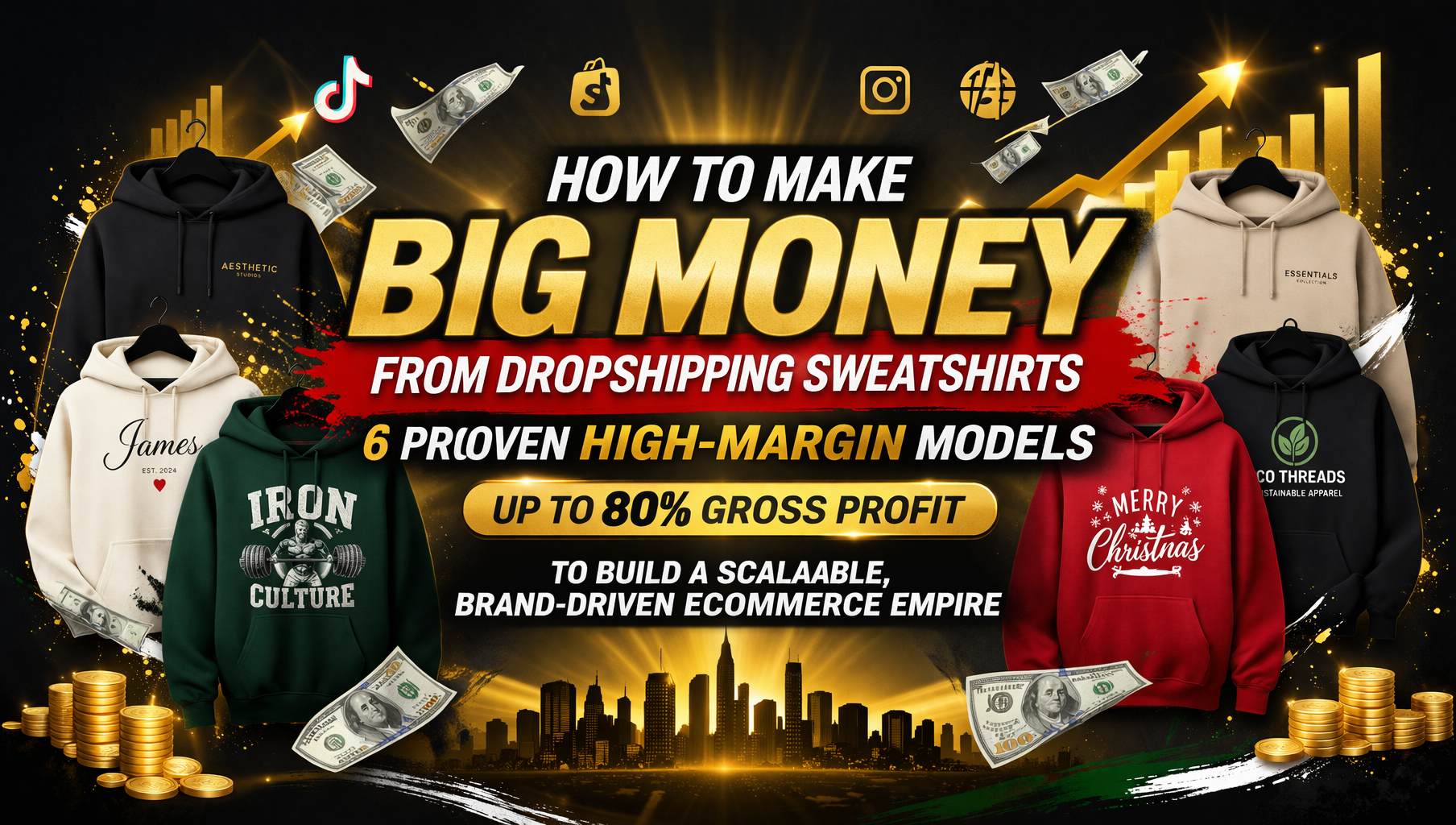
How to Make Big Money from Dropshipping Sweatshirts Through Premium Streetwear Branding
In the dropshipping apparel market, competing on price is a losing game. The real profit lies in branding, particularly within the premium streetwear segment. Inspired by labels like Supreme and Off-White, modern ecommerce entrepreneurs are shifting from commodity selling to identity-driven fashion. Sweatshirts, due to their versatility and year-round demand, are one of the easiest entry points into this model.
Streetwear consumers are not simply buying clothing; they are buying cultural relevance, exclusivity, and belonging. This psychological shift allows sellers to command significantly higher prices without a proportional increase in cost. As a result, gross margins in this niche consistently outperform generic apparel categories.
Breaking Down the Gross Margin Structure
A typical premium streetwear sweatshirt in a dropshipping model has a surprisingly favorable cost structure. Bulk blank sweatshirts sourced from manufacturers in China or Southeast Asia usually cost between $8 and $18, depending on fabric weight and quality. Adding custom elements such as embroidery, puff print, or screen printing increases the cost by $3 to $6 per unit.
This brings the total landed cost to approximately $12–$25. However, retail prices for branded streetwear sweatshirts commonly range from $49 to $120, depending on positioning and perceived exclusivity. This creates a gross margin of 55% to 80%, even before optimizing logistics or negotiating supplier rates.
Compared to standard dropshipping products, where margins often struggle to exceed 30%–40%, this model offers significantly more room for advertising spend, influencer partnerships, and reinvestment into brand building.
The Power of Limited Drops and Scarcity
One of the defining characteristics of premium streetwear is the “drop model.” Instead of maintaining constant inventory, brands release limited quantities at specific times, creating urgency and hype. This strategy, popularized by Supreme, has proven highly effective in driving conversion rates and reducing unsold inventory.
For dropshipping businesses, this model is particularly advantageous. Since products are only produced or fulfilled after orders are placed, the risk of overstock is minimized. At the same time, scarcity increases perceived value, allowing sellers to maintain higher price points without resistance.
Data from ecommerce campaigns shows that limited-time product drops can increase conversion rates by 1.5x to 3x compared to always-available listings. Additionally, average order value often rises when customers feel urgency to secure exclusive items.
Leveraging Social Media for Brand Perception
Premium streetwear success is heavily tied to visual storytelling. Platforms like TikTok and Instagram play a critical role in shaping brand perception. High-quality product photography, lifestyle videos, and influencer collaborations can transform a $15 sweatshirt into a $90 product in the eyes of consumers.
Short-form video content showcasing outfit styling, behind-the-scenes production, or “first look” drops can significantly improve engagement. In many cases, brands using TikTok organic strategies achieve customer acquisition costs 30%–50% lower than those relying solely on paid ads.
The key is consistency in branding. Fonts, color palettes, and messaging must align to create a cohesive identity that resonates with a specific audience segment.
How to Make Big Money from Dropshipping Sweatshirts with Print-on-Demand Personalization
In traditional ecommerce, most products are easily comparable, which forces sellers into price competition. Print-on-demand (POD) personalization changes this dynamic entirely. By allowing customers to customize sweatshirts with names, photos, or meaningful text, the product becomes unique and emotionally valuable. This eliminates direct price comparison and significantly increases willingness to pay.
Platforms like ScaleOrder have made it for entrepreneurs to launch personalized apparel businesses without holding inventory. More importantly, they enable scalable production while maintaining flexibility in design offerings.
From a behavioral standpoint, personalized products tap into “emotional ownership.” Customers are not just buying a sweatshirt—they are buying something that represents their identity, relationships, or memories. This psychological factor is the foundation of higher conversion rates and stronger margins.
the Gross Margin Economics
Compared to bulk manufacturing, POD has higher base costs but still offers strong profitability due to pricing power. A typical personalized sweatshirt costs between $18 and $28, including printing and fulfillment. Shipping may add an additional $4–$8 depending on the market.
Despite these higher costs, personalized sweatshirts can retail for $39 to $70, and in some niche cases even higher. This results in a gross margin of approximately 35% to 60%, which is highly competitive given the low upfront investment and zero inventory risk.
What makes this model particularly attractive is margin stability. Unlike trending products that fluctuate in demand, personalized items maintain consistent pricing because they are not commoditized. This allows for predictable profit planning and sustainable scaling.
High-Converting Personalization Niches
Not all personalization ideas perform equally. The most profitable segments are those tied to emotional triggers or identity expression. For example, couple-themed sweatshirts for anniversaries or Valentine’s Day often achieve conversion rates 2–3 times higher than generic designs. Similarly, pet-related apparel—where customers upload images of their dogs or cats—has proven to be a strong revenue driver.
Professional identity is another overlooked but lucrative niche. Sweatshirts targeting nurses, teachers, or specific trades create a sense of belonging and pride. These audiences are highly engaged and more likely to share purchases on social media, generating organic traffic.
In many successful stores, focusing on one or two of these niches leads to better branding and higher lifetime customer value compared to offering broad, unfocused catalogs.
Reducing Returns and Increasing Customer Satisfaction
One hidden advantage of personalized sweatshirts is the significantly lower return rate. Since products are custom-made, customers are less likely to return them unless there is a defect. In standard apparel ecommerce, return rates can range from 15% to 30%, primarily due to sizing issues or unmet expectations. In contrast, personalized products often see return rates below 10%.
This directly improves net margins, as fewer refunds and exchanges reduce operational costs. Additionally, customers who receive personalized items tend to have higher satisfaction levels, leading to better reviews and stronger brand trust.
Scaling with Data and Automation
As order volume grows, efficiency becomes critical. POD platforms automate production and fulfillment, allowing sellers to focus on marketing and optimization. Data plays a crucial role in scaling: tracking which designs, phrases, or personalization options convert best can quickly increase profitability.
For example, slight variations in wording or design layout can impact conversion rates by 20% or more. A/B testing product pages, mockups, and pricing strategies is essential for maximizing returns. Over time, winning designs can be turned into evergreen products that generate consistent revenue.
How to Make Big Money from Dropshipping Sweatshirts by Targeting Niche Communities
One of the most common mistakes in dropshipping is trying to sell to everyone. In reality, the highest profits come from selling to a clearly defined group with shared interests, values, or identities. Niche communities—whether centered around fitness, gaming, or digital finance—offer a powerful advantage: they already have built-in demand and strong emotional alignment.
Unlike general fashion buyers, niche audiences are not primarily price-sensitive. They are looking for products that reflect who they are. This shift allows sellers to position sweatshirts as symbols of belonging rather than basic apparel. As a result, pricing becomes more flexible, and conversion rates improve significantly.
Online platforms such as Reddit and TikTok have made it easier than ever to identify and analyze these communities. By observing trending discussions, hashtags, and content engagement, sellers can quickly validate demand before launching products.
Gross Margin Advantages in Niche Positioning
From a cost perspective, niche sweatshirts are similar to standard products. Sourcing and printing typically range between $10 and $20 per unit, depending on quality and customization level. However, the key difference lies in perceived value.
Because designs are tailored to a specific audience—such as weightlifters, gamers, or crypto enthusiasts—these sweatshirts can retail for $35 to $80 without significant resistance. This results in a gross margin of 50% to 75%, which is substantially higher than generic apparel.
Additionally, niche targeting improves advertising efficiency. Customer acquisition costs (CAC) are often 20%–40% lower because ads can be precisely tailored to specific interests. Combined with higher conversion rates—commonly reaching 3% to 6% compared to the typical 1% to 2%—this creates a much more profitable business model.
Identifying Profitable Communities with Data
The most successful niches are not necessarily the largest ones, but the most engaged. A smaller audience with strong identity and frequent interaction often outperforms a broad but passive market.
For example, fitness communities built around specific training styles, such as powerlifting or CrossFit, tend to have highly active members who regularly purchase apparel. Similarly, gaming communities tied to particular genres or titles often respond well to inside jokes and culturally relevant designs.
Data signals to look for include:
- High engagement rates on social content (likes, comments, shares)
- Repetitive language or slogans within the community
- Existing merchandise demand (even if poorly executed)
When these signals align, the probability of launching a profitable product increases dramatically.
Turning Community Insight into High-Converting Designs
Design is where niche knowledge translates into revenue. Generic graphics rarely perform well in this model. Instead, successful designs often incorporate insider language, humor, or references that only members of the community fully understand.
This creates a sense of exclusivity. When customers feel that a product “speaks their language,” they are far more likely to purchase. In many cases, this emotional resonance can double conversion rates compared to generic alternatives.
Moreover, niche designs tend to generate organic sharing. Customers frequently post products within their own communities, effectively turning each purchase into a marketing channel. This reduces reliance on paid advertising and increases overall margin efficiency.
Building Long-Term Value Through Community Alignment
Niche dropshipping is not just about initial sales—it’s about building ongoing relationships. Once a brand establishes credibility within a community, repeat purchases become more common. New designs, seasonal drops, and limited editions can be introduced with a higher likelihood of success.
Email marketing and social media groups further strengthen this connection. Engaged audiences are more receptive to product launches, leading to higher lifetime customer value (LTV). Over time, this reduces the need for constant customer acquisition and stabilizes revenue.
Another advantage is reduced competition. While mass-market products are saturated, niche segments often have fewer dedicated brands, especially those with strong positioning. This creates an opportunity to dominate a specific category rather than compete broadly.
How to Make Big Money from Dropshipping Sweatshirts with Seasonal and Trend-Driven Products
In the sweatshirt market, one of the fastest ways to generate significant profit is not by building a timeless brand, but by capitalizing on timing. Seasonal demand and viral trends create short windows where consumer intent spikes dramatically. During these periods, even relatively simple designs can outperform premium products in both volume and profitability.
Events like Christmas and Halloween consistently drive surges in apparel demand, especially for themed sweatshirts. At the same time, internet-driven trends—often fueled by platforms like TikTok—can turn a niche idea into a high-revenue product within days.
This model prioritizes speed and responsiveness over long-term brand building, making it particularly effective for generating rapid cash flow.
Gross Margin Dynamics in Trend-Based Selling
From a cost perspective, seasonal sweatshirts are similar to standard dropshipping products. Manufacturing and printing typically range from $9 to $18 per unit, depending on quality and supplier location. However, the pricing power during peak demand periods allows for strong profitability.
Retail prices for seasonal designs commonly fall between $29 and $60, resulting in a gross margin of approximately 40% to 65%. While this is slightly lower than premium branding models, the key advantage lies in volume and speed.
During peak seasons, conversion rates can increase by 2x to 4x compared to off-season periods. This allows sellers to scale aggressively with paid ads while maintaining positive return on ad spend (ROAS). In many cases, a single well-timed product can generate the majority of monthly or even quarterly revenue.
Predicting Trends with Data Instead of Guesswork
Successful trend-based dropshipping is not about luck—it is about data interpretation. Tools like Google Trends provide insight into rising search interest, allowing sellers to identify opportunities before they peak.
For example, search volume for holiday-related keywords often begins increasing 4 to 8 weeks before the actual event. This creates a predictable timeline for product launches and ad campaigns. Similarly, monitoring trending hashtags and viral content on TikTok can reveal emerging aesthetics, phrases, or cultural references that can be quickly turned into sweatshirt designs.
The key is early entry. Sellers who launch during the initial growth phase of a trend typically achieve higher margins and lower advertising costs than those who enter after the market becomes saturated.
Minimizing Risk with the Dropshipping Model
Seasonal products inherently carry risk due to their short lifecycle. Unsold inventory quickly loses value once the trend passes. This is where dropshipping provides a critical advantage.
By producing items only after orders are placed, sellers eliminate the need for large upfront inventory investments. This flexibility allows for rapid testing of multiple designs without significant financial exposure. Poor-performing products can be quickly discontinued, while successful ones can be scaled aggressively.
In addition, shorter product cycles encourage continuous experimentation. Instead of relying on a single “winning product,” sellers can launch new designs regularly, increasing the probability of hitting profitable trends.
Maximizing Revenue Through Urgency and Scarcity
Consumer psychology plays a major role in seasonal sales. Limited-time availability naturally creates urgency, pushing customers to make faster purchasing decisions. Countdown timers, “last chance” messaging, and holiday shipping deadlines all contribute to higher conversion rates.
Data from ecommerce campaigns shows that urgency-driven messaging can increase conversion rates by 20% to 50%. When combined with trend relevance, this effect becomes even more pronounced.
Average order value can also increase during peak seasons, as customers are more willing to purchase multiple items for gifts or events. This further improves overall profitability, even if individual product margins remain moderate.
How to Make Big Money from Dropshipping Sweatshirts with Eco-Friendly and Sustainable Branding
In recent years, sustainability has shifted from a niche preference to a mainstream purchasing factor, especially among younger consumers. Buyers are increasingly willing to pay a premium for products that align with their environmental values. This trend has opened a highly profitable lane in the sweatshirt market: eco-friendly and sustainably produced apparel.
Brands like Patagonia have demonstrated that environmental responsibility can be a powerful driver of both customer loyalty and high-margin pricing. For dropshipping entrepreneurs, this represents an opportunity to move beyond price competition and build value through ethics and transparency.
Unlike traditional products, sustainable sweatshirts are not evaluated solely on material or design. They are judged based on sourcing, production practices, and brand storytelling. This multi-dimensional value perception is what enables significantly higher price points.
Breaking Down the Gross Margin Structure
At first glance, eco-friendly products appear less profitable due to higher production costs. Organic cotton, recycled fabrics, and ethical manufacturing processes typically increase base costs to around $20–$35 per sweatshirt. Certifications and smaller production batches can further add to expenses.
However, the retail pricing potential more than compensates for this. Sustainable sweatshirts commonly sell for $60 to $120, depending on branding and positioning. This results in a gross margin of approximately 45% to 70%, which is competitive with—and often superior to—many standard dropshipping categories.
More importantly, these margins tend to be more stable. Because the value proposition is not purely price-driven, there is less pressure to discount, allowing sellers to maintain profitability over time.
Consumer Behavior and Willingness to Pay
Data consistently shows that Gen Z and millennial consumers are highly responsive to sustainability messaging. Surveys indicate that a significant portion of these groups are willing to pay 20%–30% more for environmentally friendly products. This willingness translates directly into higher average order values and improved margins.
Additionally, eco-conscious consumers often exhibit stronger brand loyalty. Once trust is established, repeat purchase rates tend to increase, reducing reliance on paid acquisition. This has a compounding effect on profitability, as customer lifetime value (LTV) rises while acquisition costs decline.
Transparency is critical in this process. Customers expect clear information about materials, sourcing, and production. Brands that fail to provide this risk losing credibility, which can directly impact conversion rates.
Turning Sustainability into a Conversion Driver
Sustainability alone is not enough; it must be communicated effectively. Product pages, for example, should clearly highlight key differentiators such as organic fabrics, reduced water usage, or ethical labor practices. These elements should not be treated as secondary details but as core selling points.
Visual storytelling also plays a major role. Behind-the-scenes content, supplier partnerships, and production processes can all be used to reinforce authenticity. When customers understand the “why” behind a product, they are more likely to justify higher prices.
In many cases, emphasizing sustainability can increase conversion rates by 10% to 25%, particularly when combined with strong branding and clean design aesthetics.
Operational Considerations in Sustainable Dropshipping
One of the challenges in this model is supplier selection. Not all manufacturers can provide verifiable eco-friendly materials or processes. Working with reliable partners is essential to ensure consistency and maintain brand integrity.
Print-on-demand services and specialized suppliers are increasingly offering sustainable options, making it easier to enter this market without large upfront investments. However, shipping times and costs may be slightly higher, which should be factored into pricing strategy.
Despite these challenges, the dropshipping model still offers flexibility. Sellers can test different product variations and messaging angles without committing to large inventory volumes, reducing financial risk.
How to Make Big Money from Dropshipping Sweatshirts with High-Ticket Minimalist Branding
In the sweatshirt market, complexity is often mistaken for value. Many sellers overload products with graphics, colors, and variations, assuming more features will drive sales. In reality, minimalist branding—clean design, neutral tones, and subtle logos—has proven to be far more effective in commanding high prices.
Brands like Fear of God Essentials have built entire business models around simplicity. Their success highlights a key insight: consumers often associate minimalism with quality, sophistication, and exclusivity. This perception allows sellers to charge significantly higher prices for products that are, from a production standpoint, relatively simple.
For dropshipping entrepreneurs, this creates an ideal scenario—higher selling prices without a proportional increase in operational complexity.
the High-Ticket Gross Margin Model
Minimalist sweatshirts typically use higher-quality fabrics and more refined construction, which increases production costs slightly compared to basic items. On average, sourcing costs range from $18 to $30 per unit, depending on material weight and finishing details.
However, retail prices for minimalist, high-ticket sweatshirts commonly fall between $80 and $150. This results in a gross margin of approximately 55% to 75%, placing this model among the most profitable in the apparel dropshipping space.
Another important factor is margin efficiency. Because each sale generates more profit, sellers can afford higher customer acquisition costs while still maintaining strong net margins. This makes scaling through paid advertising significantly more viable.
Reducing Operational Friction Through Fewer SKUs
A key advantage of minimalist branding is the ability to operate with a highly focused product catalog. Instead of offering dozens of designs, successful brands often concentrate on a small number of core products with slight variations in color or fit.
This approach simplifies multiple aspects of the business. Inventory management becomes easier, even in a dropshipping context. Product pages are clearer and more persuasive. Marketing efforts are more concentrated, leading to stronger brand recognition.
Data from ecommerce operations shows that reducing SKU complexity can improve conversion rates by 10% to 20%, as customers face less decision fatigue. At the same time, operational errors—such as incorrect orders or inconsistent quality—tend to decrease.
The Role of Visual Identity in Driving Conversions
In minimalist fashion, branding is everything. Since designs are intentionally simple, the perceived value must come from presentation. High-quality product photography, consistent color palettes, and refined typography all contribute to the overall brand experience.
Websites should reflect this philosophy. Clean layouts, ample white space, and understated messaging help reinforce the premium positioning. Every visual element should communicate quality and intentionality.
Social media also plays a critical role. Platforms like Instagram are particularly effective for showcasing minimalist apparel through lifestyle imagery. Instead of focusing on the product alone, successful brands highlight how the sweatshirt fits into a broader aesthetic or lifestyle.
This cohesive visual identity can significantly increase perceived value, often allowing sellers to raise prices without negatively impacting conversion rates.
Lower Return Rates and Higher Customer Satisfaction
One overlooked benefit of minimalist sweatshirts is their lower return rate. Because designs are neutral and versatile, they appeal to a broader range of preferences, reducing the likelihood of dissatisfaction. Additionally, clearer product positioning leads to more accurate customer expectations.
In standard apparel ecommerce, return rates can reach 20% or higher. In contrast, minimalist, high-quality products often experience noticeably lower return rates, which directly improves net profitability.
Higher customer satisfaction also leads to better reviews and stronger brand trust. Over time, this reduces reliance on aggressive marketing tactics and supports more organic growth.
Building a Scalable Premium Brand
The long-term potential of high-ticket minimalist dropshipping lies in brand development. Unlike trend-based models, which rely on constant product turnover, minimalist brands can build enduring product lines that remain relevant over time.
This stability allows for more strategic growth. Marketing efforts can focus on storytelling, lifestyle positioning, and brand values rather than continuous product launches. As brand recognition increases, customer acquisition costs tend to decrease, further improving margins.
Moreover, high-ticket positioning attracts a different type of customer—one who values quality over price and is more likely to make repeat purchases. This increases lifetime value and creates a more predictable revenue stream.




No Comments