


Is Dropshipping Private Label Skincare Profitable (Even If You’re Starting from Zero) Using Proven Niches, Branding, and Automation Systems

To make big money from dropshipping private label skincare, the first strategic decision is not sourcing or advertising—it is niche selection. High-margin skincare businesses are built by identifying emotionally driven skin concerns, narrowing the market focus, and positioning the brand as a specialist rather than a general retailer.
In a saturated beauty industry, clarity of niche is what transforms a simple dropshipping store into a scalable, premium skincare brand.
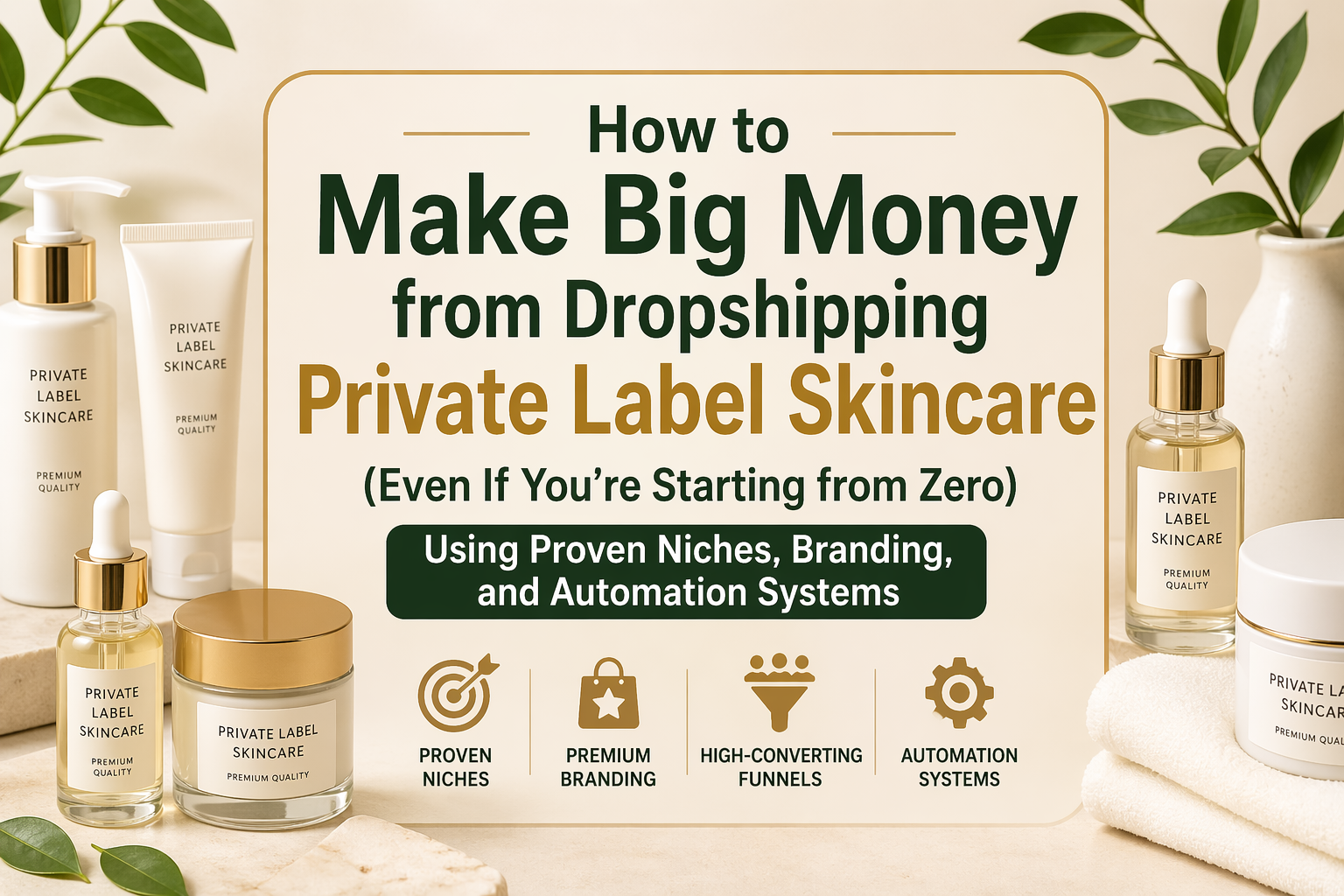
the Real Profit Driver in Private Label Skincare
In the private label skincare industry, most beginners assume that success comes from finding “winning products.” In reality, the real driver of profit is niche positioning. When you look at how to make big money from dropshipping private label skincare, the difference between low-margin stores and high-profit brands is rarely the supplier—it is the category selection and how precisely the brand is positioned within a specific skin concern or customer identity.
Skincare is not a generic commodity market. It is a problem-solution driven industry where customers are willing to pay significantly higher prices when they believe a product is formulated for their exact issue. This creates an environment where margins can expand dramatically if you choose the right niche instead of competing in overcrowded general skincare segments.
Why Broad Skincare Stores Fail to Scale Profitably
A common mistake in dropshipping skincare is building a “general beauty store” that sells everything from cleansers to serums without a focused identity. While this approach may generate traffic, it often struggles with conversion efficiency and repeat purchase rates.
The reason is simple: consumers do not emotionally connect with generic skincare stores. Without a clear positioning—such as acne treatment, anti-aging solutions, or sensitive skin repair—the brand lacks authority. As a result, pricing power is limited, advertising costs increase, and customer retention remains weak.
In contrast, private label brands that focus on a specific niche can justify premium pricing because they are perceived as specialists rather than resellers.
High-Margin Skincare Niches That Consistently Perform
When analyzing how to make big money from dropshipping private label skincare, certain niche categories consistently show higher lifetime value and stronger willingness to pay.
Anti-aging skincare is one of the most profitable segments because it targets long-term emotional concerns. Customers in this category are less price-sensitive and more focused on perceived effectiveness and ingredient quality.
Acne treatment products also perform strongly, particularly among younger demographics who are actively searching for fast and visible results. However, this niche requires careful positioning to avoid overpromising claims, especially in regulated markets.
Another high-margin category is sensitive skin and barrier repair skincare. This segment has grown rapidly due to increased awareness of skin irritation from pollution, stress, and overuse of active ingredients. Products in this category often command premium pricing because customers are seeking safety and trust rather than aggressive results.
Natural and organic skincare is also a powerful positioning angle, especially in European and North American markets. The perceived value of “clean beauty” allows brands to significantly increase markup, even when formulation costs are not substantially higher.
The Strategic Logic Behind Niche Selection
Choosing a high-margin niche is not only about demand size, but also about competitive intensity and emotional urgency. The most profitable niches tend to share three characteristics: strong emotional motivation, recurring usage, and clear problem identification.
For example, anti-aging skincare works because aging is unavoidable and emotionally charged. Acne skincare works because the problem is visible and urgent. Sensitive skin products work because discomfort drives immediate purchasing decisions.
In contrast, overly broad or purely aesthetic categories often struggle to maintain pricing power because they lack urgency and differentiation.
Positioning Determines Pricing Power and Brand Longevity
Ultimately, in private label skincare dropshipping, profit is not determined at the product level—it is determined at the positioning level. Two stores can sell similar formulations, but the one that frames itself around a precise niche will consistently outperform in both conversion rate and average order value.
Strong niche positioning also creates a compounding effect. Advertising becomes more efficient because messaging is clearer. Content marketing becomes easier because the audience is defined. Customer loyalty improves because buyers feel understood.
Why Branding Is the Real Profit Engine in Skincare Dropshipping
In private label skincare dropshipping, product sourcing is often mistakenly treated as the main competitive advantage. In reality, the ability to make big money comes from branding strength rather than formulation uniqueness. The same basic serum can be sold at $10 or $60 depending entirely on how the brand is positioned in the customer’s mind.
Skincare is a perception-driven industry. Customers are not only buying ingredients—they are buying trust, identity, and expected transformation. This is why branding and premium positioning directly determine pricing power, conversion rate, and long-term profitability.
The Shift from Commodity Products to Brand-Driven Value
Most beginners enter skincare dropshipping by focusing on “good products” from suppliers. However, in a saturated market, product differentiation alone is weak. Many private label manufacturers offer similar formulations, which means competition quickly shifts away from product features and toward brand perception.
A strong skincare brand does not compete on “what it is,” but on “what it represents.” For example, a basic vitamin C serum can be positioned as a clinical-grade brightening solution, a luxury anti-aging ritual, or a clean beauty essential depending on branding direction. Each positioning allows a completely different pricing structure.
This shift from product thinking to brand thinking is the core requirement for building high-margin skincare businesses.
Premium Positioning and the Psychology of Higher Price Acceptance
Premium positioning in skincare is not about making exaggerated claims. It is about controlling perception through consistency in visuals, messaging, and emotional framing.
Customers associate price with credibility. A $25 product and a $75 product can contain similar ingredients, but the higher-priced product often feels more trustworthy if the branding signals professionalism and exclusivity.
This perception is built through subtle but consistent signals: minimalist packaging, clinical or luxury-inspired design language, and focused messaging that emphasizes transformation rather than features.
When executed correctly, premium positioning reduces price sensitivity and increases average order value, which is critical for scaling profit in dropshipping.
Building Brand Story as a Strategic Asset
One of the most overlooked aspects of how to make big money from dropshipping private label skincare is brand storytelling. A strong brand story does not need to be complex, but it must create emotional alignment with a specific customer identity.
For example, a skincare brand targeting stressed urban professionals can position itself around restoration and simplicity. Another targeting acne-prone teenagers may focus on confidence and clarity. These narratives are not cosmetic—they directly influence how customers interpret product value.
The most profitable skincare brands consistently align their story with a clear emotional problem. This creates psychological ownership, which increases repeat purchases and brand loyalty.
Visual Identity and Trust Acceleration
In skincare, visual identity is often the first filter for trust. Customers decide within seconds whether a brand feels credible enough to consider. This makes design consistency a direct revenue factor.
Successful private label skincare brands invest heavily in packaging design, typography, and website aesthetics because these elements replace physical interaction. When customers cannot physically test a product, visual cues become the primary trust signal.
A premium-looking brand reduces friction in paid advertising as well. Higher perceived value improves click-through rate and conversion rate simultaneously, making acquisition costs more efficient.
Branding as a Long-Term Scaling Mechanism
Strong branding does more than improve initial sales. It compounds over time. Once a skincare brand establishes recognition and trust, customer acquisition becomes less dependent on paid ads and more driven by organic search, repeat purchases, and word-of-mouth.
This is especially important in dropshipping, where many stores struggle with rising ad costs. Brands with weak positioning are forced to constantly buy traffic, while strong brands gradually build demand ownership.
Choosing Reliable Manufacturers and Suppliers
In private label skincare dropshipping, supplier selection is often underestimated, yet it is one of the strongest determinants of long-term profitability. When analyzing how to make big money from dropshipping private label skincare, the difference between a scalable brand and a failing store is frequently not marketing—it is manufacturing reliability, compliance, and product consistency.
Skincare is a regulated and trust-sensitive category. Unlike general consumer goods, customers expect safety, stability, and visible results. A single batch inconsistency or compliance issue can permanently damage brand reputation. This makes supplier strategy not just an operational decision, but a foundational business structure.
The Difference Between Generic Suppliers and Skincare Manufacturers
Not all suppliers are suitable for private label skincare. Many dropshippers make the mistake of working with general trading suppliers who lack formulation expertise or regulatory understanding. While these suppliers may offer low costs and fast onboarding, they rarely provide the consistency required for brand building.
Professional skincare manufacturers operate differently. They focus on formulation stability, ingredient sourcing, and production standards. More importantly, they understand regional compliance requirements, which is critical for selling in markets like the United States and Europe.
A strong manufacturing partner does not simply produce products—they ensure that the products can legally and safely enter the target market without regulatory friction.
Compliance as a Profit Protection Strategy
One of the most important aspects of supplier selection in skincare is regulatory compliance. Markets such as the EU require strict adherence to cosmetic regulations, including ingredient safety assessments, labeling standards, and product documentation. The U.S. market also requires alignment with FDA cosmetic guidelines, even if pre-approval is not required for most products.
Ignoring compliance may initially reduce costs, but it introduces high-risk exposure that can destroy scaling potential. Payment processors, ad platforms, and marketplaces increasingly enforce compliance standards, meaning non-compliant products can be restricted or removed at any time.
From a profitability perspective, compliant suppliers are not an optional upgrade—they are a barrier against business interruption and revenue loss.
MOQ Strategy and Its Impact on Scalability
Minimum order quantity (MOQ) is another critical factor in private label skincare manufacturing. While high MOQs can feel restrictive for beginners, they often indicate higher production quality and better supplier stability. Low MOQ suppliers may be useful for testing, but they rarely support long-term brand scaling.
In a structured growth model, MOQ should be viewed as a progression tool. Early-stage businesses may start with smaller production runs to validate market demand. Once a winning product is identified, increasing MOQ becomes a strategic move to reduce unit costs and improve margins.
This transition from testing to scaling is where real profit expansion happens in skincare dropshipping.
Ingredient Transparency and Consumer Trust
Modern skincare consumers are increasingly informed about ingredients. This makes transparency a key competitive factor. Reliable manufacturers provide full ingredient disclosure, batch tracking, and stability testing results.
From a business perspective, transparency is directly linked to conversion rate. Customers are more likely to purchase and repurchase products when they feel confident about what they are applying to their skin. This reduces refund rates and increases customer lifetime value, both of which are essential for profitability.
Suppliers that cannot provide clear ingredient documentation often limit branding potential and advertising scalability, especially on platforms with strict policy enforcement.
Production Consistency and Brand Reputation
Consistency is one of the most important but overlooked aspects of supplier quality. In skincare, even small variations in texture, scent, or absorption can affect customer perception. Since private label brands rely heavily on repeat purchases, inconsistency directly reduces long-term revenue.
A reliable manufacturer ensures that every batch matches the same formulation standards. This stability allows brands to confidently scale advertising without fear of product variation damaging reviews or return rates.
In practice, consistency is what transforms a test product into a sustainable revenue-generating asset.
Building Long-Term Supplier Relationships for Scaling
High-performing skincare brands do not treat suppliers as replaceable vendors. Instead, they build long-term partnerships that support product development, customization, and cost optimization.
As order volume increases, strong supplier relationships often lead to better pricing, priority production scheduling, and access to improved formulations. This creates a compounding advantage that weaker competitors cannot easily replicate.
Over time, supplier partnerships become a strategic moat that supports brand expansion into new product lines and markets.
Using High-Converting Marketing Funnels
In private label skincare dropshipping, having a good product or strong supplier is not enough to generate consistent profit. The real difference between small stores and high-revenue brands lies in how traffic is systematically converted into paying customers. When studying how to make big money from dropshipping private label skincare, the most important operational layer is the marketing funnel.
A marketing funnel is not just a sequence of ads and pages. It is a structured system that guides potential customers from initial awareness to repeat purchase. Without this system, even high-quality skincare products struggle to maintain profitability because traffic leaks occur at every stage of the buying journey.
The Role of Awareness Traffic in Skincare Acquisition
The first stage of any profitable skincare funnel begins with awareness. In most cases, this is generated through paid advertising or organic content distribution. However, in skincare, attention alone is not enough—relevance is critical.
Consumers scrolling through social media do not actively search for products unless they already have a skin concern in mind. This means that successful acquisition strategies must align product messaging with specific emotional triggers such as acne frustration, aging concerns, or skin sensitivity.
The goal at this stage is not to sell immediately, but to attract qualified attention from users who already feel a connection to the problem being solved.
Landing Page Optimization and First Conversion Layer
Once traffic enters the funnel, the landing page becomes the first major conversion checkpoint. In skincare dropshipping, landing page performance has a direct impact on profitability because it determines how efficiently paid traffic is monetized.
High-performing skincare landing pages focus on clarity and emotional reinforcement rather than excessive information. The customer should immediately understand the problem being solved, the expected transformation, and why the product is credible.
Unlike generic e-commerce pages, skincare landing pages rely heavily on perceived trust. This is established through structured storytelling, ingredient transparency, before-and-after logic, and simplified purchasing pathways.
A poorly structured landing page creates friction, while a well-optimized one significantly increases conversion rate without increasing ad spend.
Email Marketing as a Profit Expansion Layer
Most dropshipping stores underestimate the value of email marketing, especially in skincare. However, email is one of the most important components of a high-conversion funnel because skincare products are often not impulse-only purchases—they require consideration.
Once a user enters the email system, the brand gains the ability to re-engage them without additional advertising costs. This creates a secondary conversion opportunity that significantly improves overall profitability.
Effective skincare email sequences focus on education, reassurance, and product reinforcement. Instead of pushing constant promotions, successful brands use email to strengthen trust, explain product benefits in more detail, and reduce hesitation.
Over time, this improves both first-time conversion rates and repeat purchase behavior.
Upselling and Increasing Average Order Value
Another critical component of a profitable skincare funnel is upselling. Since private label skincare products often have relatively low marginal production costs, increasing average order value has a direct impact on profit margins.
Upselling can occur at multiple stages of the funnel. It can be introduced during checkout, where complementary products such as cleansers, serums, or moisturizers are bundled together. It can also occur post-purchase through email sequences or re-engagement campaigns.
The key principle is not aggressive selling, but logical product extension. Customers are more likely to accept additional purchases when they perceive them as part of a complete skincare routine rather than unrelated add-ons.
Retention and Repeat Purchase Strategy
In skincare, long-term profitability is heavily influenced by repeat purchase behavior. Unlike one-time products, skincare is inherently cyclical, meaning customers need ongoing replenishment.
A strong funnel does not end at the first purchase. Instead, it transitions customers into a retention system that encourages continued engagement with the brand.
This is typically achieved through timed reactivation campaigns, skincare education content, and personalized product recommendations based on previous purchases. When executed correctly, retention significantly reduces dependence on paid advertising and increases customer lifetime value.
Funnel Optimization as a Scaling Mechanism
The most important insight in how to make big money from dropshipping private label skincare is that scaling does not come from increasing traffic alone. It comes from improving conversion efficiency across every funnel stage.
A small improvement in landing page conversion rate, email engagement, or upsell acceptance can have a compounding effect on overall profitability. This means that optimization is often more powerful than acquisition.
Successful skincare brands continuously test and refine their funnel structure, ensuring that every stage contributes to revenue generation rather than friction.
TikTok and Instagram Organic Growth
In private label skincare dropshipping, paid advertising is often the first growth engine, but it is not always the most sustainable one. When analyzing how to make big money from dropshipping private label skincare, organic growth on short-form video platforms has become one of the most powerful long-term strategies. Platforms like TikTok and Instagram allow skincare brands to generate attention, trust, and demand without proportional ad spend.
The key advantage of organic traffic in skincare is credibility. Unlike ads, organic content is perceived as more authentic, especially when it comes from real users demonstrating results. This perception plays a critical role in conversion behavior, particularly in a category where trust and visible transformation matter more than technical specifications.
The Attention Economy of Skincare Content
Skincare is one of the most naturally viral niches on social media because it is visually demonstrative. Before-and-after transformations, texture changes, and routine demonstrations create immediate emotional engagement. However, virality alone does not guarantee profitability. The real value lies in how attention is structured into brand interest.
Successful skincare brands do not rely on random viral content. Instead, they build repeatable content systems that consistently connect a specific skin problem with a product solution. This means every video is not just entertainment—it is a conversion entry point.
On TikTok especially, short-form storytelling is more effective than traditional product advertising. Users are not looking for polished commercials; they are looking for relatable skin journeys, real results, and simple explanations.
UGC as the Core Conversion Driver
User-generated content (UGC) is one of the most important assets in organic skincare marketing. Instead of relying solely on brand-created content, successful private label skincare brands encourage real users, micro-influencers, and creators to demonstrate product usage.
UGC works because it reduces skepticism. In skincare, customers often question authenticity, especially with online brands. Seeing real individuals using a product in everyday conditions significantly increases trust and reduces perceived risk.
From a business perspective, UGC also scales content production. Instead of relying on a single marketing team, brands can distribute content creation across hundreds of creators, creating a continuous stream of authentic promotional material.
This model is particularly effective for private label brands because it allows relatively unknown products to appear widely validated across social platforms.
Instagram as a Brand Authority Layer
While TikTok is primarily a discovery engine, Instagram functions more as a credibility and retention platform. On Instagram, users tend to evaluate brand legitimacy through profile consistency, aesthetics, and social proof.
For skincare brands, this means Instagram is less about viral reach and more about reinforcing brand identity. A well-structured Instagram presence creates the impression of an established beauty brand rather than a dropshipping store.
This is especially important when converting high-intent users who have already discovered the product on TikTok. Many users will visit Instagram before making a purchase decision to verify legitimacy.
Therefore, Instagram acts as a trust validation layer, while TikTok acts as a demand generation layer.
Algorithmic Leverage and Content Distribution Strategy
One of the most important factors in organic growth is understanding platform algorithms. Both TikTok and Instagram prioritize engagement signals such as watch time, saves, shares, and comments.
For skincare brands, this means content must be structured around retention. Videos that immediately demonstrate skin concerns, show transformation logic, or create curiosity loops tend to perform better than generic product showcases.
However, consistency matters more than individual viral hits. Brands that publish structured content regularly are more likely to build algorithmic momentum, leading to compounding reach over time.
This creates a feedback loop: more content leads to more data, which improves algorithmic targeting, which then increases organic reach.
Converting Organic Attention into Revenue
The most critical challenge in organic skincare marketing is conversion. Attention without structure does not generate revenue. This is why successful brands integrate organic content with clear funnel pathways.
Typically, this involves directing viewers from social content to a product page, landing page, or email capture system. The transition must feel natural rather than forced. In skincare, users often require multiple touchpoints before making a purchase decision.
This means organic content is not the final step—it is the entry point into a broader conversion ecosystem that includes retargeting, email marketing, and remarketing ads.
Scaling and Automating Your Business
In private label skincare dropshipping, many beginners focus heavily on finding winning products or improving ad creatives. However, when analyzing how to make big money from dropshipping private label skincare, the real transition from a small store to a high-revenue brand happens through systems, not individual tactics.
Scaling is not simply about increasing traffic or sales. It is about building operational infrastructure that allows revenue to grow without increasing complexity at the same rate. Without automation and structured scaling systems, even profitable skincare stores eventually hit operational bottlenecks that limit growth.
From Manual Operations to Systemized Business Models
Early-stage dropshipping businesses are often highly manual. Product testing, order processing, customer service, and marketing adjustments are handled individually. While this approach is necessary in the beginning, it becomes inefficient once sales volume increases.
Scaling requires a shift from task-based operations to system-based operations. Instead of reacting to daily business needs, successful skincare brands design workflows that handle repetitive tasks automatically or semi-automatically.
For example, order fulfillment can be integrated directly with suppliers, reducing manual processing. Customer inquiries can be categorized and automated using predefined responses. Marketing campaigns can be scheduled and optimized based on performance data rather than manual adjustments.
This transformation allows the business to grow without proportional increases in workload.
Automation in Marketing and Customer Acquisition
One of the most important areas for automation in skincare dropshipping is marketing. Paid advertising platforms such as Meta Ads Manager and Google Ads allow businesses to run structured campaigns with algorithmic optimization.
Instead of manually adjusting every campaign, scalable skincare brands rely on automated bidding strategies, audience targeting systems, and performance-based optimization rules. This reduces human error and improves efficiency over time.
In addition, email marketing automation plays a critical role in scaling. Once a customer enters the system, automated sequences can handle onboarding, product education, cross-selling, and reactivation without manual intervention. This ensures that every customer becomes part of a long-term revenue system rather than a one-time transaction.
Supply Chain Automation and Fulfillment Efficiency
Another key component of scaling is fulfillment automation. In skincare dropshipping, delays or inconsistencies in shipping can significantly damage brand trust. Therefore, integrating suppliers into automated fulfillment systems is essential for maintaining operational stability.
As order volume increases, manual order forwarding becomes unsustainable. Automated order routing systems ensure that purchases are instantly transmitted to suppliers, reducing processing time and minimizing human error.
More advanced brands also implement inventory synchronization systems that track product availability in real time. This prevents overselling and ensures that marketing campaigns are aligned with actual stock levels.
Optimization for Scalable Growth
Scaling a skincare brand is not only about automation—it is also about decision-making based on data rather than intuition. High-growth brands continuously analyze performance metrics across advertising, conversion rates, and customer behavior.
Instead of guessing which product or campaign works best, data-driven brands identify patterns in customer acquisition cost, lifetime value, and conversion funnels. This allows them to allocate budget more efficiently and focus only on high-performing segments.
Over time, this analytical approach creates compounding improvements. Small increases in conversion rate or retention rate can significantly impact overall profitability when applied at scale.
Reducing Operational Friction for Expansion
As skincare businesses scale, operational friction becomes one of the biggest barriers to growth. This includes delays in communication, inefficient workflows, and inconsistent execution across teams or systems.
Successful brands reduce friction by standardizing processes. Every stage—from ad creation to order fulfillment—is documented and optimized for repeatability. This ensures that new team members or systems can integrate seamlessly without disrupting performance.
Reducing friction also enables international expansion. Once operations are standardized, it becomes easier to enter new markets without rebuilding the entire business structure.
Long-Term Scaling Strategy for Skincare Brands
Sustainable scaling in private label skincare is not about rapid expansion but controlled system growth. The most successful brands focus on three core pillars: automation, data optimization, and operational standardization.
Automation ensures efficiency. Data ensures accuracy. Standardization ensures consistency. Together, these three elements allow a skincare business to scale beyond the limitations of manual management.
When properly implemented, these systems reduce dependency on individual decisions and transform the business into a structured revenue engine.

No Comments