


How to Make Big Money from Dropshipping Private Label Perfume: Complete Guide to High Margins, Viral Marketing, and Brand Building

The real leverage in private label perfume dropshipping is not sourcing—it is brand ownership over perception. When gross margins consistently sit above 70%, the limiting factor becomes marketing execution rather than product economics.
In other words, the “big money” is not made by finding cheap suppliers, but by controlling how customers interpret value.
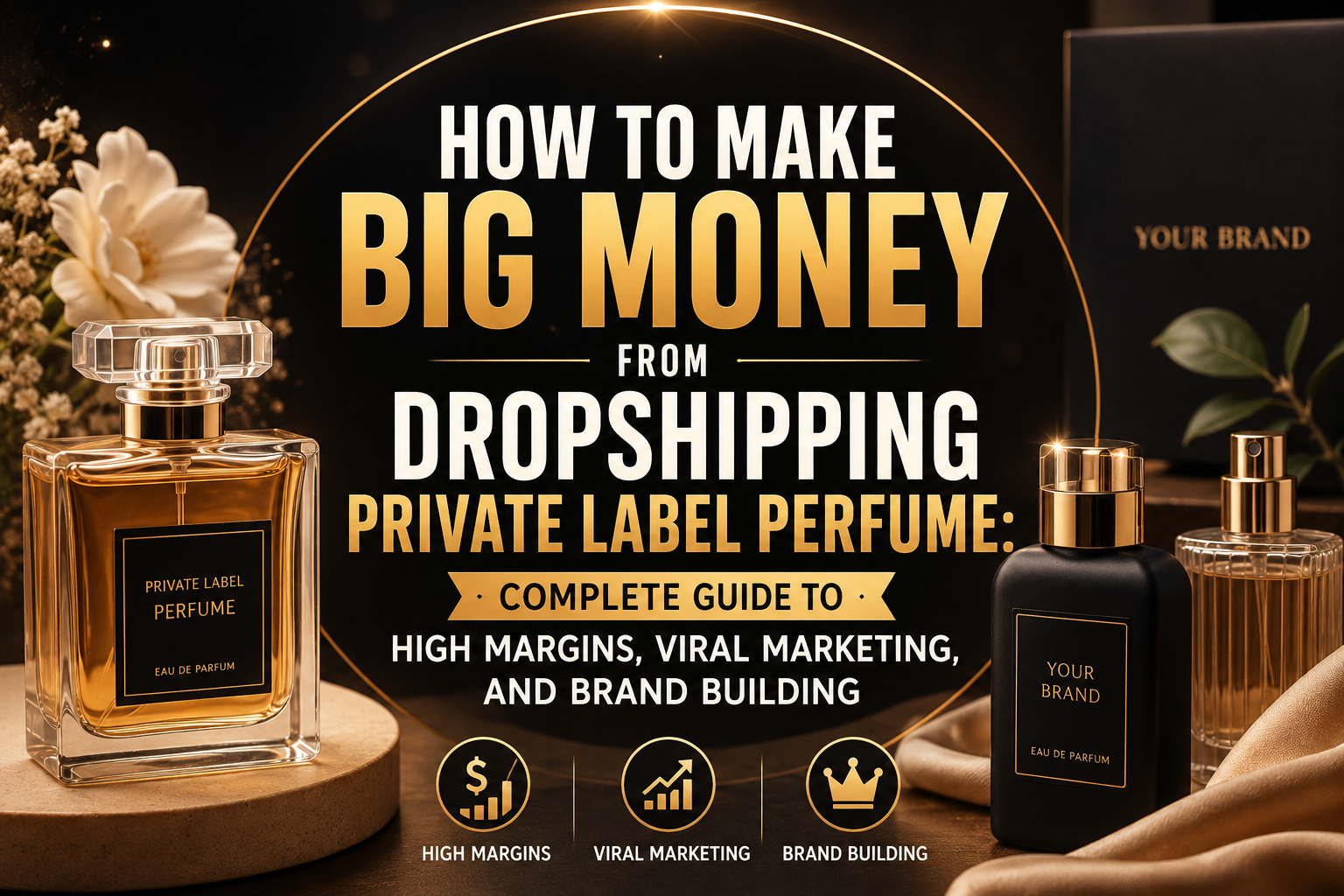
High-Margin Economics, Brand Positioning, and Scalable Profit Models
Private label perfume is one of the few dropshipping verticals where the unit economics can consistently support premium pricing and high gross margins. Unlike commodity products such as apparel or phone accessories, fragrances are perceived as emotional and identity-driven goods, which allows sellers to decouple price from production cost more effectively.
In typical sourcing scenarios, a private label perfume bottle (50ml–100ml) can be manufactured and packaged for $3–$8 per unit depending on fragrance oil quality, bottle design, and packaging complexity. However, the retail price in Western markets such as the US, UK, and EU often ranges from $29 to $120+ per bottle. This creates a gross margin structure commonly between 70% and 92%, significantly higher than standard dropshipping categories that often operate in the 20%–40% range.
The key driver behind this margin expansion is not manufacturing cost reduction, but brand perception engineering. Consumers rarely evaluate perfume based on raw material cost. Instead, they evaluate scent identity, packaging aesthetics, and brand storytelling. This allows dropshippers to position a low-cost product as a premium lifestyle item.
2. Why Private Label Perfume Has Structural Pricing Power
Perfume belongs to a category where sensory evaluation is delayed. Customers cannot fully assess value until after purchase, which creates room for strong branding influence at the conversion stage. This is fundamentally different from categories like electronics where specifications are transparent.
This delay in product verification creates what economists often describe as perceived value elasticity. In practice, this means that a product costing under $10 to produce can sustain a retail price above $50 if the branding narrative is strong enough.
Additionally, repeat purchase behavior plays a major role. Industry benchmarks show that fragrance products have a 20%–35% repurchase rate when customers associate the scent with identity or lifestyle alignment. This makes customer lifetime value (LTV) significantly higher than one-time dropshipping categories.
When LTV increases, advertisers can afford higher customer acquisition costs (CAC), which further supports aggressive scaling in paid channels like Meta Ads, TikTok Ads, and influencer partnerships.
3. Unit Economics and Realistic Profit Breakdown
A simplified but realistic dropshipping economics model for private label perfume looks like this:
- Product cost (manufacturing + packaging): $5
- Shipping & fulfillment: $3–$6
- Total landed cost: ~$10–$11
If the product is sold at $49:
- Revenue: $49
- Cost: ~$11
- Gross profit: ~$38
- Gross margin: ~77%
At scale, the real profitability depends less on product margin and more on advertising efficiency. If CAC (customer acquisition cost) is maintained at $15–$25 per customer, net profit per order can still remain in the $10–$20 range, which is considered strong for a consumer e-commerce product.
High-performing brands push even further by introducing bundles (e.g., “2 scents for $79”), increasing average order value (AOV) and reducing relative CAC impact.
4. Why This Model Attracts Aggressive Scaling Potential
Unlike low-margin dropshipping products that collapse under ad pressure, private label perfume benefits from compounding economics. Once a winning scent and creative angle are identified, scaling ad spend does not proportionally degrade profitability.
This is because:
- Creative fatigue is slower in lifestyle branding compared to utility products
- Emotional buying reduces price sensitivity
- Repeat purchase reduces reliance on constant new customer acquisition
As a result, brands can transition from simple dropshipping operations to full DTC fragrance labels with stable cash flow.
Winning Fragrance Selection, Market Demand Signals, and Viral Product Positioning Strategy
In private label perfume dropshipping, product selection is not just a sourcing decision—it directly determines the maximum revenue potential of the entire business. Even with strong branding and ads, the wrong scent profile will cap conversion rates and destroy scaling efficiency.
Market data from fragrance e-commerce brands shows a clear concentration of demand around a few dominant scent families. Typically, vanilla-based gourmand scents, woody musk blends, and clean “fresh luxury” profiles account for over 60% of total online fragrance sales in Western markets. These categories consistently outperform niche experimental scents because they align with broad psychological preference clusters.
From a profitability standpoint, winning fragrances often achieve conversion rates between 3.5% and 6.2%, while poorly positioned scents struggle below 2%. This difference alone can double or triple revenue at the same advertising cost structure.
2. Demand Signals That Indicate a High-Profit Perfume Concept
Unlike traditional retail products, perfume demand is heavily influenced by social validation rather than technical specifications. This makes trend detection critical.
High-performing private label perfume products usually emerge from three measurable demand signals:
First is TikTok-driven scent virality, where short-form content repeatedly associates a fragrance profile with lifestyle identity (e.g., “clean girl aesthetic” or “rich vanilla scent”). Products in this category often experience sudden spikes in search volume growth of 200%–800% within 30–60 days.
Second is search intent clustering, where Google Trends and keyword tools show sustained interest in phrases like “long lasting vanilla perfume” or “luxury dupe fragrance.” These keywords often convert at significantly higher rates because they reflect purchase-ready intent rather than curiosity.
Third is competitor saturation imbalance, where demand is high but branded supply is fragmented. This creates a pricing gap where private label sellers can position themselves between low-cost dupes and high-end designer fragrances priced above $120.
3. How Viral Positioning Converts a Basic Perfume into a High-Margin Product
The most profitable private label perfume dropshipping brands do not sell fragrance—they sell identity narratives. A $6 cost perfume becomes a $59 product not because of scent complexity, but because of positioning structure.
For example, positioning a fragrance as a “luxury minimalist office scent” immediately increases perceived value because it anchors the product in a specific lifestyle scenario. This improves ad relevance and reduces cognitive friction during purchase decisions.
Brands that successfully align fragrance naming, packaging design, and ad storytelling typically achieve 20%–40% higher average order value (AOV) compared to generic perfume listings. This increase directly improves gross profit per customer without changing production cost.
4. Market Entry Strategy Based on Demand Clusters
Instead of launching random scents, profitable operators often test multiple micro-categories in parallel. The goal is not to find one product, but to identify a scalable demand cluster.
For instance, a seller may test three directions:
- Warm gourmand scents targeting emotional comfort buyers
- Fresh aquatic scents targeting minimalist lifestyle audiences
- Woody amber scents targeting luxury masculine positioning
Each cluster behaves differently in advertising. Gourmand scents often perform better on TikTok, while woody luxury scents tend to convert better through Google Search and influencer reviews.
Once one cluster shows a consistent ROAS above 2.5–3.5, scaling becomes predictable and capital-efficient.
TikTok Ads, CAC Optimization, and High-ROAS Scaling Framework
In private label perfume dropshipping, product margins are only the first layer of profitability. The real determinant of “big money” is advertising efficiency—specifically how well you control customer acquisition cost (CAC) relative to gross margin.
With perfume products typically achieving 70%–90% gross margins, there is theoretical room for aggressive ad spending. However, in practice, most campaigns fail because CAC rises faster than conversion rate improvements.
Data from DTC fragrance brands shows that profitable campaigns usually maintain a CAC between $12 and $28, depending on AOV. When AOV is $49–$79, maintaining CAC below 35% of revenue becomes the critical threshold for sustainable scaling.
2. TikTok as the Primary Growth Engine for Private Label Perfume
TikTok has become the dominant acquisition channel for perfume dropshipping because fragrance is highly visual and emotionally associative. Unlike search-based platforms, TikTok creates demand rather than capturing it.
Successful campaigns often rely on short-form content that emphasizes identity positioning rather than product details. Examples include “what perfume makes you smell expensive” or “clean luxury scent aesthetic.” These narratives consistently outperform traditional product ads in engagement.
Benchmarks from high-performing campaigns show that TikTok ads for fragrance can achieve:
- CTR between 1.8% and 4.5%
- Conversion rates between 2.5% and 5%
- ROAS ranging from 2.0x to 5.5x in winning creatives
However, performance is highly dependent on creative iteration speed. Brands that test 10–20 new creatives per week significantly outperform those relying on static ad sets.
3. CAC Optimization Through Creative-Led Scaling
Unlike Google Ads, where keyword intent drives efficiency, TikTok advertising relies heavily on creative fatigue cycles. This makes content production the core lever of CAC control.
The most effective strategy used by profitable perfume dropshippers is “creative stacking,” where multiple angles of the same product are tested simultaneously:
- Lifestyle transformation angle (before vs after “smelling expensive”)
- Emotional storytelling angle (confidence, attraction, identity shift)
- Product aesthetic angle (bottle design, packaging luxury cues)
When a winning creative emerges, CAC can drop by 30%–60% within the same ad account, simply through algorithmic preference reinforcement.
This is why top operators treat creative production as an inventory system rather than a marketing task.
4. Scaling Structure: From Testing to Predictable ROAS Growth
Scaling private label perfume ads requires a structured transition from exploration to exploitation. Most failures occur when brands scale too early without creative validation.
A typical profitable structure looks like this:
In the testing phase, small budgets are distributed across multiple creatives to identify winners. Once a creative achieves a ROAS above 2.5x with stable conversion rates, it enters the scaling phase.
During scaling, budget is increased gradually while maintaining creative variation to avoid fatigue. Mature campaigns often stabilize at 3.0x–4.5x ROAS, depending on market and pricing strategy.
At this stage, gross margins of 75%+ allow reinvestment into ad scaling while still maintaining net profitability.
Why Long-Term Profit in Perfume Comes from Brand, Not First Sale
In private label perfume dropshipping, most beginners focus heavily on acquisition and first-order profit. However, the real “big money” is generated after the first purchase through brand-driven retention and customer lifetime value (LTV) expansion.
While a single perfume sale may generate 70%–90% gross margin at the product level, the true profitability emerges when customers return multiple times. Industry benchmarks show that fragrance brands with strong branding systems can achieve a repeat purchase rate of 25%–40% within 90–180 days, significantly increasing total revenue per customer.
This shift from transactional selling to brand-based selling is what separates short-term dropshipping operations from scalable DTC fragrance businesses.
2. The Role of Brand Premium in Expanding Price Elasticity
Private label perfume has a unique advantage: it is highly sensitive to emotional branding but relatively insensitive to production cost transparency. This allows sellers to establish strong price premiums without changing underlying manufacturing economics.
For example, a perfume that costs around $6–$10 to produce and fulfill can be positioned at retail prices between $49 and $89, depending on brand perception strength. Stronger brands can push this even higher, with niche luxury positioning reaching $120+ per bottle.
This pricing flexibility is what creates scalable profit structures. A 10–15 dollar increase in perceived brand value often translates directly into gross profit expansion without any cost change. In some cases, improving packaging and storytelling alone can increase conversion rates by 20%–35%, even at higher price points.
3. DTC Retention Systems That Multiply Customer Lifetime Value
The most profitable private label perfume operators build systems designed to extend customer engagement beyond the first purchase. This is typically achieved through owned channels such as email marketing, SMS automation, and retargeting funnels.
Once a customer enters the ecosystem, the goal is to maximize their lifetime exposure to additional scent products, limited editions, and bundle offers. Data from DTC fragrance brands shows that customers exposed to structured retention flows generate 1.8x to 3.2x higher LTV compared to one-time buyers.
For instance, post-purchase email sequences introducing complementary scents or seasonal collections can increase second-purchase probability by over 15% within 60 days. SMS campaigns often perform even stronger due to higher open rates, particularly in impulse-driven fragrance categories.
The key principle is simple: acquisition creates revenue, but retention creates profit scalability.
4. Bundling and Product Line Expansion as Profit Multipliers
Another critical driver of LTV expansion is strategic bundling. Instead of relying on single-bottle transactions, high-performing brands introduce multi-product offers that increase average order value (AOV) while reinforcing brand immersion.
For example, a “signature trio set” priced at $79–$99 can significantly outperform single-unit sales in both margin and customer stickiness. Even if per-unit cost remains constant, bundling improves shipping efficiency and reduces relative CAC impact, effectively increasing net margin per order.
Additionally, expanding into complementary product lines such as travel-size perfumes, discovery sets, or seasonal limited editions helps create repeat purchase cycles. This product ecosystem approach transforms a simple dropshipping store into a recurring revenue brand.
Supply Chain Control, Quality Consistency, and Profit Stability Strategy
In private label perfume dropshipping, most people underestimate the supply chain because they focus on marketing and branding. However, long-term profitability is heavily determined by consistency in manufacturing quality, not just acquisition performance.
Even if gross margins remain high—typically between 70% and 90%—profit can collapse quickly when product quality fluctuates. Unlike low-involvement products, perfume is a highly sensory category. A slight variation in scent strength, alcohol balance, or longevity can lead to a disproportionate increase in refund rates and negative reviews.
Industry data from DTC fragrance brands shows that a 1%–3% increase in defect or dissatisfaction rates can reduce net profit by 15%–40%, mainly due to refunds, chargebacks, and ad account inefficiencies caused by lower conversion rates.
2. Manufacturing Consistency as a Hidden Profit Multiplier
Private label perfume production typically involves fragrance oils, alcohol bases, blending processes, and packaging assembly. Each step introduces variability risk, especially when working with low-cost or unverified suppliers.
High-performing operators prioritize suppliers that can maintain batch consistency across large production runs. This is because customer perception in fragrance is extremely sensitive to deviation. If the second batch smells slightly different from the first, repeat purchase rates can drop significantly.
From a financial perspective, maintaining consistent formulation can increase repeat purchase rates by 20%–35%, which directly improves LTV and reduces dependency on paid acquisition channels.
This is why experienced brands often invest in small-scale pre-production testing before scaling inventory orders, even in a dropshipping model.
3. Return Rate Economics and Their Impact on Gross Margin Reality
While perfume dropshipping is often promoted as a high-margin business, real profitability must account for returns and replacements.
A typical healthy return rate in well-managed fragrance DTC operations is around 3%–8%, but poorly controlled supply chains can push this above 15%. When that happens, effective gross margin can drop from 80% to below 60%, even if product pricing remains unchanged.
Returns are particularly damaging because they create a double cost structure: lost revenue from refunds and additional logistics expenses for handling and reshipping. At scale, this creates a compounding drag on cash flow.
This is why supply chain stability is not just an operational concern—it is a direct driver of net profit sustainability.
4. Packaging, Perception, and Quality Signaling Effects
In private label perfume, packaging is not cosmetic—it is part of the product experience and a key determinant of perceived value. Poor packaging quality can reduce conversion rates even if the fragrance itself is strong.
Studies in consumer perception behavior show that premium packaging can increase willingness to pay by 15%–30%, even when product formulation remains identical. This effect is especially strong in fragrance, where visual luxury cues strongly influence expectation of scent quality.
At the same time, packaging inconsistency (such as misaligned labels, cheap atomizers, or leaking bottles) significantly increases refund probability and negative review rates, which can reduce ad efficiency and raise CAC over time.
Thus, packaging acts as both a marketing asset and a risk control mechanism.
Market Competition, Brand Moat Building, and Long-Term DTC Expansion Strategy
The private label perfume dropshipping market is not a simple low-competition niche. Instead, it is a layered ecosystem with three dominant competitive tiers: low-cost generic resellers, mid-tier branding operators, and high-end DTC fragrance brands.
At the bottom level, generic dropshippers compete primarily on price, often selling perfumes at $15–$30 retail with thin 20%–40% gross margins. These businesses struggle to scale because they lack differentiation and are highly vulnerable to ad cost fluctuations.
The mid-tier segment is where most private label operators exist. Here, products are positioned at $39–$79 price points, with 70%–85% gross margins, and competition is primarily driven by advertising efficiency and creative execution rather than pricing alone.
At the top tier, established DTC fragrance brands operate with strong identity positioning, achieving premium pricing above $80–$150 per bottle while maintaining high repeat purchase rates and brand loyalty.
2. Why Branding Creates a Sustainable Competitive Moat
In perfume dropshipping, product duplication is extremely easy. Any competitor can replicate scent profiles, packaging styles, or even supplier relationships. This makes traditional product-based differentiation weak.
The only defensible advantage is branding. Strong fragrance brands create emotional and psychological associations that cannot be easily copied. This includes scent storytelling, identity positioning, and consistent visual language across marketing channels.
Brands with strong identity alignment can maintain 30%–50% higher customer retention rates compared to generic competitors. This retention gap compounds over time, creating a structural advantage in LTV and reducing reliance on paid ads.
In financial terms, branding acts as a margin stabilizer. Even when CAC increases, strong brands maintain profitability because conversion rates and repeat purchases remain resilient.
3. From Dropshipping to DTC Brand: The Evolution Path
The most successful private label perfume businesses do not remain in a pure dropshipping model. Instead, they evolve into full DTC (Direct-to-Consumer) fragrance brands with owned infrastructure.
This evolution typically happens in three stages.
The first stage is validation through dropshipping, where operators test scent demand, ad creatives, and conversion behavior without holding inventory risk. Gross margins here are high but unstable.
The second stage is hybrid scaling, where winning products are partially stocked to improve fulfillment speed, packaging control, and customer experience. At this stage, return rates often drop by 20%–30%, and conversion rates improve due to faster delivery.
The third stage is full brand ownership, where companies invest in proprietary scent lines, exclusive packaging design, and long-term customer ecosystems. This stage enables predictable revenue growth and stronger pricing power.
4. Market Saturation vs Opportunity Gaps
Although competition is increasing, the perfume market still contains significant opportunity gaps. The key gap is not in product availability, but in positioning fragmentation.
Most competitors fail to occupy clear identity-based niches. For example, “luxury vanilla aesthetic,” “clean girl fragrance,” or “dark woody confidence scent” are often underdeveloped despite high search demand.
These micro-positioning gaps allow new entrants to achieve strong ROAS early on, especially when paired with TikTok-driven demand creation. In many cases, brands entering these gaps achieve 2.5x–4.0x ROAS within the first 30–60 days of scaling, provided creative execution is strong.
However, sustaining this advantage requires rapid reinvestment into brand building, not just ad scaling.

No Comments