


Is Dropshipping Homewares Profitable: 6 Proven High-Margin Models (Up to 80% Gross Profit) to Build a Viral, Scalable Ecommerce Brand

Personalized home decor stands out as one of the most reliable ways to make big money in dropshipping homewares. With gross margins consistently between 55% and 75%, strong emotional appeal, and built-in brand potential, this niche offers both short-term profitability and long-term scalability.
For sellers willing to invest in creative storytelling and customer experience, it is not just a product category—it is a foundation for building a durable ecommerce brand.
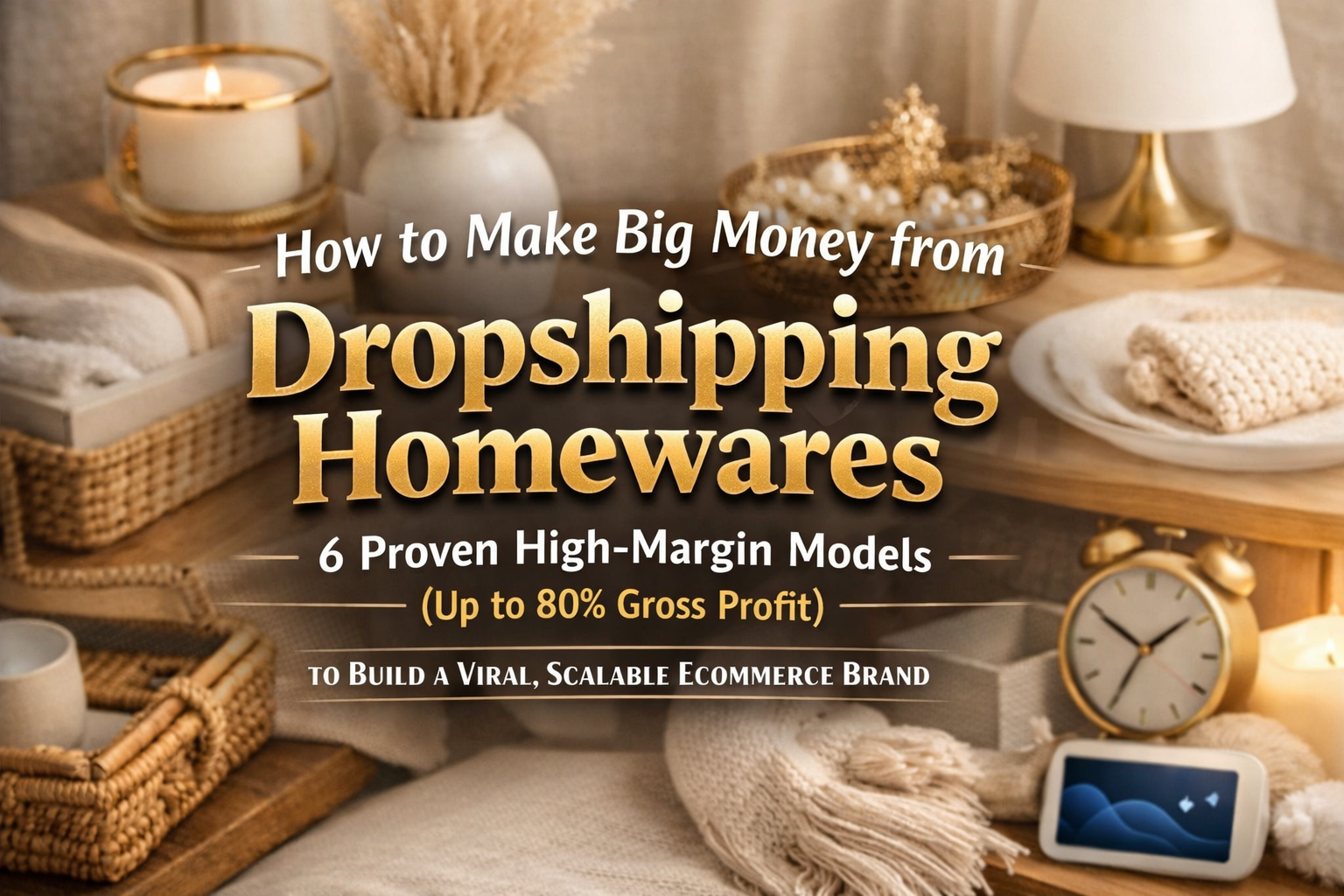
How to Make Big Money from Dropshipping Personalized Home Decor
Among all homeware categories, personalized home decor consistently delivers the highest gross margins, typically ranging from 55% to 75%, with top-performing stores even pushing beyond 80% when branding is strong. The reason is simple but powerful: personalization removes direct price competition. When a product includes a customer’s name, date, or meaningful message, it becomes unique and emotionally anchored, making it almost impossible to compare with alternatives.
From a cost perspective, most print-on-demand or light customization products—such as LED name signs, canvas prints, or engraved plaques—range between $8 and $20 to produce. Yet, they are commonly sold for $29 to $79, depending on perceived value, design quality, and niche targeting. This pricing flexibility is what allows sellers to scale profitably even with rising ad costs.
The Psychology Behind High Conversion Rates
Personalized home decor taps into emotional buying triggers rather than functional needs. Customers are not simply purchasing a decorative item; they are buying a story, a memory, or a sense of identity. This is especially evident in key life moments such as weddings, anniversaries, housewarmings, and newborn celebrations.
Data from ecommerce conversion studies shows that emotionally driven products can achieve conversion rates 20%–40% higher than standard home decor items. In addition, refund rates tend to be significantly lower, often below 3%, because personalized products are perceived as non-returnable and highly specific to the buyer.
This emotional leverage also enables more aggressive pricing strategies. For example, a customized family name sign that costs $12 can comfortably sell at $49 or higher when supported by strong visual storytelling and social proof.
Scalable Business Models: Print-on-Demand vs. Private Sourcing
There are two primary ways to scale personalized home decor in dropshipping. The first is print-on-demand, which offers low upfront risk and easy product expansion. Platforms integrate seamlessly with ecommerce stores, allowing automatic fulfillment. While margins may be slightly lower due to platform fees, they still remain in the 50%–65% range.
The second model is private sourcing through suppliers, where you can negotiate lower unit costs at scale. This approach increases margins to 60%–75%, especially when bundling products or offering premium packaging. However, it requires tighter quality control and longer testing cycles.
Advanced sellers often transition from print-on-demand to private sourcing once a product is validated, effectively combining speed with profitability.
Creative Strategy: Turning Products into Stories
The success of personalized home decor depends heavily on creative execution. High-performing stores rarely focus on product features; instead, they build narratives around relationships and milestones. For instance, a simple canvas print becomes far more compelling when framed as “The Night We Met” or “Our First Home Together.”
Short-form video platforms amplify this effect. Ads that show the customization process, unboxing reactions, or before-and-after room transformations can dramatically increase engagement and click-through rates. In many cases, a single viral video can generate thousands of orders within days.
This storytelling approach also supports higher average order value. By offering complementary items—such as matching wall art or bundled gift sets—stores can increase AOV by 20%–50% without significantly raising acquisition costs.
Long-Term Advantage: Brand Building and Customer Lifetime Value
Unlike generic dropshipping products, personalized home decor naturally lends itself to brand building. Customers who purchase once for a special occasion are highly likely to return for future events. This creates a compounding effect on customer lifetime value (LTV), which can exceed 2x–3x the initial purchase value.
Email marketing and retargeting play a crucial role here. By segmenting customers based on purchase type (e.g., wedding, baby, home), sellers can promote relevant future products at the right time, significantly increasing repeat purchase rates.
Over time, this transforms a simple dropshipping store into a brand-driven ecommerce business with stable revenue and reduced dependence on paid ads.
How to Make Big Money from Dropshipping Home Organization Products
Home organization products have quietly become one of the most scalable and profitable segments within dropshipping homewares, consistently delivering gross margins between 50% and 70%. Unlike decorative items that rely heavily on taste, organization products solve universal problems—clutter, inefficiency, and lack of space—which makes them easier to market across broad audiences.
Typical cost structures are highly favorable. Many products such as acrylic storage bins, drawer dividers, or pantry containers can be sourced for $3 to $12, while retail prices range from $15 to $39. More importantly, these products are rarely purchased individually. Customers tend to buy in sets, which increases average order value (AOV) significantly without increasing acquisition costs proportionally.
This combination of low cost, high perceived utility, and natural bundling makes organization products one of the most efficient profit engines in ecommerce.
The Viral Effect: Why These Products Explode on Short-Form Video
The real growth driver behind this niche is visual transformation. Organization products perform exceptionally well on platforms like TikTok and Instagram because they lend themselves to clear “before and after” storytelling. A cluttered drawer transformed into a perfectly arranged space creates an immediate sense of satisfaction, which drives both engagement and conversions.
Data from performance marketing campaigns shows that transformation-based creatives can improve click-through rates by 30%–80% compared to static product ads. In some cases, cost per acquisition (CPA) drops by over 25%, simply because the product demonstrates its value instantly without requiring explanation.
This visual clarity also shortens the decision-making process. Customers do not need to imagine the benefit—they see it within seconds. As a result, conversion rates for well-executed creatives in this niche often reach 3%–5%, significantly higher than many other homeware categories.
Bundling Strategy: The Key to Maximizing Profit
One of the most overlooked advantages of home organization products is their natural compatibility with bundling. Instead of selling a single item for $19, successful stores package multiple units or complementary products into sets priced at $39, $59, or even higher.
For example, a kitchen organization bundle might include labeled jars, measuring tools, and storage racks. While the combined cost may only be $12–$18, the perceived value of a complete solution allows for pricing above $49, pushing gross margins back into the 60%–70% range even after offering discounts.
This strategy not only increases revenue per customer but also improves ad efficiency. Higher AOV means more room to absorb advertising costs while maintaining profitability.
Consumer Behavior: Repeat Purchases and Expansion Potential
Organization is not a one-time need—it is an ongoing process. Customers who purchase solutions for one area of their home, such as the kitchen, are highly likely to return for other spaces like closets, bathrooms, or workstations. This creates a strong opportunity for repeat purchases and cross-selling.
Retention data in this niche often shows repeat purchase rates of 20%–35% within 60–90 days, especially when supported by email marketing and post-purchase flows. By segmenting customers based on their initial purchase category, stores can recommend relevant follow-up products, effectively increasing lifetime value without additional acquisition costs.
This repeat behavior is a critical factor in building a sustainable business rather than relying solely on one-time viral wins.
Operational Simplicity and Low Risk
From an operational standpoint, organization products are relatively low risk compared to other categories. They are typically lightweight, durable, and less prone to returns or damage during shipping. Return rates often stay below 5%, which helps protect margins and simplifies logistics.
In addition, these products are not trend-dependent in the same way fashion items are. While certain designs may go viral, the underlying demand for organization remains stable year-round, providing consistent revenue opportunities.
How to Make Big Money from Dropshipping Luxury-Look Homewares
Luxury-look homewares represent one of the most strategically powerful niches in dropshipping because they are built entirely on perceived value rather than intrinsic cost. Products in this category are designed to look expensive—marble textures, gold accents, minimalist European aesthetics—but are manufactured at a fraction of the price.
This gap between perception and cost is what enables consistent gross margins of 60% to 75%, sometimes even higher when branding and presentation are executed effectively. For example, a decorative tray with a marble finish may cost $7 to $15 to source, yet can be sold for $35 to $79 depending on positioning and visual storytelling.
Unlike functional products, customers in this segment are not buying utility—they are buying status, ambiance, and identity. This makes pricing far more flexible and less sensitive to competition.
Why High Perceived Value Reduces Price Sensitivity
In traditional ecommerce, price comparison is a major constraint. However, luxury-look homewares operate differently. Because these products are often marketed through curated aesthetics rather than technical specifications, direct comparisons become difficult for the average consumer.
Research in consumer psychology shows that when a product is associated with premium visuals and lifestyle branding, willingness to pay can increase by 20%–50%, even if the underlying product is identical to lower-priced alternatives. This is particularly true in home decor, where purchasing decisions are heavily influenced by aspiration and emotion.
As a result, conversion rates remain stable even at higher price points, typically ranging from 2.5% to 4% for well-optimized stores, while maintaining strong margins.
Visual Branding: The Core Growth Lever
Success in this niche depends less on product selection and more on how the product is presented. High-performing stores invest heavily in clean, editorial-style visuals that mimic luxury brands. Neutral color palettes, soft lighting, and minimalist compositions can significantly elevate perceived value.
Short-form video content also plays a critical role. Instead of focusing on product features, effective creatives showcase lifestyle integration—how a space looks and feels after adding the product. This subtle shift from “what it is” to “how it transforms your home” can increase engagement rates by 40% or more.
In many cases, the same product can generate vastly different results depending on branding quality. A poorly presented item may struggle to sell at $25, while the same item, positioned correctly, can succeed at $59 or higher.
Upselling and Product Pairing for Higher AOV
Luxury-look homewares are particularly well-suited for upselling because customers are often trying to create a cohesive aesthetic rather than purchase a single item. This creates natural opportunities for product pairing.
For instance, a minimalist vase can be bundled with matching decorative objects or artificial flowers to form a complete set. While the combined cost may only increase by $5–$10, the bundle can be priced $20–$40 higher, maintaining margins in the 65%+ range.
This approach not only increases average order value but also reinforces the brand’s premium positioning by offering curated solutions rather than standalone products.
Low Return Rates and Operational Efficiency
Another advantage of this niche is operational stability. Luxury-look items are generally simple in function, which reduces the likelihood of defects or customer dissatisfaction. Return rates typically remain below 4%, significantly lower than categories like apparel.
Additionally, these products often have a longer lifecycle. Unlike trend-driven items that fade quickly, minimalist and luxury-inspired designs tend to remain relevant over time, allowing for sustained sales without constant product replacement.
This stability is essential for scaling, as it reduces the need for continuous testing and minimizes operational complexity.
Long-Term Strategy: Transitioning to a Brand
Luxury-look homewares provide an ideal foundation for transitioning from a generic dropshipping store to a recognizable brand. Because the niche already relies on aesthetics and identity, it is easier to build a cohesive brand narrative around it.
As customer trust grows, stores can introduce private labeling, premium packaging, and even limited collections, further increasing perceived value and margins. Over time, this can push gross margins beyond 75% while also improving customer retention.
How to Make Big Money from Dropshipping Eco-Friendly Homewares
Eco-friendly homewares have evolved from a niche preference into a mainstream consumer movement, driven by increasing environmental awareness and shifting purchasing behavior. This category consistently delivers gross margins between 45% and 65%, with higher margins achievable through strong branding and product positioning.
Typical products such as bamboo kitchen tools, reusable cleaning cloths, or plastic-free storage solutions are sourced at $4 to $15 and sold between $18 and $45. While margins may appear slightly lower than luxury decor, the real advantage lies in customer loyalty and repeat purchases, which significantly increase long-term profitability.
Consumers in this segment are not just buying products—they are buying into a value system. This fundamentally changes how pricing, marketing, and retention work.
Price Elasticity: Why Eco Consumers Accept Higher Prices
One of the most important economic characteristics of eco-friendly products is reduced price sensitivity. Studies in sustainable commerce show that over 60% of consumers are willing to pay a premium for environmentally responsible products, especially when transparency and authenticity are present.
This allows sellers to maintain healthy margins even when sourcing costs are higher. For example, a set of reusable kitchen wraps costing $9 can be sold at $29 or more when positioned as a long-term alternative to disposable products. The perceived savings over time further justifies the upfront cost.
Conversion rates in this niche typically range from 2% to 4%, but average order values and lifetime value often exceed those of non-branded dropshipping stores.
Branding as the Primary Growth Engine
Unlike many other dropshipping categories, eco-friendly homewares are inherently brand-driven. Customers are more likely to trust and purchase from stores that communicate a clear mission, consistent values, and transparent sourcing practices.
This shifts the business model away from pure performance marketing and toward brand equity building. Elements such as sustainable packaging, carbon-neutral messaging, and educational content can significantly enhance perceived value.
Data from ecommerce retention benchmarks shows that brands with a clear sustainability message can achieve repeat purchase rates of 25%–40%, compared to 10%–20% in more generic niches. This has a direct impact on profitability by reducing reliance on paid acquisition.
Content Strategy: Education Drives Conversion
Marketing in this niche is less about aggressive selling and more about education. High-performing stores focus on explaining why their products matter—how they reduce waste, replace disposable alternatives, or contribute to a healthier lifestyle.
Content formats such as “before vs. after waste reduction,” product lifecycle explanations, and sustainability tips tend to outperform traditional ads. These approaches can increase engagement rates by 30%–50%, while also building trust with the audience.
Long-form content, including blog posts and email sequences, is particularly effective. It not only improves SEO rankings but also nurtures customers over time, leading to higher conversion rates on repeat visits.
Product Ecosystem and Lifetime Value Expansion
Eco-friendly homewares naturally lend themselves to ecosystem building. A customer who purchases one sustainable product is highly likely to adopt others as part of a broader lifestyle shift.
For example, a buyer of reusable kitchen items may later purchase eco cleaning tools, bathroom products, or storage solutions. This creates multiple cross-selling opportunities and drives customer lifetime value to 2x–3x the initial purchase.
Bundles are especially effective in this context. A “zero-waste starter kit” combining several products can be priced significantly higher than individual items while maintaining margins in the 50%–65% range.
Operational Considerations and Trust Factors
While the niche is profitable, it also requires greater attention to authenticity. Misleading claims or low-quality products can quickly damage credibility. As a result, supplier selection and product verification are critical.
Return rates are generally low, often under 5%, but customer expectations are higher. Clear communication about materials, sourcing, and usage is essential to maintain satisfaction and protect brand reputation.
In addition, certifications or verifiable claims—even if basic—can improve conversion rates by reinforcing trust.
How to Make Big Money from Dropshipping Smart Home Gadgets
Smart and functional home gadgets occupy a unique position in the homewares market because they are driven by clear problem–solution dynamics. Unlike decor-focused products that rely on taste, these items address specific pain points such as convenience, hygiene, or efficiency. This makes them significantly easier to sell, especially in performance-driven advertising environments.
From a financial perspective, this category consistently achieves gross margins between 50% and 65%. Common products like automatic soap dispensers, motion-sensor lights, or multi-functional kitchen tools typically cost between $6 and $20, while retail prices range from $25 to $60. The relatively wide pricing spread allows sellers to remain profitable even with fluctuating ad costs.
More importantly, these products benefit from high conversion efficiency because the value proposition is immediately clear to the customer.
The Conversion Advantage of Demonstration-Based Marketing
The primary growth driver for smart home gadgets is their compatibility with demonstration-based content. Unlike static products, these items can visually prove their usefulness within seconds. A short video showing a motion sensor light activating in a dark hallway or a kitchen tool reducing prep time creates instant understanding.
Performance data from ecommerce advertising indicates that demo-style creatives can increase conversion rates by 25%–60% compared to non-demonstrative ads. Click-through rates also tend to improve significantly, often exceeding 2%–3%, because users quickly grasp the benefit without needing additional explanation.
This efficiency directly lowers customer acquisition costs, making it easier to scale campaigns while maintaining profitability.
Impulse Buying Behavior and Pricing Strategy
Smart home gadgets often fall into the category of “affordable problem solvers,” which makes them ideal for impulse purchases. When priced within the $25 to $50 range, customers are more likely to make quick decisions without extensive comparison.
This pricing strategy aligns well with the underlying cost structure. For example, a product sourced at $10 can be sold at $39, achieving a gross margin above 60% while still appearing affordable to the end consumer.
Limited-time offers, discounts, and urgency-driven messaging further amplify this effect. In many cases, these tactics can increase conversion rates by 10%–20%, especially when combined with strong visual demonstrations.
Product Selection: Simplicity Over Complexity
One critical success factor in this niche is product simplicity. While “smart” devices may suggest advanced technology, the most profitable items are often those that are easy to understand and use. Overly complex products with complicated setups tend to generate higher return rates and customer support issues.
High-performing stores focus on products with:
- Immediate visual impact
- Minimal setup requirements
- Clear, single-purpose functionality
By prioritizing simplicity, sellers can keep return rates below 5% and maintain operational efficiency.
Scaling Through Product Variations and Upsells
Another advantage of smart home gadgets is their scalability through variations and complementary products. A single winning product can often be expanded into multiple versions—different colors, sizes, or upgraded features—without significantly increasing sourcing complexity.
Upselling also plays a key role. For example, offering a “buy 2, get 1 free” deal or bundling related items can increase average order value by 15%–30%, while still maintaining margins in the 55%–65% range.
This approach allows sellers to maximize revenue from each customer without increasing acquisition costs.
Operational Efficiency and Global Demand
Smart home gadgets benefit from broad, global appeal. The problems they solve—such as saving time or improving convenience—are universal, making them suitable for multiple markets without significant localization.
Logistically, these products are typically compact and lightweight, which helps reduce shipping costs and delivery times. Combined with relatively low defect rates, this contributes to stable operations and predictable margins.
How to Make Big Money from Dropshipping Seasonal Home Decor
Seasonal home decor is one of the most overlooked yet highly lucrative segments in dropshipping homewares. Unlike evergreen niches that rely on steady demand, this category benefits from intense, time-bound purchasing behavior, allowing sellers to generate rapid revenue spikes within short periods.
Financially, seasonal products often deliver gross margins between 60% and 80%, among the highest in the entire homewares space. Items such as holiday lights, themed table decorations, or festive ornaments typically cost $2 to $10 and sell for $15 to $45. Because demand is driven by urgency rather than necessity, customers are significantly less price-sensitive during peak periods.
This dynamic creates an environment where aggressive pricing, high ad spend, and fast scaling can coexist profitably.
Consumer Psychology: Urgency Overrides Price Sensitivity
The key driver behind this niche is psychological urgency. Seasonal events—such as Christmas, Halloween, or Thanksgiving—have fixed deadlines. If customers do not purchase in time, the opportunity disappears entirely. This creates a natural pressure to act quickly.
Ecommerce data shows that during peak seasonal windows, conversion rates can increase by 30%–70% compared to off-season averages. At the same time, cart abandonment rates tend to decrease, as customers are more decisive and less likely to delay purchases.
This urgency also enables higher pricing flexibility. A product that might struggle to sell at $19 year-round can successfully sell at $29 or higher during a holiday period, pushing margins well above 70%.
Short-Term Scaling: Maximizing Return on Ad Spend
Seasonal home decor is uniquely suited for short-term, high-intensity advertising strategies. Instead of building campaigns slowly, sellers can scale aggressively within a narrow time frame, often achieving strong returns on ad spend (ROAS) in just a few weeks.
Performance benchmarks indicate that well-timed campaigns in this niche can achieve ROAS of 3x to 6x, particularly when creatives align closely with current trends or viral themes. This makes it possible to reinvest profits quickly and dominate a specific seasonal window.
However, timing is critical. Successful sellers typically launch campaigns 4–8 weeks before the peak holiday, allowing enough time to test creatives, optimize targeting, and scale winning ads before competition intensifies.
Product Strategy: Trend Alignment and Rapid Testing
Unlike evergreen niches, product selection in seasonal decor is heavily influenced by trends. Designs, colors, and themes change each year, which requires continuous testing and adaptation.
Winning products often share three characteristics:
- Strong visual appeal in social media feeds
- Clear association with a specific holiday or event
- Emotional or nostalgic resonance
Because product lifecycles are short, speed becomes a competitive advantage. Sellers who can identify and launch trending items quickly are more likely to capture early demand and achieve higher margins before the market becomes saturated.
Inventory Risk vs. Dropshipping Flexibility
One of the traditional risks of seasonal products is unsold inventory after the holiday passes. However, dropshipping largely eliminates this risk by allowing sellers to operate without holding stock.
This flexibility enables rapid experimentation across multiple products without significant financial exposure. Even if some items fail to perform, the cost is limited to advertising spend rather than unsold inventory.
Return rates are also relatively low, typically under 5%, as most purchases are low-cost and event-specific, reducing the likelihood of returns.
Extending Revenue Beyond a Single Season
While individual products may have short lifespans, the business model itself can be extended across the entire year by rotating through different holidays and events. For example, a store can transition from Valentine’s Day to Easter, then to Halloween and Christmas, maintaining continuous revenue streams.
Customer data collected during one season can also be leveraged for future campaigns. Retargeting previous buyers with new seasonal offers can improve conversion rates and reduce acquisition costs over time.
This cyclical approach transforms a seemingly short-term strategy into a repeatable and scalable system.




No Comments