


Is Dropshipping Custom Watches Profitable: 6 High-Margin Strategies (50%–80% Gross Profit) to Build a Scalable Premium Brand in 2026

If your goal is to master how to make big money from dropshipping custom watches, personalized luxury positioning is not optional—it is foundational. By combining emotional branding, strategic pricing, and low-cost customization, you create a business model where margins expand naturally instead of being squeezed by competition.
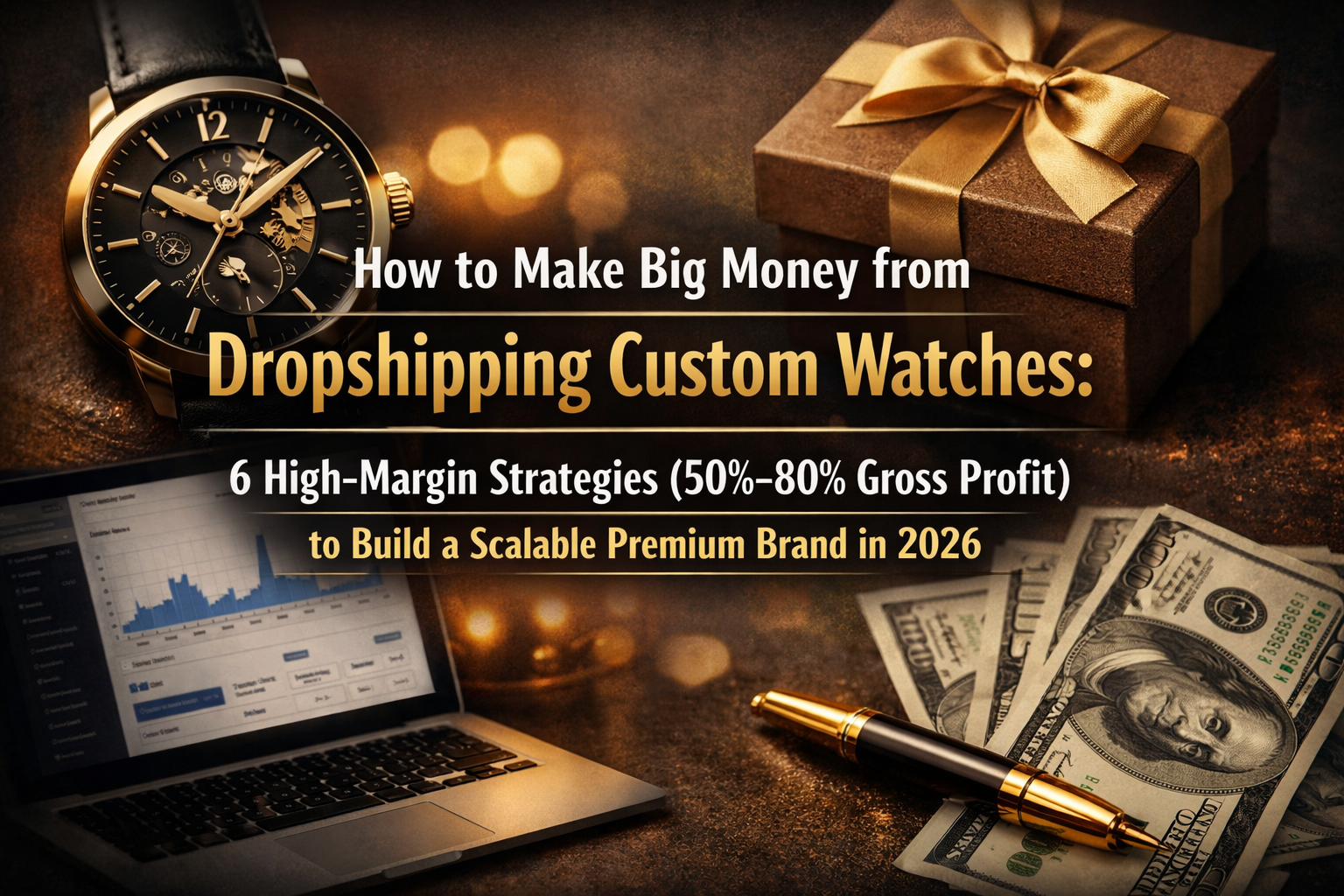
How to Make Big Money from Dropshipping Custom Watches with Personalized Luxury Positioning
If you want to understand how to make big money from dropshipping custom watches, the fastest path is not competing on price—it’s engineering perceived value. Personalized luxury positioning allows you to transform a $25 product into a $150 emotional purchase by shifting the buying trigger from utility to meaning.
The economics are straightforward. A typical custom watch sourced from suppliers costs between $18 and $45, depending on materials and engraving complexity. Once positioned as a premium personalized gift, the same product can retail between $89 and $249. This creates a gross margin range of 55% to 80%, even before optimization. Compared to generic fashion watches, which often operate at 30%–50% margins due to price competition, personalization introduces a structural pricing advantage.
Consumer behavior data supports this. Studies across ecommerce platforms show that personalized products can increase willingness to pay by 30% to 100%, especially in gift-driven categories. Even more importantly, conversion rates for customized products tend to be 20%–40% higher, because the purchase is tied to identity or emotional significance rather than impulse alone.
Turning a Commodity into a Premium Gift Product
The key shift is positioning. You are not selling a watch—you are selling a story. Successful stores in this space rarely emphasize technical specifications first. Instead, they lead with emotional hooks such as:
- “A timeless gift for your father”
- “Celebrate your journey together”
- “Mark the moment that changed everything”
This approach reframes the product as a keepsake rather than an accessory. Once that shift happens, price sensitivity drops significantly. A customer comparing two $30 watches behaves very differently from one choosing a meaningful $120 engraved gift.
From a unit economics perspective, adding personalization features such as engraving or custom messages typically increases cost by only $3–$8. However, it can justify a price increase of $20–$60. That delta alone can expand gross margins by an additional 10%–20%, making personalization one of the highest ROI levers in dropshipping.
Occasion-Based Marketing Drives Consistent Revenue Spikes
Another advantage of personalized luxury positioning is its alignment with predictable buying cycles. Custom watches naturally fit into high-intent occasions such as:
- Father’s Day
- Anniversaries
- Graduations
- Birthdays
- Christmas gifting seasons
During these periods, customer intent shifts from browsing to purchasing. Data from ecommerce analytics platforms shows that gift-oriented keywords can drive conversion rates above 5%–8%, compared to the typical 2%–3% baseline in general ecommerce.
This means your advertising becomes more efficient. Even if your cost per acquisition (CPA) stays constant, higher conversion rates directly improve profitability. Combined with higher average order values, your revenue per visitor can increase by 50%–150% during peak seasons.
Building a Premium Brand Without Holding Inventory
One common misconception is that “luxury positioning” requires large upfront investment. In reality, dropshipping custom watches allows you to simulate a premium brand without owning inventory.
You can achieve this by controlling three variables:
First, product presentation. High-quality mockups, lifestyle imagery, and clean product pages can elevate perceived value instantly. Second, offer structure. Including elements like “free engraving,” “premium gift box,” or “limited edition release” increases perceived exclusivity without significantly raising costs. Third, pricing psychology. Prices ending in $129 or $149 tend to perform better than lower round numbers because they reinforce premium positioning.
When executed correctly, this model allows you to maintain 60%+ gross margins while scaling with paid ads or organic traffic. More importantly, it creates brand equity, which reduces dependence on constant customer acquisition over time.
Why This Strategy Scales Better Than Low-Ticket Models
Low-ticket dropshipping relies heavily on volume and aggressive advertising. Margins are thin, competition is intense, and profitability is fragile. In contrast, personalized luxury positioning flips the equation.
With higher margins per order, you can afford higher acquisition costs, which opens access to more competitive ad channels. At the same time, the emotional nature of the product increases sharing, gifting, and repeat purchases. Over time, this compounds into a more stable and scalable business model.
In practical terms, a store selling $120 personalized watches at a 65% margin only needs a fraction of the orders required by a $30 product store to generate the same profit. This reduction in operational pressure is one of the biggest hidden advantages of this strategy.
How to Make Big Money from Dropshipping Custom Watches by Dominating Niche Audiences
If you’re serious about learning how to make big money from dropshipping custom watches, targeting “everyone” is one of the fastest ways to stay unprofitable. The most scalable and margin-rich stores are built by focusing on a clearly defined niche audience and owning that segment completely.
From a unit economics perspective, niche targeting directly improves profitability. A typical custom watch costs between $20 and $50 to source and customize. In a general store, you may only be able to sell it for $69–$99 due to intense competition, resulting in a gross margin of 40%–55%. However, when the same product is positioned specifically for a niche audience, pricing power increases significantly, allowing you to sell between $99 and $199 with a gross margin of 50%–75%.
More importantly, your marketing efficiency improves. Data from ecommerce campaigns consistently shows that niche-focused brands can reduce customer acquisition costs (CPA) by 25%–60%, simply because their messaging resonates more deeply with a specific group.
The Psychology Behind Niche Profitability
Niche audiences convert better because they feel understood. When a customer lands on a product page that speaks directly to their identity, interests, or lifestyle, the decision-making process becomes faster and less price-sensitive.
For example, a generic product page might say:
“Minimalist Custom Watch with Engraving”
But a niche-focused version could say:
“A Personalized Watch Designed for Veterans Who Value Time, Service, and Legacy”
The second version does not just describe a product—it reflects identity. This shift can increase conversion rates by 20%–40%, according to A/B testing benchmarks across Shopify stores.
In addition, niche audiences are more likely to engage with storytelling, which increases average order value and reduces bounce rates. This is especially important in the custom watch space, where emotional triggers play a central role in purchasing decisions.
High-Profit Niches That Consistently Perform
Not all niches are equal. The most profitable ones share three characteristics: strong identity, emotional connection, and clear gifting potential.
One high-performing segment is veterans and military families. Products tailored to this group often emphasize honor, service, and legacy. These emotional themes justify premium pricing and lead to strong conversion rates, especially around national holidays.
Another effective niche is fitness enthusiasts. Watches designed around discipline, progress, and performance can be positioned as symbolic tools rather than simple accessories. This allows for pricing in the $89–$149 range with solid margins.
Minimalist lifestyle consumers also represent a valuable segment. Clean design, neutral colors, and simplicity appeal to buyers who associate minimalism with sophistication. This niche often supports higher price points due to its alignment with premium aesthetics.
Across these niches, repeat purchase rates can reach 15%–30%, particularly when customers buy gifts for others within the same community.
Lower Competition, Higher Pricing Power
One of the most overlooked advantages of niche domination is reduced competition. In broad markets, you are competing against thousands of sellers offering nearly identical products. This leads to price wars and declining margins.
In contrast, niche markets are less crowded. Even when competitors exist, they often lack strong branding or consistent messaging. By building a cohesive brand around a niche, you create differentiation that cannot be easily copied.
This directly impacts your ability to maintain higher prices. Instead of competing on cost, you compete on relevance. As a result, customers are less likely to compare your product with cheaper alternatives, allowing you to sustain 10%–30% higher pricing without negatively affecting conversion rates.
Scaling Through Community and Repeat Buyers
Niche brands benefit from built-in communities. Whether it’s veterans, cyclists, entrepreneurs, or pet lovers, these groups tend to share common spaces—online forums, social media groups, and content platforms.
This creates organic growth opportunities. Customers are more likely to share products that reflect their identity, leading to word-of-mouth traffic and lower dependency on paid ads. Over time, this reduces your blended CPA and increases overall profitability.
Additionally, niche stores can expand product lines more easily. Once trust is established, you can introduce new variations, limited editions, or complementary products without starting from zero. This increases customer lifetime value (LTV), which is critical for long-term scalability.
How to Make Big Money from Dropshipping Custom Watches with High-Converting Bundle Strategies
When analyzing how to make big money from dropshipping custom watches, most beginners focus on getting more traffic. But experienced operators know that profit growth often comes from increasing revenue per customer, not just acquiring more customers.
This is where bundling becomes a high-leverage strategy.
A standard custom watch might cost $25 and sell for $89, resulting in a gross margin of around 55%. While this is already profitable, it leaves limited room for scaling, especially as advertising costs rise.
Now consider a bundle:
- Watch ($25 cost)
- إضافی表带 / strap ($5–$8 cost)
- Premium gift box ($3–$6 cost)
Total cost: ~$35–$45
Bundle selling price: $119–$199
Gross margin: 60%–78%
The key insight is that your cost increases by about $10–$15, but your selling price can increase by $40–$100. This margin expansion is what makes bundling one of the most effective profit multipliers in ecommerce.
Average Order Value (AOV) Is the Real Growth Engine
Bundling directly impacts Average Order Value (AOV), which is one of the most important metrics in scaling a dropshipping business.
Industry data shows:
- Bundles can increase AOV by 30%–120%
- Revenue per visitor can increase by 40%–100%
- Profit per order often grows faster than ad costs
For example, if your CPA is $30:
- Selling a $89 product → limited profit after ads
- Selling a $149 bundle → significantly higher net profit
Even if your conversion rate drops slightly (which often happens with higher prices), the increase in AOV usually more than compensates. This results in a higher overall return on ad spend (ROAS).
Psychological Pricing Makes Bundles Convert
Bundles work not just because of math, but because of psychology. Customers perceive bundles as “better value,” especially when framed correctly.
Instead of presenting items individually, high-performing stores position bundles like this:
- “Complete Gift Set – Save 30% Today”
- “Limited Edition Bundle with Free Engraving”
- “Upgrade to Premium Experience”
This framing shifts the focus from price to value. In A/B tests across ecommerce stores, value-framed bundles can increase conversion rates by 10%–25% compared to standard product listings.
Additionally, anchoring plays a role. Showing the “original combined price” versus the discounted bundle price creates a perception of savings, even when your margins remain high.
Bundles Reduce Decision Friction and Increase Conversions
Another overlooked benefit is that bundles simplify decision-making. Instead of forcing customers to choose multiple add-ons, you present a pre-optimized package.
This reduces friction in the buying process.
For example:
- Without bundle: customer hesitates about adding a strap or gift box
- With bundle: decision is pre-made, reducing cognitive load
This can improve checkout completion rates by 5%–15%, especially for gift-oriented purchases where customers want a complete solution.
In the custom watch niche, this is particularly powerful because many buyers are purchasing gifts. A “ready-to-gift bundle” aligns perfectly with their intent.
Operational Simplicity with Higher Margins
One concern sellers often have is operational complexity. However, modern dropshipping suppliers frequently support pre-packaged bundles or allow you to create simple SKU combinations.
Even when assembling bundles manually, the margin increase typically justifies the slight increase in operational effort.
From a financial perspective, bundles also provide a buffer against rising ad costs. As CPAs increase over time, businesses with higher AOV and margins remain profitable, while low-ticket stores struggle to survive.
This makes bundling not just a growth tactic, but a risk management strategy.
Scaling Bundles into a Premium Offer Ladder
Advanced stores don’t stop at one bundle—they create a pricing ladder:
- Basic watch ($89)
- Standard bundle ($129)
- Premium bundle ($169–$199)
This structure captures different customer segments while maximizing revenue from high-intent buyers. Data shows that 20%–40% of customers will choose higher-tier options when presented with clear value differentiation.
This tiered approach can increase total store revenue by 25%–60% without increasing traffic.
How to Make Big Money from Dropshipping Custom Watches with Print-on-Demand Design Strategies
To truly understand how to make big money from dropshipping custom watches, you need a model that balances profitability with low risk. Print-on-demand (POD) design does exactly that by removing inventory constraints while still allowing strong pricing power.
In a traditional model, holding inventory creates financial pressure and limits testing speed. With POD, each watch is produced only after an order is placed. This reduces unsold inventory risk to כמעט zero while keeping upfront costs minimal.
From a margin perspective, POD watches typically cost between $15 and $35 depending on materials and customization complexity. These products can be sold between $69 and $149, resulting in a gross margin of 50%–75%. While slightly lower than premium personalized luxury models, the key advantage lies in scalability and flexibility.
Design-Driven Sales: Turning Creativity into Revenue
In POD, the product itself is not the differentiator—the design is. This fundamentally changes how you approach ecommerce.
Instead of asking “what product should I sell,” you focus on “what design will resonate.” High-performing designs often fall into categories with built-in emotional or identity triggers:
- Zodiac and astrology themes
- Pet-based personalization
- Coordinates of meaningful locations
- Inspirational or symbolic typography
These designs work because they tap into personal identity. Data from ecommerce platforms shows that design-driven products can achieve conversion rates 15%–35% higher than generic alternatives, especially when aligned with specific audiences.
More importantly, winning designs can scale rapidly. A single viral design can generate consistent revenue without requiring product changes.
Rapid Testing Leads to Higher ROI
One of the biggest advantages of POD is the ability to test multiple concepts quickly. In traditional dropshipping, testing 10 products might require significant investment in inventory or supplier coordination. With POD, you can launch 10–20 designs in the same timeframe with minimal cost.
This speed directly impacts profitability.
For example:
- Testing 10 designs → 2 winners
- Killing underperformers quickly reduces ad waste
- Scaling winners increases overall return
In many cases, successful POD stores achieve ROAS (Return on Ad Spend) of 3x to 6x on winning designs. This is largely because the testing phase filters out low-performing concepts early, allowing budget to concentrate on proven creatives.
Creative Strategy Drives Traffic and Conversions
Unlike traditional ecommerce, where product features dominate, POD success depends heavily on creative execution. Your ads and product pages must highlight the uniqueness of the design rather than technical specifications.
High-performing creatives often include:
- Visual storytelling (what the design represents)
- Personalization previews (showing custom names or details)
- Emotional hooks (why the design matters)
Short-form video platforms amplify this effect. Demonstrating the creation or meaning behind a design can significantly increase engagement. This leads to higher click-through rates and lower acquisition costs.
Data from social commerce campaigns shows that strong creative can reduce CPA by 20%–40%, even without changing the product itself.
Scaling Winning Designs into Micro-Brands
Once a design proves successful, the next step is expansion. Instead of treating it as a one-off product, you can build a collection around the same theme.
For example:
- A successful zodiac watch design → expand into all 12 signs
- A pet-themed design → extend to different breeds
- A location-based design → adapt for multiple cities
This approach transforms a single product into a product line. It increases customer lifetime value and creates opportunities for repeat purchases.
From a financial perspective, expanding winning designs can increase total revenue per concept by 2x–5x without significantly increasing acquisition costs.
Low Operational Complexity, High Scalability
POD suppliers typically handle production, customization, and shipping. This reduces operational workload and allows you to focus on marketing and design optimization.
Additionally, because you are not tied to inventory, you can pivot quickly. If a design trend fades, you simply replace it with new concepts. This flexibility is critical in fast-moving markets where trends change rapidly.
Over time, this model allows you to maintain consistent margins while continuously discovering new revenue opportunities.
How to Make Big Money from Dropshipping Custom Watches with TikTok and Influencer Virality
If you’re exploring how to make big money from dropshipping custom watches, at some point you’ll hit a ceiling with traditional ads. Rising CPMs and competition compress margins, even if your product is strong. The way advanced sellers break through this ceiling is by leveraging organic and influencer-driven traffic, especially through short-form video platforms.
The economics here are different. A typical custom watch still costs $20–$40 and sells for $89–$159, maintaining a gross margin of 55%–75%. But instead of relying entirely on paid acquisition, you inject low-cost or even free traffic into the system. This dramatically increases net profit.
For example, reducing your effective CPA from $35 to $15 through influencer content can increase profit per order by 30%–80%, without changing your product or pricing.
TikTok Virality Creates Asymmetric Returns
Short-form video platforms reward engaging content with exponential reach. Unlike traditional ads, where impressions scale linearly with spend, a single viral video can generate 100,000 to 1,000,000+ views with minimal cost.
This creates asymmetric upside. One successful video can outperform dozens of paid campaigns.
In the custom watch niche, content that performs well typically includes:
- Personalization demonstrations (engraving process)
- Emotional gifting moments (reactions from recipients)
- Transformation-style storytelling (before/after customization)
These formats work because they combine visual appeal with emotional triggers. Data from social commerce campaigns shows that high-engagement videos can achieve click-through rates 50%–150% higher than static ads.
Micro-Influencers Deliver the Best ROI
You don’t need celebrities to scale this strategy. In fact, micro-influencers often deliver better returns.
Creators with 10,000 to 100,000 followers typically charge between $50 and $300 per post. At this level, engagement rates are higher and audiences are more targeted.
From a profitability standpoint:
- One $100 influencer post generating 20 sales at $120 each
- Revenue: $2,400
- Product cost: ~$600
- Gross profit before ads: ~$1,800
Even after accounting for additional expenses, the ROI is significantly higher than most paid ad campaigns.
Across multiple collaborations, brands often see blended ROAS in the 3x–8x range, especially when they reinvest in top-performing creators.
Content Compounding Reduces Long-Term Acquisition Costs
One of the biggest advantages of influencer and TikTok strategies is content compounding. Each piece of content you create or commission becomes an asset that can continue generating traffic over time.
Unlike paid ads, which stop performing when you stop spending, organic content can:
- Continue driving views for weeks or months
- Be reused in ad creatives
- Improve brand credibility and trust
Over time, this reduces your blended customer acquisition cost. Stores that consistently produce or source content often see CPA reductions of 20%–50% compared to ad-only models.
This is critical for maintaining profitability as competition increases.
Turning Viral Content into a Scalable System
The key is not just going viral once—it’s building a repeatable system.
Successful stores typically follow a structured approach:
- Test multiple creators and content angles
- Identify top-performing videos based on engagement and conversions
- Reuse and scale winning creatives through paid ads
This hybrid model combines the best of both worlds. Organic content identifies what works, and paid ads amplify it.
From a financial perspective, this approach improves efficiency at every stage:
- Higher CTR lowers CPC
- Better conversion rates reduce CPA
- Stronger branding increases customer trust and AOV
The result is a more resilient and scalable business model.
Emotional Storytelling Drives Conversions
Custom watches are inherently emotional products, which makes them ideal for storytelling. The most effective content doesn’t just show the product—it shows the meaning behind it.
Examples include:
- A son gifting a personalized watch to his father
- A couple commemorating an anniversary
- A customer reacting to a custom engraving
These narratives create a connection that pure product-focused ads cannot replicate. As a result, they often achieve higher engagement and conversion rates.
In many cases, emotionally driven videos can outperform traditional ads by 2x–4x in terms of revenue generated per view.
How to Make Big Money from Dropshipping Custom Watches with High-Ticket Premium Positioning
When most people think about how to make big money from dropshipping custom watches, they assume it requires high volume. In reality, one of the most efficient models is the opposite: sell fewer units, but at significantly higher prices.
This is the high-ticket strategy.
Instead of competing in the $69–$129 range, you move into the $199–$499 segment. The product itself becomes more refined—better materials, upgraded movements, and stronger branding—but the real shift is in positioning.
From a cost perspective:
- Premium custom watch cost: $60–$120
- Selling price: $199–$499
- Gross margin: 50%–70%
Even at similar margin percentages, the absolute profit per order increases dramatically. A $300 watch at 60% margin generates $180 gross profit, compared to ~$50–$70 in low-ticket models.
This fundamentally changes how your business scales.
Higher Margins Absorb Rising Ad Costs
One of the biggest challenges in ecommerce is increasing advertising costs. In low-ticket models, even small increases in CPA can eliminate profit entirely.
High-ticket products solve this problem.
For example:
- Low-ticket product:
Selling price: $89
CPA: $30 → limited profit - High-ticket product:
Selling price: $299
CPA: $60 → still highly profitable
Because your margin per order is larger, you can afford higher acquisition costs while maintaining strong net profit. This gives you access to more competitive ad auctions and allows you to scale more aggressively.
In many cases, high-ticket stores maintain 20%–40% net profit margins even with rising CPAs, something low-ticket stores struggle to achieve.
Perceived Value Justifies Premium Pricing
The success of high-ticket dropshipping depends on perceived value, not just product cost.
Customers are willing to pay more when they believe the product offers:
- Superior craftsmanship
- Premium materials (e.g., sapphire glass, genuine leather)
- Exclusive or limited-edition designs
- Strong brand identity
In the custom watch space, personalization amplifies this effect. A $300 watch with a meaningful engraving feels significantly more valuable than a generic product at the same price.
Data from ecommerce studies shows that premium positioning can increase willingness to pay by 50%–150%, especially when combined with strong branding and storytelling.
Lower Competition, Higher Conversion Quality
High-ticket markets are less saturated than low-price segments. Many sellers avoid them due to perceived complexity or fear of lower conversion rates.
However, the traffic you attract is more qualified.
Customers considering a $300 purchase typically:
- Spend more time on the product page
- Have higher purchase intent
- Are less impulsive and more deliberate
While conversion rates may be lower (e.g., 1%–2% vs. 2%–4%), the higher AOV more than compensates. In fact, revenue per visitor often increases by 30%–100% in high-ticket models.
Branding Becomes a Profit Multiplier
At higher price points, branding is no longer optional—it becomes a core driver of profitability.
Key elements include:
- Clean, premium website design
- High-quality product photography and video
- Clear brand story and positioning
- Trust signals (reviews, guarantees, warranties)
These factors reduce perceived risk and justify the higher price. Stores that invest in branding can often maintain 10%–25% higher pricing than competitors selling similar products.
Over time, strong branding also increases repeat purchases and customer lifetime value, further improving overall profitability.
Upsells and Customization Increase Order Value Further
High-ticket models also unlock more upsell opportunities.
For example:
- Extended warranty (+$20–$40)
- Premium engraving (+$10–$25)
- Luxury packaging (+$15–$30)
These add-ons have low incremental costs but high perceived value. As a result, they can increase total order value by 10%–30% while maintaining or even improving overall margins.
This layered pricing structure turns each customer into a higher-value transaction.
Scaling with Stability Instead of Volume Pressure
One of the biggest advantages of high-ticket dropshipping is operational stability. You don’t need hundreds of daily orders to generate significant revenue.
For example:
- 10 orders/day × $300 = $3,000 revenue
- With 60% gross margin → $1,800 gross profit
This reduces logistical complexity, customer service load, and fulfillment pressure. It also allows you to focus more on optimization and brand building rather than constant traffic acquisition.



No Comments