


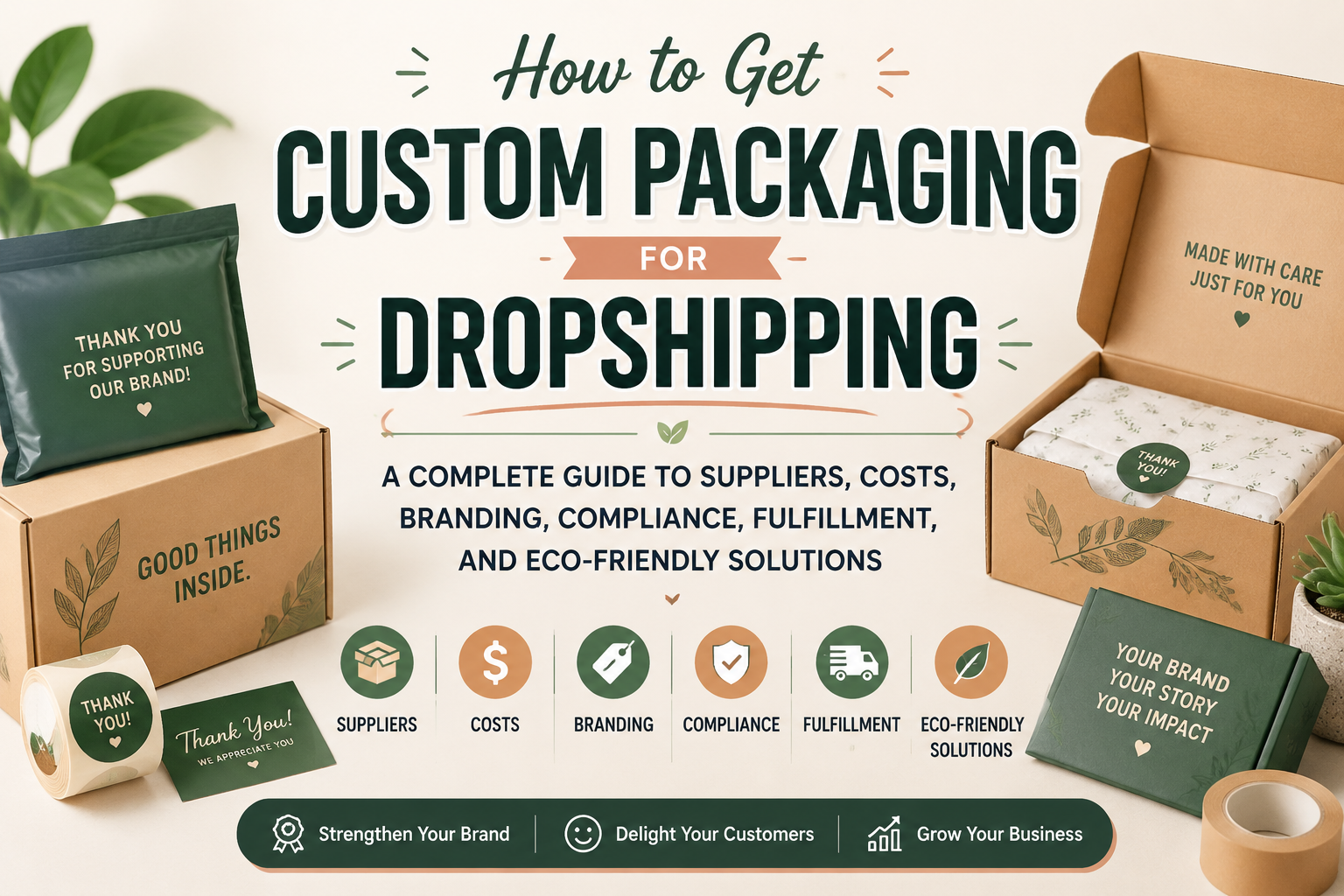
How to Get Custom Packaging for Dropshipping: A Complete Guide to Suppliers, Costs, Branding, Compliance, Fulfillment, and Eco-Friendly Solutions

Learning how to get custom packaging for dropshipping starts with finding suppliers that balance quality, cost, scalability, and reliability. Rather than focusing solely on the lowest price, successful brands evaluate communication, production capacity, sample quality, and long-term partnership potential. By carefully testing suppliers and developing a scalable packaging strategy, dropshipping businesses can create a stronger brand identity, improve customer retention, and build a more competitive ecommerce business.
How to Find Reliable Custom Packaging Suppliers for Dropshipping
Many dropshipping businesses start with generic packaging because it is simple and inexpensive. However, as competition increases, custom packaging becomes one of the most effective ways to differentiate a brand. A customized package can improve customer perception, increase repeat purchases, and create a memorable unboxing experience. The challenge is that many dropshippers struggle to find reliable packaging suppliers that can meet quality expectations while remaining cost-effective.
The supplier you choose will directly affect production quality, shipping speed, branding consistency, and customer satisfaction. A poor supplier can create delays, inconsistent packaging, and damaged products, ultimately hurting your brand reputation.
the Different Types of Packaging Suppliers
Not all packaging suppliers operate the same way. Some specialize in producing branded mailers, boxes, stickers, and inserts, while others provide full-service fulfillment solutions that combine packaging and shipping under one roof.
For small and medium-sized dropshipping stores, suppliers that offer print-on-demand packaging or low-MOQ customization are often the most practical choice. These suppliers allow businesses to test branded packaging without committing to thousands of units upfront.
Larger brands with consistent order volume may benefit from dedicated packaging manufacturers. Although minimum order quantities are typically higher, unit costs often decrease significantly as volume increases. This can improve profit margins while maintaining stronger brand consistency.
The ideal supplier depends largely on your monthly order volume, target market, and branding goals.
Key Factors to Evaluate Before Choosing a Supplier
Price is important, but it should never be the only evaluation criterion. A supplier offering the lowest quote may deliver inconsistent print quality or unreliable production timelines.
Quality should be assessed through physical samples whenever possible. Reviewing packaging samples allows you to examine material thickness, print accuracy, color consistency, and overall durability. Customers often associate packaging quality with product quality, making this step particularly important.
Production capacity is another critical factor. A supplier that performs well with 100 monthly orders may struggle when your business reaches 5,000 orders per month. Asking about production lead times, scalability, and seasonal capacity helps prevent future bottlenecks.
Communication quality is equally valuable. Responsive suppliers typically resolve issues faster and provide clearer updates regarding production schedules and shipping timelines. Reliable communication becomes especially important when operating across different countries and time zones.
How to Verify Supplier Reliability
One of the most effective ways to evaluate a supplier is through a structured testing process. Rather than placing a large order immediately, start with a small trial project.
Request customized samples featuring your logo and branding elements. Assess both product quality and delivery performance. Pay attention to how accurately the supplier follows design instructions and whether promised timelines are respected.
Customer reviews and case studies can also provide useful insights. Established suppliers often showcase partnerships with ecommerce brands and provide examples of previous packaging projects. Looking for long-term client relationships can indicate operational stability and consistent service quality.
Video calls can further improve supplier verification. Seeing production facilities, printing equipment, and warehouse operations provides a clearer picture of actual capabilities than website photos alone.
Working With Dropshipping Agents and Fulfillment Partners
Many successful dropshipping brands obtain custom packaging through fulfillment agents rather than directly through packaging factories. This approach simplifies logistics because the fulfillment partner manages packaging inventory, assembly, and shipping on behalf of the store owner.
A fulfillment partner can often coordinate with multiple packaging manufacturers and recommend cost-effective solutions based on order volume. This model reduces operational complexity and allows entrepreneurs to focus more on marketing and customer acquisition.
As order volume increases, fulfillment partners can also negotiate better packaging rates due to their existing supplier relationships. These savings may offset management fees and improve overall operational efficiency.
Building a Long-Term Packaging Strategy
Finding a supplier should not be viewed as a one-time task. The most successful ecommerce brands continuously optimize their packaging strategy as they grow.
Early-stage stores may begin with custom stickers and branded inserts because these options require minimal investment. As sales increase, businesses can gradually upgrade to fully branded mailers, custom boxes, tissue paper, and premium packaging materials.
This phased approach minimizes risk while allowing the brand experience to evolve alongside revenue growth. It also creates opportunities to test customer response before making larger investments.
Cost Analysis and Budgeting for Custom Packaging in Dropshipping
Custom packaging is no longer a luxury for dropshipping brands—it is a strategic investment that can enhance brand recognition and customer loyalty. However, it comes with financial implications that require careful planning. Many dropshippers underestimate the costs associated with design, production, shipping, and potential storage fees. Without proper budgeting, the added expense can erode profit margins and offset the benefits of branding efforts.
Knowing how to get custom packaging for dropshipping means understanding all cost components and aligning them with your business model. The goal is to improve customer experience while maintaining profitability.
Breaking Down the Costs
The total cost of custom packaging typically includes several elements. First, there is the base material cost, which depends on the type of packaging selected. Cardboard boxes, paper mailers, and eco-friendly options vary significantly in price. Thicker materials or specialty coatings, such as matte finishes or foil stamping, usually increase costs.
Printing and design fees are another critical factor. Custom logos, color schemes, and graphics can incur setup charges, particularly for small-batch orders. Some suppliers offer free digital proofs, but physical samples may have additional fees. Dropshippers should always include these costs when forecasting expenses.
Shipping and fulfillment can also affect the total packaging cost. Customized packages may weigh more than standard options, potentially increasing postage or freight charges. If products are shipped internationally, duty and customs documentation may further add to costs.
Finally, storage and inventory management fees should not be overlooked. For dropshippers storing branded packaging in warehouses or fulfillment centers, space and handling fees may apply. These costs are often less visible but can accumulate over time.
Evaluating Profit Margins
Calculating the impact of custom packaging on profit margins is essential. Start by analyzing the cost per unit, including all materials, printing, shipping, and storage expenses. Compare this to your average selling price to determine gross margin. In many cases, custom packaging can increase the per-unit cost by 10% to 25%, depending on design complexity and volume.
To maintain profitability, consider incremental strategies. For instance, ordering in larger quantities often reduces per-unit costs due to economies of scale. Using simpler packaging designs initially can lower printing fees, while still adding a recognizable brand touch through stickers or inserts.
Budgeting Strategies for Small Dropshipping Stores
Small dropshipping stores can manage costs effectively through phased implementation. Begin with minimal customization, such as branded tape, stickers, or thank-you cards. Monitor customer feedback and measure the impact on repeat purchases and social media engagement. This approach allows businesses to justify further investment in full-scale packaging upgrades over time.
Another strategy is to negotiate with suppliers for bundled services. Some packaging providers offer reduced rates when combining printing, assembly, and shipping. Dropshippers can leverage these packages to optimize both cost and efficiency.
Balancing Brand Impact and Cost
It is important to recognize that custom packaging delivers more than just a functional purpose—it represents your brand identity. An attractive, well-designed package can increase perceived product value, drive social sharing, and enhance the overall customer experience. These intangible benefits often offset the additional financial investment, particularly if it leads to higher customer retention and repeat purchases.
Dropshippers must therefore strike a balance between cost and brand impact. Overspending on elaborate packaging too early may reduce margins unnecessarily, while underinvesting could undermine the perceived professionalism of the brand.
How to Design Custom Packaging for Dropshipping That Builds a Memorable Brand Experience
Many dropshipping entrepreneurs focus heavily on product selection, advertising campaigns, and website optimization while overlooking packaging design. Yet packaging is often the first physical interaction customers have with a brand. A customer may forget an advertisement within minutes, but a thoughtfully designed package can leave a lasting impression long after delivery.
It is also about creating a packaging design that communicates your brand values, differentiates your business from competitors, and enhances the customer experience. In increasingly competitive ecommerce markets, packaging can become a powerful branding asset rather than simply a shipping container.
Establishing a Clear Brand Identity Before Designing Packaging
One of the most common mistakes businesses make is designing packaging before defining their brand identity. Effective packaging reflects the overall personality of the business and creates consistency across all customer touchpoints.
A luxury skincare brand may use minimalist designs, premium textures, and subtle color palettes to communicate sophistication. A fitness brand might emphasize bold typography, energetic colors, and motivational messaging. Meanwhile, an eco-conscious company may prioritize recycled materials and natural-looking designs to reinforce sustainability values.
Before creating packaging concepts, businesses should identify their target audience, brand positioning, and long-term goals. Every design decision should support these strategic objectives rather than follow temporary design trends.
Choosing the Right Packaging Format
The type of packaging selected can significantly influence customer perception and operational costs. Different products require different packaging solutions.
For lightweight products such as clothing and accessories, custom poly mailers are often cost-effective and practical. Premium brands may prefer rigid boxes that create a more luxurious unboxing experience. Subscription businesses frequently use custom cartons designed specifically to showcase multiple products.
The packaging format should balance protection, presentation, and shipping efficiency. Oversized packaging can increase shipping costs, while inadequate protection may lead to damaged products and customer complaints. The best packaging solutions achieve both visual appeal and functional performance.
Creating a Memorable Unboxing Experience
Modern consumers increasingly view ecommerce purchases as experiences rather than simple transactions. Social media platforms have amplified the importance of unboxing, with customers frequently sharing attractive packaging through videos and photos.
A memorable unboxing experience often includes several carefully coordinated elements. Branded tissue paper, thank-you cards, custom inserts, discount vouchers, and personalized messages can all contribute to a stronger emotional connection with customers.
However, effective packaging design is not necessarily expensive. Even relatively simple packaging can feel premium when the design is cohesive and professionally executed. Consistency often matters more than complexity.
The goal should be to create a positive emotional response that encourages repeat purchases and word-of-mouth marketing.
Selecting Colors, Typography, and Visual Elements
Visual design plays a major role in shaping customer perceptions. Colors can influence emotional reactions, while typography affects readability and brand personality.
For example, black and gold are often associated with luxury products, while bright colors may communicate creativity and energy. Clean typography typically suggests professionalism and trustworthiness, whereas decorative fonts can express uniqueness or artistic character.
Businesses should avoid overcrowding packaging with excessive graphics or promotional messages. Modern consumers generally respond better to clean, focused designs that communicate confidence and authenticity.
Visual consistency between packaging, website design, advertising creatives, and social media content also helps strengthen brand recognition over time.
Incorporating Functional Design Into Branding
Beautiful packaging that performs poorly during shipping can damage a brand’s reputation. Design decisions should always consider practical requirements.
Packaging should protect products from moisture, compression, and transportation damage. Labels should remain readable throughout the shipping process. Opening mechanisms should be intuitive and convenient for customers.
Functional details can also contribute to branding. Easy-open packaging, reusable containers, or clever product presentation can improve customer satisfaction while reinforcing brand values.
The most successful packaging designs combine aesthetics and functionality rather than prioritizing one over the other.
Using Packaging to Increase Customer Lifetime Value
Custom packaging can support broader business objectives beyond first impressions. Well-designed inserts can encourage customers to join loyalty programs, follow social media accounts, or make future purchases.
Brands can also use packaging to communicate their story, mission, or product education. This additional engagement can strengthen customer trust and improve retention rates.
Over time, packaging becomes part of the overall customer experience ecosystem. Businesses that invest strategically in packaging often benefit from stronger brand recognition and higher customer lifetime value compared to competitors relying solely on generic shipping materials.
Legal and Compliance Considerations for Custom Packaging in Dropshipping
Many entrepreneurs view custom packaging primarily as a branding tool. While branding is important, packaging also serves a legal and regulatory function. Businesses that overlook packaging compliance may face customs delays, product seizures, financial penalties, or even marketplace account suspensions.
As dropshipping becomes increasingly global, sellers often ship products across multiple countries with different packaging regulations. It also requires ensuring that packaging complies with local laws, industry standards, and international shipping requirements.
For growing ecommerce brands, compliance should be treated as a risk-management strategy rather than an administrative burden.
Country-Specific Packaging Regulations
One of the biggest challenges in international dropshipping is that packaging regulations vary significantly between countries. Requirements that are acceptable in one market may violate regulations in another.
The European market, for example, has strict rules regarding packaging waste, recyclability, and environmental labeling. Certain materials may require registration under producer responsibility programs. In some countries, businesses are expected to contribute financially to recycling systems based on the amount of packaging they introduce into the market.
Meanwhile, countries such as the United States, Canada, Australia, and Japan may have different requirements regarding product labeling, consumer information, and packaging safety standards.
Dropshippers selling globally should review the packaging requirements of their primary target markets before finalizing any custom packaging design.
Product Labels and Mandatory Information
Many products require specific information to appear either on the packaging itself or on attached labels. The exact requirements depend on the product category and destination country.
Common requirements may include manufacturer information, importer details, country of origin, material composition, usage instructions, safety warnings, age recommendations, and barcode identification.
Products in categories such as cosmetics, supplements, electronics, toys, and children’s products often face additional labeling obligations. Missing information can result in customs clearance issues or product removal from online marketplaces.
Businesses should verify whether packaging needs to accommodate these mandatory disclosures before approving production designs.
Packaging Safety and Transportation Requirements
Packaging is not only about presentation. It must also protect products throughout the shipping process.
Certain products require packaging that complies with transportation standards. Fragile products may need specific protective materials. Electronics containing lithium batteries often face special shipping regulations. Liquids may require leak-resistant packaging and additional labeling.
Failure to meet transportation standards can increase damage rates, trigger carrier restrictions, and create customer service problems. For dropshippers, damaged deliveries often result in refund requests, replacement costs, and negative reviews.
A well-designed compliance strategy considers both regulatory requirements and practical shipping performance.
Environmental Regulations and Sustainable Packaging Rules
Environmental regulations have become one of the fastest-growing areas of packaging compliance. Governments worldwide are implementing policies aimed at reducing packaging waste and encouraging sustainable materials.
Many countries now regulate single-use plastics, excessive packaging, and non-recyclable materials. Some jurisdictions require packaging manufacturers or importers to participate in recycling programs or disclose environmental information directly on packaging.
Brands that ignore these requirements may face legal risks as environmental regulations continue to evolve. At the same time, adopting sustainable packaging can create a competitive advantage among environmentally conscious consumers.
When selecting custom packaging suppliers, businesses should verify whether materials meet relevant environmental standards in their target markets.
Intellectual Property Risks in Packaging Design
Custom packaging introduces another often-overlooked legal concern: intellectual property protection.
Businesses sometimes use images, graphics, slogans, or design elements without securing proper rights. While this may appear harmless, it can lead to trademark disputes, copyright claims, or marketplace enforcement actions.
Packaging designs should be reviewed carefully to ensure that all logos, artwork, product images, and marketing claims are legally owned or licensed. Brands investing heavily in packaging may also consider trademark registration to protect their own visual identity from competitors.
Strong intellectual property management helps prevent future legal complications as a business grows.
Working With Suppliers to Maintain Compliance
Many dropshipping businesses assume that suppliers automatically handle compliance requirements. In reality, responsibility often remains with the seller.
Before ordering custom packaging, businesses should discuss regulatory requirements with suppliers and request documentation where applicable. Material certifications, safety reports, and environmental compliance records can provide additional protection.
Regular communication becomes especially important when expanding into new markets. Regulations evolve over time, and packaging that was compliant last year may require adjustments in the future.
Successful ecommerce brands often treat suppliers as long-term compliance partners rather than simple manufacturers.
Building a Scalable Compliance Strategy
As order volume increases and new markets are added, packaging compliance becomes more complex. Businesses that establish compliance processes early can scale more efficiently and avoid costly operational disruptions.
Creating standardized packaging review procedures, maintaining documentation records, and monitoring regulatory changes can significantly reduce risk. While these efforts require time and resources, they often cost far less than resolving legal disputes or customs-related issues later.
Compliance should therefore be viewed as an investment in business stability and international growth.
How to Integrate Custom Packaging Into Your Dropshipping Workflow
Many dropshipping businesses successfully design custom packaging but struggle when it comes to implementation. Creating a branded box, mailer, or insert is relatively straightforward. Integrating those packaging elements into a fulfillment workflow that remains efficient, cost-effective, and scalable is often much more complicated.
The real challenge lies in ensuring that every customer order is shipped with the correct branded packaging without slowing down fulfillment operations or creating inventory management problems.
As order volume grows, even small workflow inefficiencies can lead to shipping delays, packaging shortages, increased costs, and customer complaints. For this reason, successful ecommerce brands treat packaging integration as an operational strategy rather than a simple branding project.
Mapping the Customer Journey Before Implementation
Before introducing custom packaging, businesses should analyze their existing fulfillment process from order placement to final delivery.
Many dropshippers operate through multiple suppliers, warehouses, or fulfillment centers. Some businesses attempt to add custom packaging after fulfillment has already been optimized for generic shipments, creating unnecessary complexity.
A more effective approach is to map the complete customer journey and determine where packaging can be incorporated most efficiently. This often reveals opportunities to automate tasks and reduce manual handling.
When packaging decisions align with operational workflows, businesses can improve both customer experience and fulfillment performance.
Choosing the Right Fulfillment Model
The best packaging workflow depends heavily on the fulfillment model being used.
Some dropshippers rely directly on manufacturers who package and ship products to customers. In this situation, custom packaging must be integrated at the factory level. This often requires close coordination with suppliers and may involve maintaining packaging inventory at production facilities.
Other businesses work with third-party fulfillment centers or dropshipping agents. These partners can store branded packaging materials and apply them during order processing. This model typically offers greater flexibility because fulfillment specialists manage inventory, packaging assembly, and shipping operations.
As businesses grow, many transition toward fulfillment partners that specialize in custom branding services. These providers can often support more advanced packaging requirements while maintaining fast shipping times.
Managing Packaging Inventory Effectively
One of the most common operational mistakes is treating packaging inventory separately from product inventory.
Custom packaging is a physical asset that requires forecasting, replenishment planning, and inventory control. Running out of branded boxes can disrupt fulfillment just as severely as running out of products.
Businesses should monitor packaging consumption rates alongside product sales trends. Seasonal fluctuations, promotional campaigns, and viral product launches can all significantly affect packaging demand.
Many experienced ecommerce operators maintain safety stock levels for critical packaging materials. This reduces the risk of supply interruptions while ensuring consistent customer experiences throughout the year.
Proper inventory planning becomes increasingly important as order volume scales.
Automating Packaging Processes
Automation can significantly improve packaging efficiency. Modern fulfillment systems often allow businesses to connect ecommerce platforms directly with warehouses and suppliers.
When a customer places an order, automated workflows can trigger picking, packing, and shipping instructions that include specific packaging requirements. This reduces manual errors and ensures branding consistency across all shipments.
Some fulfillment providers also support rule-based packaging selection. For example, different packaging types can be automatically assigned based on product category, order value, destination country, or subscription status.
Automation becomes particularly valuable for businesses processing hundreds or thousands of orders per month.
Coordinating With Suppliers and Fulfillment Partners
Strong communication is essential when integrating custom packaging into a dropshipping workflow.
Suppliers, packaging manufacturers, and fulfillment providers should all operate from the same set of specifications. Packaging dimensions, branding guidelines, material requirements, and inventory thresholds must be clearly documented and regularly updated.
Many operational issues occur because one party changes a process without notifying others. Regular performance reviews and inventory audits can help identify potential problems before they affect customers.
Long-term supplier relationships often produce better operational outcomes because partners become more familiar with brand standards and fulfillment expectations.
Measuring the Impact of Custom Packaging
Packaging integration should be evaluated using measurable business metrics rather than assumptions.
Customer retention rates, repeat purchase behavior, product review scores, social media mentions, and support ticket volume can all provide insights into packaging performance. Businesses should compare these indicators before and after implementing custom packaging initiatives.
Operational metrics are equally important. Order processing speed, packaging costs, inventory turnover, and fulfillment accuracy should be monitored continuously.
A successful packaging workflow improves both customer experience and operational efficiency. If one area improves while the other deteriorates, further optimization may be necessary.
Scaling Custom Packaging as the Business Grows
Many brands begin with simple branded inserts or custom stickers before moving toward fully customized boxes, tissue paper, and premium packaging experiences.
This gradual approach allows businesses to validate customer demand and operational feasibility before making larger investments. As sales volume increases, packaging systems can evolve alongside the broader fulfillment infrastructure.
Scalable packaging strategies focus on standardization wherever possible. Reducing unnecessary complexity helps maintain efficiency even as product catalogs expand and order volume grows.
The most successful ecommerce brands view packaging as part of a larger operational ecosystem rather than an isolated marketing expense.
Sustainable and Eco-Friendly Packaging Options for Dropshipping
Consumer expectations around environmental responsibility are rapidly changing. Buyers are increasingly aware of the ecological impact of their purchases, including packaging waste. For dropshipping brands, this shift means that offering sustainable packaging is no longer optional—it can directly influence purchasing decisions and brand perception.
Choosing eco-friendly materials and design practices can differentiate a brand, appeal to environmentally conscious consumers, and even create cost efficiencies in the long term.
Identifying Eco-Friendly Materials
Sustainable packaging begins with material selection. Traditional plastics, polystyrene, and non-recyclable laminates contribute heavily to landfill waste and are increasingly restricted in many markets.
Popular eco-friendly alternatives include recycled cardboard, kraft paper, biodegradable mailers, and plant-based plastics. These materials reduce environmental harm while remaining functional for shipping.
Some innovative options combine sustainability with premium presentation. For instance, molded pulp inserts protect fragile products while being compostable, and reusable cloth or drawstring bags can reinforce brand loyalty through multiple uses.
When choosing materials, businesses should consider both recyclability and customer perception. Packaging that feels premium while remaining environmentally responsible enhances brand credibility.
Designing for Minimal Waste
Sustainability is not only about materials but also about design. Excessively large boxes or over-engineered inserts increase material usage and shipping costs. Efficient, appropriately sized packaging minimizes waste and reduces transportation carbon emissions.
Designing modular packaging that fits a range of product sizes can further reduce the need for multiple packaging SKUs. This approach simplifies inventory management while maintaining consistent branding.
Businesses should also evaluate print techniques. Water-based inks, soy-based dyes, and minimalistic designs reduce chemical usage and support recyclable packaging processes.
Balancing Sustainability with Brand Identity
Some dropshippers worry that eco-friendly packaging limits branding opportunities. In reality, sustainability can reinforce brand identity. Minimalist designs, natural textures, and environmentally conscious messaging can communicate sophistication, social responsibility, and authenticity.
Eco-friendly branding messages can be printed on packaging, encouraging customers to recycle, reuse, or compost materials. Including this information can increase customer engagement and enhance perceived value.
Sustainability messaging also aligns with modern consumer values, particularly among younger demographics who actively seek brands that share their environmental concerns.
Supplier Selection and Verification
Finding suppliers that provide sustainable custom packaging requires careful vetting. Businesses must verify that materials meet environmental certifications such as FSC (Forest Stewardship Council), compostability standards, or recycled content claims.
Some suppliers may label packaging as “eco-friendly” without providing verification. Requesting documentation and product samples ensures compliance and avoids reputational risks.
Dropshippers may also consider fulfillment partners that specialize in sustainable packaging, as these providers can handle sourcing, inventory management, and quality control while maintaining consistent environmental standards.
Cost Considerations and ROI
Eco-friendly packaging is sometimes perceived as more expensive. While initial unit costs may be higher, the investment often pays off through increased customer satisfaction, social media exposure, and repeat purchases.
A well-executed sustainable packaging strategy can become part of a brand’s unique selling proposition. In addition, as sustainable materials and production methods become more widespread, prices are gradually decreasing, narrowing the cost gap with conventional packaging.
Businesses should conduct a cost-benefit analysis to assess both tangible and intangible returns, including brand value and customer loyalty.
Monitoring and Continuous Improvement
Sustainability is an ongoing effort. Businesses should regularly evaluate new materials, packaging innovations, and shipping methods to continuously reduce environmental impact.
Tracking metrics such as packaging waste per order, shipping weight, and customer feedback can guide improvements. Brands that actively communicate sustainability initiatives often enjoy stronger customer trust and long-term engagement.




No Comments