


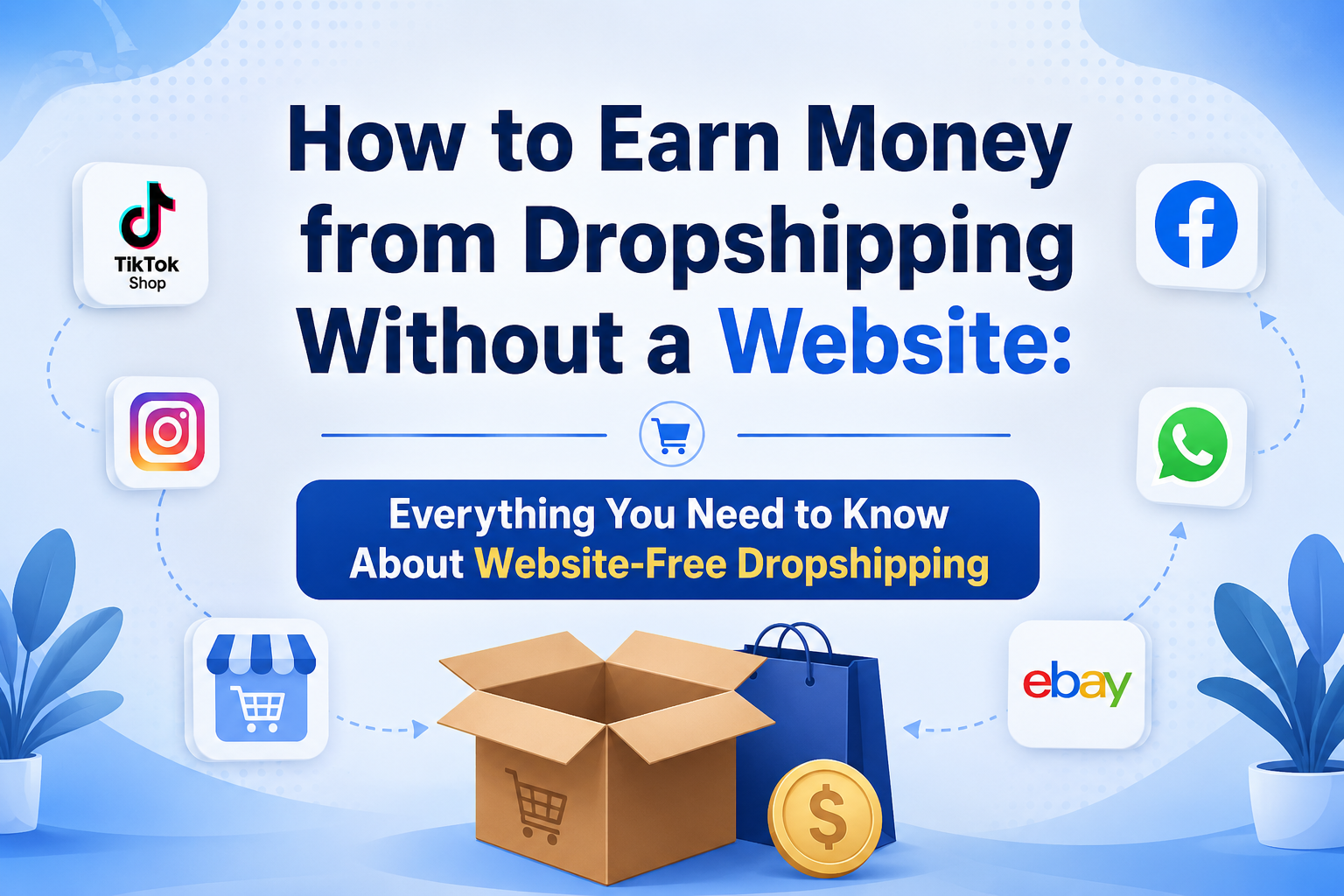
How to Earn Money from Dropshipping Without a Website: Everything You Need to Know About Website-Free Dropshipping

Earning money from dropshipping without a website is increasingly realistic due to the rise of social commerce platforms. TikTok, Instagram, and Facebook allow sellers to reach customers directly while avoiding many of the costs associated with traditional online stores.
The model favors content creation, audience engagement, and product presentation rather than technical website management. For beginners seeking a low-cost way to test the market, social media may represent the fastest route from product idea to first sale.
How to Earn Money from Dropshipping Without a Website Using TikTok, Instagram, and Facebook
Many beginners assume that starting a dropshipping business requires building a Shopify store, paying for web hosting, and learning website design. In reality, social commerce has changed the traditional model of e-commerce. Platforms such as TikTok, Instagram, and Facebook now provide enough traffic and customer interaction to allow sellers to generate sales without operating a dedicated website.
Why Social Media Has Become a Viable Alternative to Websites
Traditional dropshipping relies heavily on paid advertising that directs visitors to an independent store. This approach often involves website expenses, app subscriptions, payment gateway fees, and ongoing maintenance costs. For beginners, these fixed expenses can create pressure before the business generates any revenue.
Social media platforms work differently. Instead of purchasing traffic and sending visitors to a store, sellers can publish content directly where customers already spend their time. Product discovery, engagement, trust building, and purchasing decisions can all happen within the same ecosystem.
This reduces both the financial barrier and the technical complexity associated with launching an online business.
The Economics of Organic Traffic
The biggest advantage of social media dropshipping is access to organic traffic. A short product demonstration video on TikTok or a viral Instagram Reel can reach thousands or even millions of users without advertising costs.
From a financial perspective, customer acquisition cost becomes significantly lower than traditional Facebook advertising campaigns. Since advertising is often the largest expense in dropshipping, reducing acquisition costs directly improves profit margins.
However, organic traffic is less predictable than paid advertising. Sellers need to consistently produce content and test multiple products before finding winning combinations.
Choosing Products That Fit Social Commerce
Not every product performs well on social platforms. Items that generate curiosity, solve visible problems, or create emotional reactions tend to perform better in short-form video environments.
Products with clear visual demonstrations often outperform technical or highly functional items. Viewers need to understand the value proposition within a few seconds, otherwise engagement rates drop rapidly.
Impulse purchases also play a larger role in social commerce compared with traditional website shopping behavior. Lower-priced products frequently convert more efficiently because customers face less purchase hesitation.
Building Trust Without an Independent Store
One common concern is credibility. Consumers are generally more comfortable purchasing from established websites than directly through social channels.
The solution is to replace website trust signals with social proof. Product reviews, customer videos, comments, user-generated content, and transparent communication become essential components of the buying process.
A highly active social media account with consistent posting often creates more trust than a newly launched website with little traffic or customer feedback.
In many cases, social proof becomes more influential than professional website design.
Scaling Beyond the First Sales
Social media dropshipping works particularly well during the testing phase of a business. Sellers can validate product demand without investing heavily in infrastructure.
Once certain products demonstrate stable demand and repeat purchases, some entrepreneurs eventually transition toward dedicated stores or branded websites in order to gain more control over customer data and profit margins.
This means that social commerce should not necessarily be viewed as a replacement for websites, but rather as an efficient entry point into e-commerce entrepreneurship.
How to Earn Money from Dropshipping Without a Website Through Marketplaces Like eBay and Etsy
One of the biggest misconceptions in e-commerce is that every successful dropshipping business requires an independent website. In reality, online marketplaces have supported profitable sellers for decades before Shopify became popular. Platforms such as eBay, Etsy, Facebook Marketplace, and other marketplace ecosystems continue to generate billions of dollars in transactions every year, creating opportunities for entrepreneurs who prefer to avoid the costs and complexity of operating their own websites.
Why Marketplaces Remove the Biggest Barrier to Entry
Launching an independent store usually requires website development, theme customization, payment setup, conversion optimization, and traffic acquisition. Even before the first sale occurs, sellers may already be paying for subscriptions, plugins, and advertising campaigns.
Marketplaces simplify this process by providing ready-made infrastructure. Sellers can create product listings and immediately access an existing customer base without worrying about technical maintenance or website performance.
The marketplace effectively acts as both the storefront and the traffic source, allowing entrepreneurs to focus primarily on product selection and operational efficiency.
For many beginners, this dramatically reduces startup costs and shortens the time needed to reach profitability.
the Value of Marketplace Traffic
The primary advantage of marketplaces is buyer intent. Visitors on social media platforms may be browsing for entertainment, while marketplace users often arrive with the intention to purchase.
This difference changes the economics of customer acquisition. Instead of spending money to attract visitors through advertisements, sellers compete for visibility inside a platform where customers are already searching for products.
The result is often a lower customer acquisition cost compared with traditional independent-store advertising models.
However, sellers exchange this advantage for platform fees and stronger competition from other merchants selling similar products.
Choosing the Right Marketplace Strategy
Different marketplaces serve different consumer behaviors and product categories.
eBay generally favors consumer electronics, automotive accessories, household products, and various everyday items with broad demand. The platform attracts price-sensitive buyers and rewards sellers who can maintain competitive pricing and reliable fulfillment.
Etsy attracts customers searching for personalized products, handmade goods, custom gifts, and niche products with strong emotional appeal. Sellers using print-on-demand or customized dropshipping products often find higher margins in this environment because buyers are less focused on price comparisons.
Facebook Marketplace occupies a middle ground, benefiting from social discovery while maintaining marketplace-style purchasing behavior.
The Profitability Challenge of Platform Fees
Although marketplaces eliminate website expenses, they introduce other costs that directly affect margins. Listing fees, transaction commissions, payment processing fees, and advertising options can gradually reduce profitability.
As competition increases, some categories become highly saturated, forcing sellers to compete aggressively on price.
For this reason, marketplace dropshipping tends to reward operational efficiency rather than branding ability. Sellers who manage supplier costs, shipping times, and inventory accuracy often outperform competitors who rely solely on low pricing.
Long-term profitability depends less on finding a single winning product and more on maintaining a scalable operational system.
Platform Dependency and Business Risk
The largest disadvantage of marketplace-based dropshipping is dependence on platform policies.
Algorithm updates, account suspensions, fee increases, and changing seller regulations can significantly affect revenue. Unlike independent websites where merchants control their customer relationships, marketplace sellers operate within an ecosystem controlled by the platform owner.
This creates a trade-off between convenience and control.
Many experienced sellers use marketplaces as a customer acquisition channel during the early stages of growth before gradually diversifying into additional sales channels.
How to Earn Money from Dropshipping Without a Website Using TikTok Shop
The rapid growth of TikTok Shop has fundamentally changed the relationship between content and commerce. For many years, dropshipping businesses followed a predictable process: attract traffic through advertisements, direct visitors to a website, and optimize conversion rates through landing pages and checkout design. TikTok Shop compresses this entire process into a single platform, allowing sellers to generate revenue without operating an independent website.
As a result, many entrepreneurs are now asking whether TikTok Shop can serve as a complete alternative to traditional e-commerce stores.
Why TikTok Shop Changes the Traditional Dropshipping Model
Independent websites require sellers to solve two separate problems. The first is acquiring traffic, and the second is converting that traffic into paying customers.
TikTok Shop combines these two functions into one ecosystem. Consumers discover products while watching entertainment content, product reviews, livestreams, or creator recommendations. The transition from product discovery to purchase often takes only a few clicks.
This reduction in friction has significant implications for conversion efficiency. Customers no longer need to leave the platform, wait for external pages to load, or navigate unfamiliar checkout systems.
For many products, this shorter purchasing journey leads to higher conversion rates than traditional websites.
The Importance of Algorithmic Distribution
One of TikTok Shop’s greatest advantages is its recommendation algorithm. Unlike search-based marketplaces where visibility depends heavily on rankings and historical sales volume, TikTok can distribute content from new sellers to large audiences if engagement metrics perform well.
This creates opportunities for small businesses that lack advertising budgets or established customer bases.
A single product video can generate thousands of impressions within hours if viewers interact positively with the content. In some cases, a product can achieve profitability before any paid advertising investment becomes necessary.
This significantly changes the economics of product testing and market validation.
Products That Perform Best on TikTok Shop
TikTok favors products that can communicate value visually and quickly. Demonstration products, problem-solving gadgets, beauty accessories, home improvement tools, and lifestyle products often perform well because viewers immediately understand their benefits.
Products requiring lengthy explanations or technical specifications usually struggle in short-form video environments.
The platform rewards emotional reactions, curiosity, surprise, and convenience. Successful products frequently share one characteristic: viewers understand the value proposition within the first few seconds of exposure.
This behavior differs substantially from search-based shopping environments where customers actively compare specifications and features.
The Role of Influencers and Affiliate Creators
Another factor that separates TikTok Shop from traditional websites is the creator ecosystem.
Many sellers do not produce content themselves. Instead, they collaborate with creators through affiliate programs that reward influencers with commissions for each sale generated.
This model effectively transforms content creators into decentralized sales teams.
Compared with traditional advertising campaigns, affiliate partnerships often reduce financial risk because commissions are only paid after a successful sale occurs. The seller shifts part of the marketing burden to creators while benefiting from the trust those creators have already established with their audiences.
For dropshipping businesses with limited budgets, this approach can provide significant leverage.
Limitations of a Website-Free TikTok Strategy
Despite its advantages, TikTok Shop introduces several risks that independent websites do not face.
Platform policies, commission structures, algorithm adjustments, and account restrictions can directly influence business performance. Sellers also have limited access to customer ownership compared with businesses operating their own websites.
This means the platform provides exceptional growth opportunities but less strategic control over long-term customer relationships.
As businesses mature, some entrepreneurs eventually expand into additional channels to reduce platform dependency.
How to Earn Money from Dropshipping Without a Website Through Influencer Marketing
Many discussions about dropshipping focus on advertising platforms, website conversion rates, and store optimization. However, influencer marketing has gradually created an alternative path that allows sellers to generate revenue without building an independent website. Instead of investing heavily in website infrastructure and paid traffic, entrepreneurs can leverage existing audiences that influencers have already spent years developing.
This approach shifts the business model from buying traffic to borrowing trust.
Why Influencer Traffic Works Differently
Traditional online advertising interrupts users while they browse content, creating a natural resistance to promotional messages. Influencer marketing operates under a different dynamic because recommendations are embedded within content that audiences have already chosen to consume.
Followers often view creators as trusted sources of information rather than advertisers. As a result, product recommendations can achieve higher engagement rates and stronger purchase intent compared with conventional display advertisements.
For dropshipping businesses without websites, this trust becomes particularly valuable because customers may have fewer traditional credibility signals available during the buying process.
The influencer effectively becomes part of the seller’s customer acquisition strategy and trust-building mechanism simultaneously.
Reducing Customer Acquisition Costs
Customer acquisition costs represent one of the largest expenses in modern dropshipping. Paid advertising campaigns often require extensive testing before reaching profitability, and unsuccessful campaigns can consume budgets quickly.
Influencer partnerships offer an alternative cost structure. Instead of paying upfront for impressions or clicks, many collaborations operate through commission-based affiliate arrangements where creators earn a percentage of completed sales.
This aligns incentives between sellers and creators. Both parties benefit only when products successfully convert into revenue.
For small businesses with limited capital, performance-based compensation can reduce financial risk and improve cash flow management during the early stages of growth.
Selecting Products Suitable for Influencer Promotion
Not every product benefits equally from influencer marketing. Products with visual appeal, emotional value, or clear lifestyle associations generally perform better because creators can naturally integrate them into content.
Fashion accessories, beauty products, fitness equipment, pet products, home gadgets, and hobby-related items frequently succeed because audiences can immediately visualize how the products fit into their daily lives.
Highly technical or industrial products often struggle because they require detailed explanations that may not fit naturally within creator content formats.
Successful influencer campaigns usually focus less on product specifications and more on practical outcomes or lifestyle improvements.
The Importance of Creator Selection
Audience size alone rarely determines campaign performance. Smaller creators with highly engaged communities often produce stronger conversion rates than larger influencers with broad but less committed audiences.
Micro-influencers frequently maintain closer relationships with followers, which increases recommendation credibility. Their audiences may perceive product endorsements as personal suggestions rather than commercial advertising.
For dropshipping businesses operating without websites, this authenticity can compensate for the absence of a dedicated online storefront.
The quality of audience alignment is often more important than total follower numbers.
Managing Dependency Risks
Although influencer marketing reduces reliance on websites and advertising platforms, it introduces another form of dependency. Revenue generation becomes partially tied to creator performance, content quality, and audience behavior.
Changes in platform algorithms or shifts in influencer popularity can affect campaign outcomes unexpectedly.
Businesses that rely entirely on a small number of creators may experience unstable revenue patterns over time. Diversifying partnerships across multiple influencers and content formats often improves long-term resilience.
The objective should be building a repeatable customer acquisition system rather than depending on a single viral collaboration.
How to Earn Money from Dropshipping Without a Website Using WhatsApp and Messenger
The traditional image of e-commerce usually involves customers browsing a website, adding products to a cart, and completing payment through an online checkout page. However, in many regions around the world, transactions increasingly take place through messaging applications rather than conventional websites. Platforms such as WhatsApp, Messenger, Telegram, and LINE have evolved from communication tools into important commercial channels, allowing entrepreneurs to operate profitable dropshipping businesses without maintaining an independent online store.
This model is particularly common in emerging markets where mobile messaging applications have become central to everyday consumer behavior.
Why Messaging Commerce Is Growing
One of the main limitations of independent websites is the absence of direct interaction between buyers and sellers. Customers often have questions regarding product quality, shipping times, payment methods, or after-sales support. When these concerns remain unanswered, many potential buyers abandon the purchase process.
Messaging platforms remove this barrier by enabling real-time conversations. Buyers can ask questions, request additional photos, negotiate product options, and receive immediate responses before committing to a purchase.
This direct communication creates a shopping experience that resembles traditional retail interactions rather than anonymous online transactions.
For many consumers, particularly in developing markets, this approach increases confidence and reduces perceived purchasing risk.
Lower Infrastructure Costs Compared with Traditional Stores
Operating an independent website typically involves recurring expenses such as hosting fees, software subscriptions, payment gateway costs, and ongoing technical maintenance. Messaging-based commerce eliminates many of these requirements.
A seller can display products through catalogs, images, videos, or pinned messages while handling customer communication directly within the application.
The reduction in fixed costs lowers the financial threshold for entering the dropshipping industry. Entrepreneurs can begin validating products and customer demand without committing significant resources to website development.
This makes messaging commerce especially attractive for first-time sellers or businesses targeting highly localized markets.
The Role of Personalized Selling
Unlike websites that rely heavily on automation and standardized purchasing flows, messaging commerce emphasizes personalization.
Sales conversations can adapt to customer preferences, purchasing history, and specific concerns. Sellers can recommend alternative products, upsell complementary items, and provide customized offers during the conversation itself.
This consultative approach often increases average order values compared with self-service online stores.
For products that require explanation, customization, or trust-building, personalized communication may generate higher conversion rates than traditional checkout pages.
The sales process becomes relationship-driven rather than transaction-driven.
Regional Differences in Consumer Behavior
The effectiveness of messaging commerce varies significantly across geographic regions.
In parts of Southeast Asia, Latin America, the Middle East, and Africa, consumers frequently use messaging applications as their primary method of interacting with businesses. Many local merchants operate successfully without sophisticated websites because customers already expect to communicate directly with sellers before purchasing.
In contrast, consumers in North America and Western Europe often place greater emphasis on automated checkout experiences and established e-commerce platforms.
Understanding these regional differences is essential when selecting a website-free dropshipping strategy.
A model that performs well in one market may generate limited results in another.
Operational Challenges of Manual Sales Processes
Although messaging platforms improve customer interaction, they introduce operational complexity as order volume increases.
Every inquiry requires human attention, and response speed directly affects conversion rates. As businesses scale, manually handling conversations can become time-consuming and expensive.
Automation tools, chatbots, and customer service teams can partially address these issues, but messaging commerce generally remains more labor-intensive than website-based transactions.
As a result, the model tends to favor businesses focused on higher-margin products rather than high-volume, low-margin sales strategies.
How to Earn Money from Dropshipping Without a Website Compared with Traditional Shopify Stores
The rise of social commerce, marketplaces, and messaging-based selling has led many entrepreneurs to question whether an independent website is still necessary for building a profitable dropshipping business. While Shopify stores have dominated the industry for years, alternative sales channels now allow sellers to generate revenue without owning a dedicated website.
The more important question is no longer whether website-free dropshipping is possible, but rather how its economics compare with the traditional Shopify model.
The Difference in Startup Costs
One of the strongest advantages of website-free dropshipping is the reduction in upfront investment.
Operating a Shopify store usually involves recurring expenses such as platform subscriptions, premium themes, applications, domain registration, email systems, and conversion optimization tools. In many cases, sellers also invest heavily in advertising before generating their first order.
Website-free models remove many of these costs. Sellers can begin operating through marketplaces, social commerce platforms, or messaging applications with minimal financial commitment.
For entrepreneurs with limited budgets, reducing fixed costs significantly lowers business risk during the testing stage.
This makes website-free dropshipping particularly attractive for beginners who prioritize experimentation over long-term infrastructure.
Customer Acquisition Economics
Traffic acquisition represents the largest financial challenge for most Shopify businesses.
Independent stores generally depend on paid advertising through platforms such as Meta Ads or Google Ads. As competition increases, customer acquisition costs continue to rise, placing pressure on profit margins.
Alternative sales channels often provide built-in traffic sources. TikTok Shop relies on algorithmic recommendations, marketplaces attract customers through search intent, and messaging platforms benefit from personal networks and referrals.
As a result, website-free models frequently achieve lower acquisition costs during the early stages of operation.
However, this advantage often decreases as competition intensifies within these ecosystems.
Ownership and Control of Customer Relationships
The greatest strategic advantage of independent websites is ownership.
Shopify merchants control customer databases, email lists, remarketing campaigns, and long-term brand communication. This ownership enables businesses to increase customer lifetime value and improve profitability through repeat purchases.
Website-free models typically offer less access to customer information and fewer opportunities for direct remarketing.
Marketplace sellers operate under platform rules, while social commerce sellers often depend on algorithms that can change without notice.
This creates an important trade-off between convenience and control.
Short-term efficiency often comes at the expense of long-term asset ownership.
Brand Development Potential
Brand value plays a central role in business scalability.
Independent websites provide complete control over design, customer experience, packaging presentation, and storytelling. These factors contribute to stronger customer loyalty and pricing power over time.
Without a website, businesses often compete primarily on product availability, speed, or pricing rather than brand differentiation.
This makes sustainable competitive advantages more difficult to establish.
For sellers aiming to build recognizable consumer brands, independent websites remain a highly valuable strategic asset.
Scalability and Operational Complexity
Website-free models often scale quickly during the initial stages because they remove technical barriers and simplify operations.
However, as order volumes increase, operational limitations may emerge. Platform restrictions, commission structures, policy changes, and limited customization options can constrain growth.
Independent stores require more resources to launch but offer greater flexibility for automation, international expansion, and advanced marketing strategies.
The scalability curve therefore differs significantly between the two approaches.
Website-free businesses optimize for speed, while independent websites optimize for long-term control and expansion.
The Most Common Growth Path
In practice, successful sellers rarely choose only one model.
Many businesses begin by validating products through TikTok Shop, marketplaces, or social commerce channels before investing in a dedicated website after demand becomes predictable.
This approach reduces risk while preserving future growth opportunities.
The evolution often follows a sequence similar to:
Social Commerce → Marketplace Validation → Shopify Store → Brand Development
Rather than competing against each other, these models frequently serve different stages of business maturity.


No Comments