


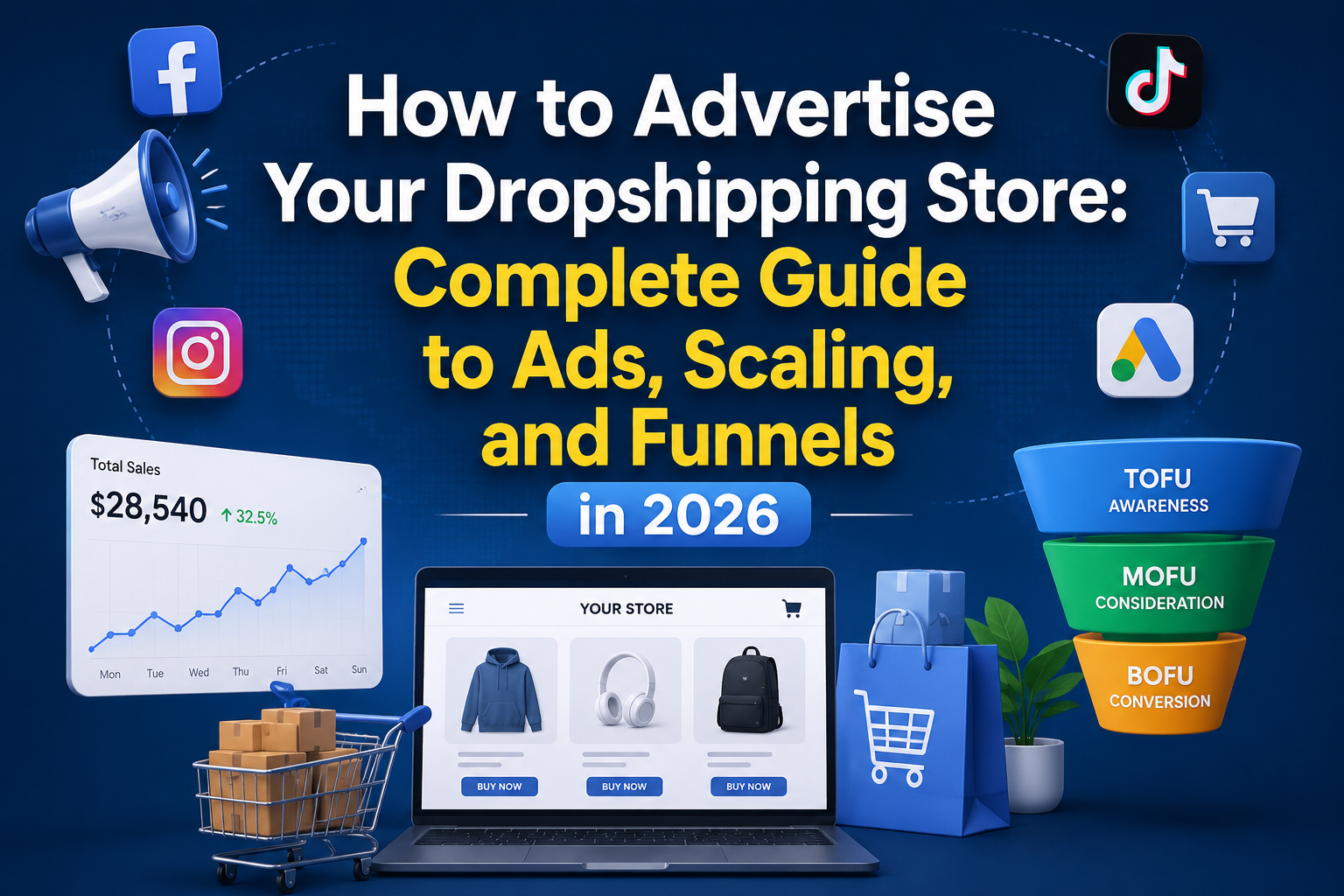
How to Advertise Your Dropshipping Store: Complete Guide to Ads, Scaling, and Funnels in 2026

Figuring out how to advertise your dropshipping store starts with a shift in mindset. Instead of chasing immediate profit, beginners should focus on building a repeatable testing system.
When budgeting, platform selection, and creative testing are aligned with data-driven thinking, advertising becomes predictable rather than random. Over time, this system allows small stores to evolve into scalable brands rather than one-time product experiments.
Paid Ads Fundamentals Every Beginner Needs to Avoid Wasting Budget
Learning how to advertise your dropshipping store is less about finding a “winning ad” and more about understanding how paid traffic systems actually behave. Most beginners lose money not because the product is bad, but because they treat advertising like a lottery instead of a controlled testing system.
In reality, paid ads are a feedback loop. Every dollar spent is data, and every result is a signal about audience, offer, or creative direction. Without understanding this structure, scaling becomes impossible.
Choosing the Right Ad Platform Based on Intent, Not Trends
A common mistake in dropshipping advertising is choosing platforms based on hype instead of user intent.
Meta Ads (Facebook and Instagram) are typically used for impulse-driven products, where users discover products they did not actively search for. TikTok operates similarly but relies more heavily on entertainment-driven discovery. Google Ads, on the other hand, captures active intent, meaning users are already searching for a solution.
For beginners, the key is not choosing the “best platform,” but selecting one that matches your product type. If your product solves an immediate emotional desire, social platforms tend to perform better. If it solves a direct problem, search-based advertising often converts more efficiently.
Budget Allocation: Why Small Testing Beats Large Spending
One of the most misunderstood aspects of how to advertise your dropshipping store is budgeting.
Beginners often assume that higher budget leads to faster success. In reality, inefficient testing at a large scale only accelerates losses. The correct approach is controlled micro-testing.
Instead of committing a large budget to a single campaign, successful advertisers split their spending across multiple small ad sets. Each ad set tests a different variable such as audience type, creative angle, or product positioning.
This process creates structured learning rather than random outcomes. The goal of the initial stage is not profit, but identifying patterns in click-through rates, engagement behavior, and conversion signals.
the Role of the Testing Phase
The testing phase is where most beginners fail because they expect immediate profitability. However, the real purpose of testing is validation, not revenue.
During this phase, advertisers should focus on three core metrics: click-through rate, cost per click, and add-to-cart behavior. These indicators reveal whether the offer is emotionally compelling, visually engaging, and commercially viable.
If a campaign is generating clicks but no conversions, the issue is usually not the traffic source but the landing page or product positioning. If there are no clicks at all, the problem is typically the creative or hook.
Creative Strategy: The Real Driver of Early Success
In dropshipping advertising, creative quality often matters more than targeting precision. Platforms like Meta and TikTok rely heavily on algorithmic distribution, meaning strong creatives can find the right audience even with broad targeting.
Effective beginner creatives are not polished brand ads. They are simple, problem-focused messages that communicate value within the first few seconds. The opening hook determines whether users continue watching or scroll away.
A strong creative usually follows a clear structure: problem introduction, visual demonstration, and simple outcome. Overcomplicating this structure often reduces performance.
Facebook & Instagram Ads Scaling System for Sustainable Growth
Once you understand how to advertise your dropshipping store at a basic level, the next challenge is scaling. Many advertisers assume that scaling simply means increasing budget, but in Facebook and Instagram ads, scaling is a structural process, not a financial one.
The difference between a small profitable campaign and a scaled brand is consistency. Scaling requires systems that can maintain performance under increasing spend without breaking the learning phase or inflating acquisition costs.
From Testing to Scaling: Recognizing the Transition Point
The first critical step in scaling is identifying when a campaign is actually ready. Many beginners scale too early, which leads to unstable performance. A campaign is not ready to scale just because it has one profitable day.
Instead, stability is the key signal. Consistent performance over multiple days, stable cost per purchase, and repeatable engagement patterns indicate that the algorithm has found a reliable audience segment.
At this stage, the objective shifts from exploration to exploitation. You are no longer searching for what works; you are maximizing what already works.
Vertical Scaling vs Horizontal Scaling
In Facebook and Instagram advertising, scaling generally happens in two ways: vertical scaling and horizontal scaling.
Vertical scaling means increasing the budget on existing winning ad sets. This approach is simple but sensitive. Increasing budget too quickly can disrupt the algorithm and reset performance stability. Gradual increases are usually more effective, allowing the system to adapt without losing optimization quality.
Horizontal scaling, on the other hand, involves duplicating winning ad sets into new audiences, placements, or creatives. This method reduces risk because it spreads performance across multiple structures rather than relying on a single campaign.
Successful advertisers rarely rely on only one method. Instead, they combine both approaches depending on campaign maturity and product performance.
Creative Expansion as the Core of Scaling
A major misunderstanding in scaling dropshipping ads is the belief that audience targeting is the main lever. In reality, creative variation is often more powerful than audience refinement.
As a campaign scales, creative fatigue becomes the biggest threat. Even if targeting remains accurate, repeated exposure to the same ad reduces engagement and increases cost per result.
To prevent this, scaling strategies must include continuous creative expansion. This means producing multiple variations of winning concepts rather than relying on a single ad. Each variation should maintain the core message but shift the presentation angle, emotional trigger, or visual structure.
This allows the algorithm to redistribute delivery to fresh engagement pockets without losing relevance.
Managing Learning Phase Stability During Scaling
Facebook’s algorithm relies heavily on the learning phase to optimize delivery. When scaling improperly, campaigns often re-enter this phase, leading to unstable performance.
To avoid this, changes should be incremental rather than aggressive. Sudden increases in budget or frequent structural edits can disrupt optimization and reset historical learning.
A more stable approach is controlled scaling over time. This allows the system to adjust gradually while preserving accumulated data signals.
In practice, consistency in campaign structure is often more important than rapid expansion.
Audience Expansion Without Losing Precision
As campaigns scale, audience fatigue becomes inevitable. However, expanding audiences does not mean abandoning targeting logic. Instead, it involves widening parameters strategically.
Lookalike audiences based on high-quality customer data often provide the most stable scaling path. Broad targeting can also work, but it requires strong creative inputs to guide algorithm distribution.
The key is maintaining relevance while increasing reach. If relevance drops too quickly, scaling becomes inefficient regardless of budget size.
TikTok Ads and Organic Content Hybrid Strategy for Lower CPA and Viral Growth
Learning how to advertise your dropshipping store on TikTok requires a different mindset compared to traditional ad platforms. Unlike Meta or Google, TikTok is not primarily a search or social intent platform—it is a content discovery engine driven by attention, entertainment value, and rapid feedback loops.
This means that performance is less dependent on precise targeting and more dependent on how well your content fits into user behavior patterns. On TikTok, the creative is not just part of the ad; it is the entire targeting system.
The Core Idea: Ads and Organic Content Should Work Together
One of the biggest advantages of TikTok advertising is the ability to combine paid ads with organic content strategy. Many dropshipping beginners treat these as separate channels, but in practice they reinforce each other.
Organic content helps validate ideas before scaling, while paid ads amplify content that already shows engagement signals. When both are aligned, the cost per acquisition decreases because the algorithm receives stronger engagement data across multiple distribution paths.
A product that performs well organically often requires less optimization in paid campaigns because the audience response is already pre-qualified through engagement metrics like watch time, shares, and comments.
UGC Creatives: The Foundation of TikTok Advertising
User-generated content, or UGC, is the most effective format for dropshipping ads on TikTok. Unlike traditional polished brand videos, UGC focuses on authenticity and relatability.
The reason UGC performs well is psychological. Users on TikTok are not actively looking for advertisements; they are consuming content. Ads that resemble native content reduce resistance and increase retention.
A strong UGC ad typically starts with a relatable problem or scenario, followed by a simple demonstration of the product, and ends with a clear but non-intrusive call to action. Overproduction often reduces trust, while simplicity improves conversion.
Viral Testing: How Organic Content Validates Products
Before investing heavily in ads, many successful dropshipping advertisers use organic TikTok content as a testing environment. The goal is to identify which product angles naturally attract attention without paid amplification.
Key signals include watch duration, comment quality, and share rate. These metrics reveal whether the product resonates emotionally with the audience.
If a video gains traction organically, it becomes a strong candidate for paid promotion. This reduces risk because the product concept has already demonstrated market interest.
Paid Amplification: Turning Organic Winners Into Scalable Ads
Once a piece of content performs well organically, the next step is paid amplification. However, the goal is not to completely replace organic reach but to extend it.
In this phase, advertisers typically promote content that already has engagement history. This improves ad performance because users are more likely to interact with content that already shows social proof.
Unlike traditional platforms, TikTok rewards continuity. Ads that maintain the same style and tone as organic posts tend to perform better than highly branded or disruptive formats.
Reducing CPA Through Creative Iteration Instead of Targeting
On TikTok, lowering cost per acquisition is less about refining audiences and more about iterating creative angles. The algorithm is highly capable of finding the right users if the content is engaging enough.
Instead of focusing on narrow targeting, advertisers should focus on producing multiple variations of the same product concept. Each variation should test a different emotional hook—such as curiosity, problem awareness, or lifestyle aspiration.
When one angle begins to fatigue, another variation can take over without resetting the entire campaign structure.
Building a Feedback Loop Between Content and Ads
The most effective TikTok advertising systems are not linear; they are cyclical. Organic content feeds into paid ads, and paid ads generate data that informs future content creation.
This feedback loop allows advertisers to continuously refine both messaging and creative direction. Over time, the system becomes more efficient because every piece of content contributes to learning.
Stores that master this loop tend to scale faster because they are not dependent on a single winning ad—they are building a continuous content engine.
Google Ads Intent-Based Strategy for High Conversion Traffic
When learning how to advertise your dropshipping store, many beginners focus heavily on social media ads and overlook Google Ads. However, Google operates on a fundamentally different principle: user intent.
Unlike TikTok or Facebook, where products are shown to users who are not actively searching, Google captures people who are already expressing demand. This makes it one of the most conversion-efficient advertising channels when used correctly.
The key difference is timing. Google Ads reaches users at the moment they are actively looking for a solution, which significantly reduces friction in the buying process.
Understanding Intent: The Foundation of Google Advertising
The entire Google Ads system is built on search intent. Not all keywords are equal, and understanding intent levels is essential for profitability.
High-intent keywords typically include phrases where users are close to making a purchase decision. These searches often contain product names, comparisons, pricing queries, or problem-solving language.
Low-intent keywords, on the other hand, are more informational and may not lead to immediate conversions. The mistake many dropshipping advertisers make is targeting broad informational traffic instead of purchase-ready users.
The goal is not maximum traffic volume, but maximum purchase probability.
Search Ads vs Shopping Ads: Choosing the Right Format
Google Ads offers multiple campaign types, but for dropshipping, Search Ads and Shopping Ads are the most relevant.
Search Ads rely on text-based results triggered by keywords. They are highly flexible and allow advertisers to control messaging directly. This format works well when you want to test different value propositions or product positioning angles.
Shopping Ads, however, are more visually driven and show product images, prices, and store names directly in search results. These ads often generate higher conversion rates because users can immediately evaluate product relevance before clicking.
Successful advertisers often combine both formats rather than relying on a single campaign type.
Keyword Strategy: Moving From Traffic to Purchase Intent
A strong Google Ads strategy starts with keyword selection. Instead of focusing on broad categories, effective campaigns prioritize keywords that indicate buying readiness.
This includes terms where users compare products, search for specific solutions, or evaluate pricing options. These users are already in the decision-making phase, which increases conversion probability.
It is also important to structure keywords into clear intent groups. Mixing different intent levels in one campaign often leads to inefficient budget allocation and unclear performance signals.
Landing Page Alignment: Turning Clicks Into Conversions
Even with strong keyword targeting, traffic quality alone does not guarantee sales. Landing page relevance plays a critical role in conversion performance.
When users click a Google ad, they expect immediate confirmation that they have found what they were searching for. If the landing page does not match their intent, bounce rates increase and ad costs rise.
Effective landing pages maintain consistency between search intent, ad copy, and product presentation. This alignment reduces cognitive friction and increases trust.
The goal is not just to attract clicks, but to maintain continuity from search query to purchase decision.
Controlling Cost Per Acquisition Through Quality Signals
Google Ads operates on a quality-based auction system. This means that cost per click is influenced not only by bids, but also by relevance and user experience.
Higher relevance leads to better ad placements and lower costs over time. Poorly optimized campaigns often pay more for less qualified traffic because the system detects weak engagement signals.
Improving click-through rate and post-click behavior can significantly reduce acquisition costs without increasing budget. This makes optimization more important than spending power.
Scaling Google Ads for Dropshipping Stores
Scaling Google Ads is less aggressive than social platforms. Instead of rapidly increasing budgets, scaling is typically achieved through expansion of keyword sets and refinement of high-performing campaigns.
Once profitable keywords are identified, advertisers expand into related search terms that share similar intent. This creates a structured growth path rather than random scaling attempts.
Over time, this approach builds a stable acquisition system where traffic quality remains consistent even as volume increases.
Creative Strategy for High-Converting Ad Creatives That Actually Drive Sales
When people search how to advertise your dropshipping store, they usually expect answers about platforms, budgets, or targeting. But in real-world performance data, creative quality is often the strongest variable affecting results.
Platforms like Meta, TikTok, and even Google increasingly rely on algorithmic distribution. This means the system decides who sees your ad based on how users respond to the creative itself. In other words, the ad is not just messaging—it is the targeting mechanism.
If the creative fails to hold attention, even perfect targeting cannot save the campaign.
The Core Principle: Stop Making Ads, Start Making Content Experiences
High-performing dropshipping creatives do not look like traditional advertisements. They resemble content that fits naturally into user behavior.
This shift is important because users are not entering the platform to be sold to. They are there to watch, scroll, or search for information. Ads that interrupt this behavior are ignored, while ads that blend into it are consumed.
The most effective creatives create a seamless transition between entertainment and persuasion, without forcing the user to feel like they are being marketed to aggressively.
The Hook: The First 3 Seconds Decide Everything
The hook is the most important part of any dropshipping ad creative. Most campaigns fail not because the product is bad, but because the hook fails to capture attention fast enough.
A strong hook works by creating instant curiosity, tension, or relevance. It can highlight a problem, show an unexpected result, or introduce a relatable situation that the viewer recognizes immediately.
If the viewer does not stop scrolling within the first few seconds, the rest of the creative becomes irrelevant. This is why early attention is more valuable than detailed explanation.
Problem–Solution Structure: The Foundation of Converting Creatives
Most successful dropshipping ads follow a simple psychological structure: problem, demonstration, and resolution.
The problem stage establishes relevance. It reminds the viewer of an inconvenience, frustration, or desire they already have. The demonstration stage shows the product in action, often in a real-life or relatable setting. The resolution stage connects the product to a clear outcome.
This structure works because it mirrors how users naturally process decision-making. Instead of pushing information, it guides attention through a logical sequence.
UGC Style vs Studio Ads: Why Authenticity Wins More Often
User-generated content (UGC) has become the dominant format in dropshipping advertising because it reduces psychological resistance.
Studio-quality ads often feel distant or overly polished, which can create skepticism. UGC, on the other hand, feels like a peer recommendation rather than a sales pitch.
The effectiveness of UGC comes from perceived authenticity. Even if the content is scripted, the visual style makes it feel more trustworthy. This trust directly impacts click-through and conversion rates.
Emotional Angles: The Hidden Driver Behind Performance
Beyond structure and format, emotional framing is often what determines whether a creative performs or fails.
Different products respond to different emotional triggers. Some rely on curiosity, others on convenience, aspiration, or problem relief. Understanding which emotional layer drives purchase behavior is critical.
For example, impulse-driven products often perform better with curiosity and novelty, while problem-solving products rely more on frustration relief and efficiency. Misaligning emotional tone with product type is one of the most common creative mistakes.
Creative Iteration: Why One Winning Ad Is Not Enough
A common misconception in dropshipping is that finding one “winning ad” is sufficient for scaling. In reality, creative fatigue is inevitable.
Even high-performing ads lose effectiveness over time as audiences become saturated. This is why successful advertisers focus on creative systems rather than single assets.
A strong system continuously generates variations of successful concepts. These variations may change the hook, visual format, or emotional angle while keeping the core product positioning intact.
This approach extends campaign lifespan and stabilizes performance during scaling.
Full Funnel Advertising Strategy for Building a Scalable E-commerce Brand
When learning how to advertise your dropshipping store, most beginners focus only on isolated ads—one campaign, one product, one winning creative. This approach may generate short-term sales, but it rarely builds long-term stability.
A full funnel advertising strategy solves this problem by structuring traffic into stages. Instead of treating all users the same, it separates them based on awareness, intent, and readiness to purchase. This allows each group to receive different messaging, reducing wasted spend and increasing overall conversion efficiency.
In modern dropshipping, sustainable growth is no longer about single ad success. It is about system design.
Cold Traffic: Creating Awareness Without Pressure
The top of the funnel is where most users first encounter your brand. At this stage, they are not actively looking to buy. They are scrolling, browsing, or consuming content passively.
The goal here is not immediate conversion. It is attention capture. Ads should focus on emotional relevance, curiosity, or problem awareness rather than direct sales messaging.
Cold traffic campaigns typically rely on broad targeting and high-volume creative testing. The key metric is engagement quality, not purchase rate. Strong cold traffic builds the foundation for everything downstream.
Warm Traffic: Building Familiarity and Trust
Once users have interacted with your brand—watched a video, clicked an ad, or visited your website—they enter the warm stage of the funnel.
At this point, the goal shifts from awareness to consideration. Users are aware of the product but not yet convinced to purchase. This is where trust becomes critical.
Warm traffic campaigns often use retargeting strategies. These ads reinforce messaging, highlight product benefits, or show social proof. Instead of introducing the product, they reduce hesitation.
This stage is where most conversions begin to take shape, because users now recognize the brand and understand its value proposition.
Hot Traffic: Converting Intent Into Purchases
Hot traffic represents users who have already shown strong purchase intent. This includes cart abandoners, product page visitors, or repeat engagers.
The focus here is efficiency. Ads should be direct, clear, and conversion-oriented. There is no need for broad storytelling because the user already understands the product.
Common strategies include limited-time offers, urgency messaging, and reminder-based retargeting. The purpose is to remove final barriers to purchase, not to reintroduce the product.
This stage typically delivers the highest return on ad spend when properly optimized.
Retargeting Systems: Turning Lost Users Into Revenue
Retargeting is one of the most powerful components of a full funnel strategy. In dropshipping, a large percentage of users do not convert on their first visit, but many of them are still valuable prospects.
Effective retargeting separates users based on behavior. Someone who viewed a product page behaves differently from someone who added to cart but did not purchase. Treating these groups the same leads to inefficiency.
By segmenting retargeting audiences, advertisers can deliver more relevant messaging, which significantly increases conversion probability.
The Role of Data in Funnel Optimization
A full funnel strategy is not static. It evolves based on performance data.
Each stage of the funnel generates signals that inform the next. Cold traffic provides insight into which creatives attract attention. Warm traffic reveals which messages build trust. Hot traffic shows which incentives drive final conversions.
By analyzing these layers together, advertisers can identify bottlenecks in the system. For example, strong cold traffic with weak conversions often indicates landing page or offer issues, not traffic quality problems.
This data-driven feedback loop is what transforms advertising from guesswork into a controlled system.
Increasing Lifetime Value (LTV) Through Funnel Design
Most dropshipping stores focus only on first purchase value, but long-term profitability depends on customer lifetime value.
A full funnel strategy helps increase LTV by continuing engagement after the first sale. Email marketing, retargeting ads, and cross-sell campaigns all play a role in extending the customer relationship.
When customers are re-engaged properly, the cost of acquisition becomes more sustainable because each user contributes more revenue over time.
This shift from single purchase thinking to lifetime value thinking is what separates temporary stores from scalable brands.


No Comments