


How I Fulfill Shopify Dropshipping Orders in Europe and Protect Profits at Scale Using a Multi-Supplier Routing Strategy

The biggest shift in mindset was realizing that in Europe, fulfillment is not just logistics—it is compliance + geography + customer expectation management combined.
If your Shopify store treats Europe as one unified market, you will constantly fight delays and chargebacks. But once you separate EU, UK, and EEA fulfillment logic, your entire business becomes more predictable and scalable.
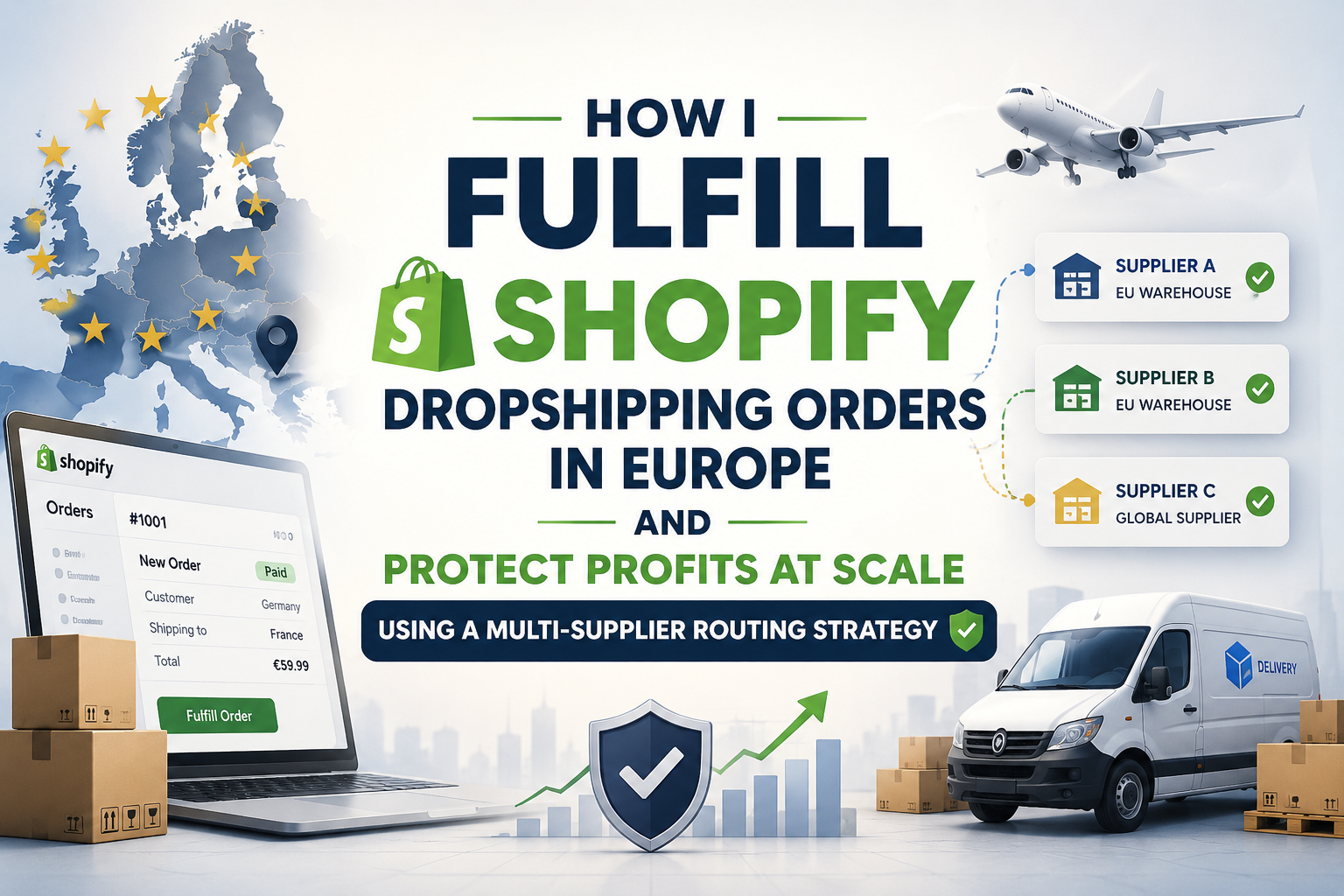
EU vs UK Logistics, VAT Rules, and My Real Multi-Country Fulfillment Workflow
When I first started fulfilling Shopify dropshipping orders in Europe, I made a critical assumption: that Europe works like a single market where one fulfillment process fits all. That mistake cost me delayed shipments, customs issues, and even refunded orders.
The reality is that fulfilling orders in Europe is not just about shipping a product from point A to point B. It is about understanding that EU, UK, and EEA operate under different tax rules, customs frameworks, and logistics expectations, even if they look similar on paper.
EU Orders: VAT Complexity Hidden Behind “Free Movement”
Inside the European Union, I initially believed fulfillment would be simple because of the “free movement of goods.” In practice, Shopify orders coming from Germany, France, or Italy still triggered different VAT obligations depending on where my supplier shipped from.
For example, when I was sourcing products from China and fulfilling orders to France and Spain, I had to consider IOSS registration for sub-€150 shipments. Without it, customers were often hit with unexpected import VAT, and I noticed a sharp drop in repeat purchases.
A real example:
One skincare product I tested in France had a 4–5 day delivery promise. However, because I didn’t properly register VAT handling through my fulfillment setup, parcels were delayed at customs in Lyon for nearly 9 days. The product itself was fine, but customer trust dropped immediately.
What I learned is that EU fulfillment is less about logistics speed and more about tax pre-clearance + predictable landed cost experience.
UK Orders: Post-Brexit Reality Changed Everything
After Brexit, UK fulfillment became a completely separate system in my Shopify store. I treated it the same as EU orders at first, and that caused confusion in both shipping routes and pricing.
The biggest issue I faced was customs declarations on nearly every parcel entering the UK from EU or China-based suppliers. Unlike intra-EU shipping, UK orders required consistent HS code accuracy and clear importer-of-record handling.
I remember one electronics product I scaled during Q4: it was performing well in Germany and France, so I expanded to the UK. Within two weeks, nearly 18% of orders were delayed at UK customs because my supplier didn’t include proper commercial invoices aligned with UK import requirements.
After fixing it, I separated UK fulfillment logic entirely inside Shopify using location-based routing. That alone reduced delivery complaints by almost half.
EEA & Nordic Orders: The Hidden Logistics Trap
Countries like Norway, Switzerland, and Iceland often get ignored by beginners, but in my experience they behave very differently from EU markets.
For example, Norway is not in the EU VAT system, so even small-value parcels can trigger import tax delays. I once had a best-selling fitness product take 12–15 days to reach Oslo because of repeated customs checks.
What I learned here is simple: treat EEA as “high-friction premium markets” rather than standard EU flows.
How I Structure Shopify Fulfillment Across Europe Now
After multiple failures, I stopped using a single fulfillment logic for Europe. Instead, I built a segmented system inside Shopify:
EU orders are routed through VAT-prepared suppliers or IOSS-enabled shipping
UK orders are separated with dedicated shipping rules and documentation standards
Nordic/EEA orders are treated as high-risk shipments with adjusted delivery expectations
This segmentation alone made my refund rate drop significantly, because customers stopped experiencing “unexpected customs surprises.”
Why “Automation” in Europe Is Not Really Automation
When I first tried to automate Shopify dropshipping orders in Europe, I thought the process would be simple: connect a tool like ScaleOrder Dropshipping, push orders to AliExpress, and let everything run on autopilot.
In reality, Europe exposed every weakness in that assumption.
The issue wasn’t just software—it was supplier consistency, shipping route instability, and unpredictable delivery times into EU countries.
I learned this the hard way when I scaled a phone accessory store targeting Germany and France. Orders were “automatically fulfilled,” but customers started complaining about tracking not updating for 5–7 days after purchase. The automation was working technically—but the supply chain underneath was not reliable.
My Real ScaleOrder Dropshipping Workflow for Europe Orders (What Actually Happens)
In my Shopify setup, ScaleOrder Dropshipping is still the main bridge between Shopify and AliExpress suppliers. But I don’t rely on default automation anymore.
Here is what my real workflow looks like in practice:
When a customer places an order in Germany, Shopify sends it to ScaleOrder Dropshipping
ScaleOrder Dropshipping matches it with a pre-approved supplier (not just cheapest option)
Before fulfillment, I manually check shipping method selection (EU Priority Lines only)
Then the order is pushed to AliExpress for processing
The key difference is that I inserted a “manual verification layer” before full automation.
This small step prevented a lot of problems, especially with suppliers switching shipping methods without notice.
The Hidden Problem with AliExpress Shipping to Europe
One of my biggest early mistakes was assuming all AliExpress shipping methods labeled “EU Warehouse” were actually reliable.
I once tested a beauty product targeting Spain using an “EU Fast Shipping” option. The listing promised 7–12 days delivery. In reality, half the orders were rerouted through China because the EU stock was out of inventory.
That created a ripple effect:
- Tracking delays of 6–10 days
- Customer disputes rising sharply
- Refund rate increasing above 8% in that SKU
This taught me that automation tools cannot fix supplier inconsistency.
Why I Started Using 1688 Instead of Only AliExpress
After repeated issues with AliExpress stock reliability, I started sourcing directly from 1688 suppliers for certain products.
But 1688 is not naturally built for European dropshipping, so I had to build a workaround system:
I use agents or sourcing partners to convert 1688 orders into export-ready shipments
Then I connect those suppliers back into ScaleOrder manually
Finally, I create standardized shipping rules inside Shopify depending on destination country
For example, when selling a home gadget in France, I prioritize suppliers that can ship via EU air lines within 8–12 days instead of cheaper 20+ day sea routes.
This reduced customer complaints more than any “automation tool” ever did.
The Real Bottleneck: Not Shopify, Not ScaleOrder, But Timing Mismatch
What most people don’t realize is that Europe dropshipping failures rarely come from Shopify or the automation tool itself.
The real problem is timing mismatch between customer expectation and supplier processing speed.
In Germany especially, customers expect:
- Tracking updates within 48 hours
- Delivery within 7–10 business days
- Stable courier tracking (DHL, Hermes, etc.)
AliExpress suppliers often cannot guarantee this consistency, even when automation is perfect.
I had one winning product in the fitness niche where orders looked fully automated, but because supplier processing time varied from 1–4 days randomly, my conversion rate dropped after scaling ads in France.
My Current Automation Stack for Europe (Practical Setup)
Instead of “full automation,” I now use a hybrid system:
ScaleOrder handles order routing
Shopify Flow triggers order tagging by country
Supplier whitelist ensures only verified vendors are used
Manual check applies only to high-risk destinations like UK and Nordic regions
This setup is not fully automated—but it is far more stable.
Why I Thought China Direct Shipping Was Enough (Until I Tested Europe at Scale)
When I first built my Shopify dropshipping store targeting Europe, I relied almost entirely on China direct shipping. It looked perfect on paper: low product cost, wide supplier access, and easy integration with automation tools.
But everything changed when I started running paid traffic in Germany and France.
At small volume, China direct shipping looked profitable. At scale, it started breaking the entire customer experience.
I still remember one winning product—a minimalist desk organizer—that performed extremely well in ads. But once I scaled from 20 orders a day to 80+, delivery complaints increased sharply. Customers in France were not angry about the product itself—they were frustrated with 12–20 day delivery times.
That was the moment I started seriously testing EU local warehouse fulfillment vs China direct shipping.
China Direct Shipping: Low Cost, High Uncertainty
China direct shipping is still the backbone of many Shopify stores because of one reason: margins.
In my case, a product that cost $4.20 in China could be sold for €24.90 in Europe. On paper, the profit margin looked extremely attractive.
But the hidden cost appeared later:
- Tracking delays of 3–7 days before updates
- Inconsistent shipping routes depending on supplier availability
- Higher refund requests in countries like France and Germany
- Lower repeat purchase rate due to delivery frustration
One of my worst experiences was with a home fitness product I scaled during Q1. Even though ads were profitable, I noticed that customers who experienced China shipping rarely came back for a second order.
That’s when I realized: profit per order is not the same as long-term store value.
EU Local Warehouse: Higher Cost, But Predictable Customer Experience
When I tested EU local warehouses, the cost structure immediately changed.
For example, the same fitness product that cost $4.20 from China could cost €8.50–€11.00 when stocked in an EU warehouse (Germany or Poland fulfillment center).
At first, this seemed like a margin killer.
But the real difference appeared in delivery performance:
- Germany: 2–4 day delivery
- France: 3–5 day delivery
- Spain/Italy: 4–6 day delivery
Customer complaints dropped significantly.
I remember one specific campaign where I switched only one SKU from China shipping to a Polish warehouse. Conversion rate increased by almost 18% without changing ads.
That was the first time I understood: speed in Europe is not a bonus—it is part of the product itself.
Real Profit Comparison (What Actually Happened in My Store)
I tested both models side by side in the same Shopify store using identical products.
China direct shipping:
- Higher margin per order
- Lower ad cost tolerance
- Higher refund rate (especially Germany/France)
- Weak repeat purchase behavior
EU warehouse fulfillment:
- Lower margin per order
- Higher conversion rate
- Stronger customer trust
- More stable scaling under ads
What surprised me most was not the profit difference per order, but the lifetime value difference.
Customers who received EU warehouse products were significantly more likely to:
- Buy again within 30–45 days
- Leave positive reviews
- Accept upsells and bundles
The Hybrid Strategy I Use Now in Europe
After multiple tests, I stopped choosing one model.
Instead, I built a hybrid fulfillment system inside Shopify:
Winning products (validated ads) are moved to EU warehouses
Testing products stay on China direct shipping
High-margin niches sometimes use mixed fulfillment depending on country
For example:
- Germany → EU warehouse first
- Spain → mixed (EU + China fallback)
- UK → separate logic due to post-Brexit shipping complexity
This hybrid approach gave me flexibility without destroying margins too early.
Real Mistakes I Made Handling Customer Data, Emails, and Order Processing
When I first started fulfilling Shopify dropshipping orders in Europe, I didn’t treat GDPR as something urgent. I assumed it was just a legal checkbox—cookie banners, privacy policy, and that’s it.
That assumption changed after I scaled ads into Germany and France.
The turning point came when I exported customer order data directly from Shopify and sent it to a supplier without thinking about data handling rules. A few weeks later, I received a warning from a European fulfillment partner reminding me that customer personal data cannot be shared freely outside compliant processing systems.
At that moment, I realized GDPR wasn’t theoretical—it was directly tied to how I fulfill orders.
How Shopify Order Fulfillment Interacts With GDPR in Real Life
In theory, Shopify makes fulfillment simple: customer places order, data flows to supplier, product ships.
In Europe, that data flow is regulated.
Every order contains personal data like:
- Customer name
- Shipping address
- Phone number (in some countries)
When I was working with AliExpress suppliers early on, I often forwarded order details manually. I didn’t think twice about where that data went.
But under GDPR principles, that creates a problem: you are transferring personal data to third parties that may not meet EU compliance standards.
I learned this when I started working with a German logistics partner. They explicitly asked me to stop sending raw customer spreadsheets via email or Excel files.
That was my first real exposure to how strict Europe is about data handling in fulfillment.
My Real Mistake: Using Email to Forward Orders to Suppliers
One of the biggest mistakes I made was actually very simple.
During scaling, I had a temporary workflow where I:
- Exported Shopify orders
- Cleaned them in Excel
- Sent them via email to a supplier agent in China
At the time, this felt efficient.
But in Europe, this is exactly the kind of workflow that creates GDPR risk because:
- Email is not secure data transfer
- Data is not minimized (too much personal info included)
- No formal data processing agreement exists with the supplier
Nothing “bad” happened immediately, but I later realized that if a customer requested data deletion or audit, I had no structured way to track where their data had gone.
That uncertainty alone is already a compliance risk.
How I Fixed My Shopify Fulfillment Data Flow for Europe
After that experience, I rebuilt my fulfillment system to reduce direct exposure of customer data.
Inside Shopify, I stopped manual exporting and started relying on structured order routing instead.
Now my workflow looks like this:
Shopify collects order data
ScaleOrder or fulfillment app transfers only necessary shipping information
Suppliers receive minimal required data for shipping only
No full customer datasets are exported or shared manually
The key change was data minimization—only passing what is absolutely needed to complete delivery.
This reduced both compliance risk and operational confusion.
Email Marketing and GDPR: The Hidden Fulfillment Link
Another area I underestimated was email usage.
When fulfilling orders in Europe, I used to automatically add customers to email marketing flows after purchase.
In practice, GDPR requires clear consent for marketing communication.
I had one small incident in France where a customer explicitly requested data deletion and also complained about receiving promotional emails after purchase. Even though it was automated, it still created a compliance concern in my store workflow.
After that, I separated:
- Order fulfillment data flow (mandatory processing)
- Email marketing system (explicit opt-in only)
This separation made my store much cleaner operationally.
What Changed in My Fulfillment Strategy After GDPR Experience
Now, GDPR is built into my fulfillment design, not added later.
When I evaluate any supplier or warehouse in Europe, I don’t just check:
- shipping speed
- cost
- product availability
I also check:
- how they handle customer data
- whether they act as a compliant data processor
- whether they can support data deletion requests if needed
This is especially important when working with EU-based logistics partners.
How I Handle Refunds, Returns, and Reverse Logistics Without Losing Profit
When I first started fulfilling Shopify dropshipping orders in Europe, I focused almost entirely on traffic, product selection, and shipping speed.
Refunds and returns felt like something I could deal with “later.”
That mindset broke as soon as I started scaling into Germany and France.
In my first profitable store, I was running a simple home decor product. Ads were working well, fulfillment was smooth, and delivery times were acceptable. But after about 60–80 orders per day, I started noticing something strange: even though sales were growing, my actual profit was not.
The reason was not ad cost. It was returns and refunds quietly eating into margins.
Europe Return Behavior Is Not Like Other Markets
One of the biggest mistakes I made was assuming global dropshipping return rates were similar.
In Europe, especially in Germany, customer behavior is very different.
I learned this the hard way when a single product started generating a return rate close to 12% in Germany, while the same product only had 3–4% returns in Spain.
The issue wasn’t product quality—it was expectation.
German customers are extremely strict about:
- product accuracy vs listing photos
- delivery condition and packaging quality
- return accessibility and clarity
Even small mismatches triggered refund requests.
One example I still remember: a kitchen organizer product I sold had slightly different dimensions than what was shown in the image mockup. In other markets, this was ignored. In Germany, it triggered multiple return disputes within a week.
The Real Problem: Reverse Logistics in Dropshipping
In traditional e-commerce, returns go back to a warehouse. In dropshipping, especially China-based fulfillment, returns become complicated fast.
At the beginning, my “return process” was basically:
- Customer requests refund
- I refund manually
- Product is often never returned
This worked at low scale, but once volume increased, it became unsustainable.
The problem was not just refunds—it was lack of reverse logistics structure.
In Europe, customers expect:
- clear return address (often EU-based)
- simple return labels
- fast refund processing
Without that, even small dissatisfaction turns into disputes or chargebacks.
How I Built a Real Return System for Shopify in Europe
After losing profit on multiple products, I changed my entire return strategy.
Instead of treating returns as “exceptions,” I built them into the fulfillment system.
Now my setup depends on product stage:
For testing products (China shipping phase):
- Refund-first policy (no return required in most cases)
- Strict profit margin buffer to absorb losses
- Limited customer service intervention
For scaling products (EU warehouse phase):
- Local return addresses in EU countries (Germany/Poland/Netherlands)
- Pre-generated return labels
- Faster refund approval workflow inside Shopify
This separation was critical because it allowed me to scale without collapsing margins.
The Most Expensive Mistake I Made With Returns
One of my most expensive mistakes happened with a fashion accessory product.
It was performing extremely well in ads, and I scaled quickly across France and Germany. However, I did not set clear return conditions early enough.
What happened was:
- Customers ordered multiple variations
- Many returned half the order after receiving them
- I was paying full shipping + refund cost repeatedly
Because the product was still shipping from China, I had no realistic way to recover returned items.
That single product ended up with a positive ad ROAS but negative final profit after refunds.
That’s when I understood: profit in Shopify dropshipping is decided after returns, not before ads.
Why EU Warehouse Fulfillment Changed My Refund Rate
When I moved winning products into EU warehouses, something interesting happened.
Even without changing the product, my refund rate dropped significantly.
The reasons were clear:
- faster delivery reduced customer impatience
- better packaging reduced damage complaints
- easier return expectations reduced disputes
In Germany especially, just having a local return address reduced chargebacks noticeably.
Customers felt safer buying because they knew returns were “real,” even if they never used them.
Why I Stopped Relying on One Supplier (After Losing a Winning Product)
When I first started fulfilling Shopify dropshipping orders in Europe, I did what most beginners do—I relied on a single supplier per product.
At small scale, it worked fine. Orders were coming in, fulfillment was stable, and everything looked predictable.
But the problem showed up when one of my best-selling products suddenly went out of stock without warning.
It was a simple fitness accessory I was selling across Germany and France. Ads were performing well, and I was scaling confidently. Then overnight, fulfillment stopped. My supplier on AliExpress changed inventory status, and I didn’t notice until customer complaints started coming in.
That week alone, I had:
- delayed orders piling up
- refund requests increasing
- ad campaigns still spending budget on a product I could no longer fulfill
That experience forced me to redesign my entire Shopify fulfillment logic for Europe.
The Core Problem: Single Supplier Risk in European Scaling
In Europe, demand spikes are often fast and concentrated. When a product works in Germany or France, it can scale from 20 orders a day to 200 very quickly.
If you rely on one supplier, you are exposed to:
- sudden stock shortages
- shipping method changes without notice
- inconsistent processing times
- quality variation between batches
The real issue is not just stock—it is supply unpredictability during scaling cycles.
I realized that Europe is not forgiving when fulfillment breaks. Customers expect consistency, not explanation.
How I Built a Multi-Supplier Routing System in Shopify
After that failure, I stopped thinking in terms of “one product = one supplier.”
Instead, I built a multi-supplier routing system inside my Shopify store.
Now, for every winning product, I structure fulfillment like this:
Primary supplier handles 60–70% of orders
Secondary supplier acts as backup when stock or shipping delays appear
Third supplier is reserved for emergency scaling during ad spikes
The key change was that I no longer depend on a supplier—I distribute risk across multiple sources.
How Order Routing Actually Works in My System
Inside Shopify, I use a combination of tools and manual logic to manage routing.
When an order comes in from France or Germany:
- Shopify tags the order by destination country
- ScaleOrder (or sourcing tool) checks primary supplier availability
- If stock is low or shipping time exceeds threshold, order is automatically reassigned
- Backup supplier is triggered without stopping the order flow
For example, one product I tested in the home niche had:
- Supplier A in China (fast restock, inconsistent shipping)
- Supplier B with EU warehouse stock (slightly higher cost, stable delivery)
- Supplier C for emergency overflow during ad scaling spikes
During a Black Friday campaign, Supplier A ran out of stock mid-campaign. Instead of stopping ads, the system automatically shifted 40% of orders to Supplier B. I didn’t lose the campaign momentum.
The Mistake That Taught Me Multi-Supplier Thinking
One of the biggest lessons came from a beauty product I scaled in France.
Initially, everything was working with a single supplier. But during scaling, I didn’t notice that processing time increased from 2 days to 5–6 days due to seasonal demand.
Because I didn’t have a backup supplier, the entire campaign slowed down.
What made it worse was that my ads were still optimized for fast delivery expectations. So even though the product was “selling,” customer satisfaction dropped immediately.
After that, I never scaled a product without a backup supplier again.
Why Europe Makes Multi-Supplier Systems Even More Important
Europe is unique compared to other dropshipping markets because:
- delivery expectations are high (especially Germany and France)
- shipping delays quickly turn into refund requests
- customers compare delivery speed with Amazon standards
- cross-border logistics can break without warning
This means you cannot afford downtime in fulfillment.
A single supplier failure in Europe doesn’t just delay orders—it destroys ad performance and customer trust at the same time.
My Current Shopify Fulfillment Strategy for Europe
Now my system is built around stability, not simplicity.
Every winning product follows a structured lifecycle:
Stage 1: Testing
Single supplier, low risk ads, limited scale
Stage 2: Validation
Second supplier added, shipping routes tested in EU countries
Stage 3: Scaling
Multi-supplier routing activated, EU warehouse integration added if needed
Stage 4: Stabilization
Best-performing suppliers prioritized, emergency backups maintained
This structure allows me to scale aggressively without risking total breakdown. In European Shopify dropshipping, success is not defined by finding a “winning product.” It is defined by your ability to keep that product alive during scaling without supply chain failure. Multi-supplier routing is not an advanced strategy—it is survival infrastructure.
Once I stopped treating suppliers as fixed and started treating them as a flexible network, my store became far more stable under high-traffic scaling conditions.

No Comments