


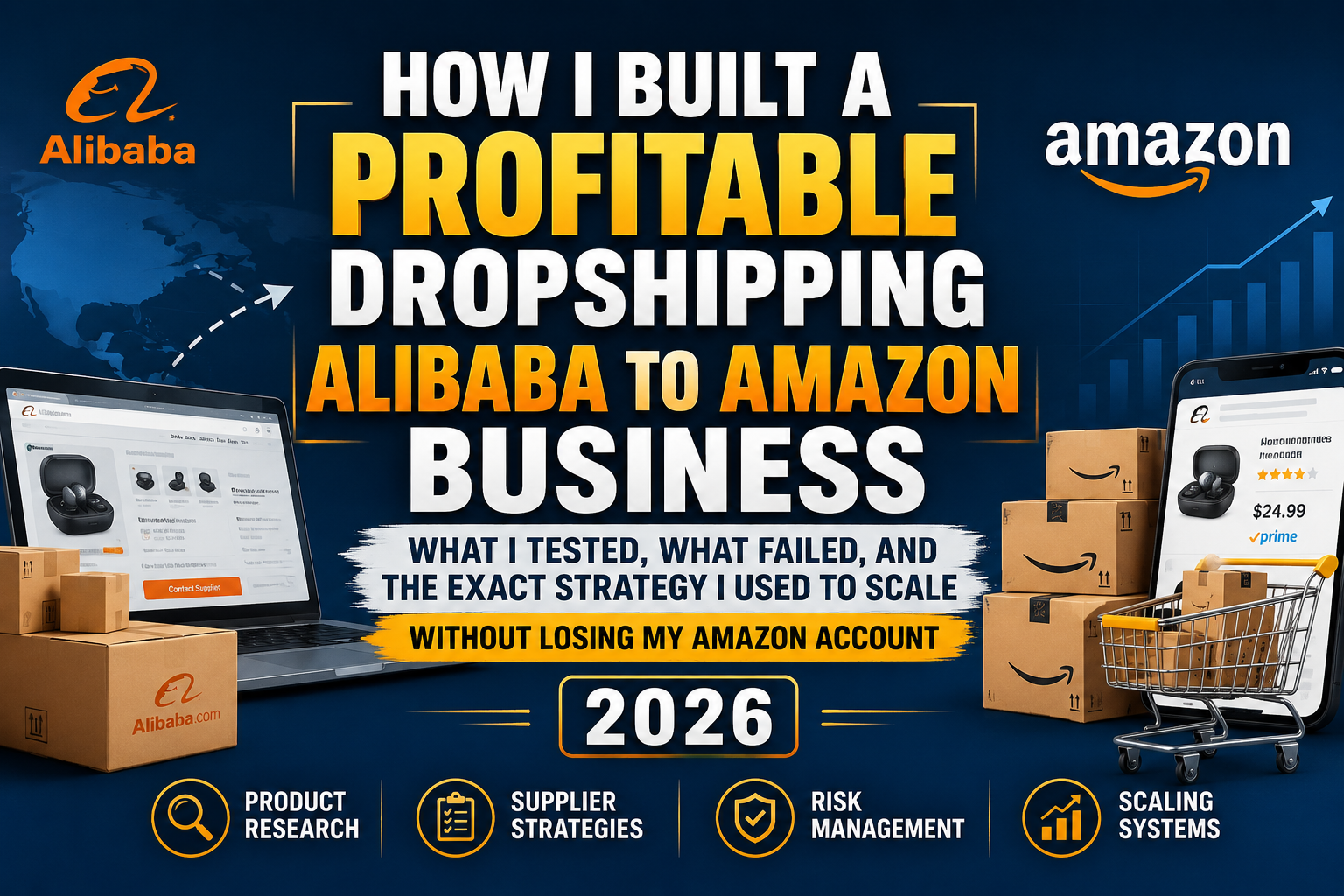
How I Built a Profitable Dropshipping Alibaba to Amazon Business: What I Tested, What Failed, and the Exact Strategy I Used to Scale Without Losing My Amazon Account in 2026

Alibaba suppliers are optimized for wholesale manufacturing. Amazon is optimized for fast consumer satisfaction. If you try connecting those systems without adapting logistics, packaging, communication speed, and delivery expectations, the business becomes fragile very quickly.
That is why many beginners make sales but still lose their stores.
Why Most Alibaba to Amazon Dropshipping Stores Fail in the First 90 Days — The Problems I Didn’t Expect Until Amazon Warned My Account
When I first started testing the Alibaba to Amazon model, I honestly believed the hardest part would be finding winning products. After all, Alibaba prices looked unbelievably cheap, and Amazon already had massive buyer traffic. On paper, the business seemed almost automatic.
What I didn’t understand was that Amazon does not reward “cheap sourcing.” It rewards operational stability.
My first store failed within three months, not because the products were bad, but because the fulfillment process created problems faster than I could fix them. I learned very quickly that Amazon’s algorithm watches shipping behavior far more aggressively than most beginners realize.
The first warning email I received was related to late shipment tracking updates. At that time, I thought a one- or two-day delay from my supplier in Shenzhen was normal. Amazon did not agree.
That experience completely changed how I approached Alibaba to Amazon dropshipping.
Slow Supplier Communication Became My Biggest Operational Risk
One of the biggest misconceptions beginners have is assuming Alibaba suppliers operate like Amazon sellers. They do not.
Most Alibaba factories are built for bulk B2B orders, not individual consumer fulfillment. When I started sending single-unit Amazon orders directly to suppliers, response times became unpredictable. Some suppliers answered immediately before payment but disappeared for 24 hours once orders started coming in daily.
I remember selling a trending kitchen organizer that suddenly gained traction after a small PPC campaign. I received 19 orders in two days. The supplier confirmed inventory, but later admitted they only had 6 units available.
That single mistake triggered:
- shipment delays
- angry customer messages
- order cancellations
- increased late shipment rate
Within weeks, my Amazon account health dashboard started turning yellow.
That was the moment I realized Alibaba sourcing and Amazon fulfillment are completely different systems trying to work together.
Amazon Customers Expect Prime-Level Delivery Even When You Don’t Offer Prime
This was another painful lesson.
Even if your listing does not use FBA, customers still mentally compare your shipping speed to Prime. If tracking updates slowly or delivery takes 10–15 days, refund requests increase dramatically.
One product I tested had a 28% refund rate simply because customers thought the item was “lost,” even though it was still in transit from China.
The strange part was that the product quality itself was actually good. The real issue was delivery psychology.
Alibaba suppliers often use shipping methods that look inexpensive upfront but create tracking gaps after export customs processing. During that gap, Amazon buyers become nervous and impatient.
I eventually discovered that customer perception matters almost as much as the product itself.
Packaging Mistakes Nearly Got My Listing Removed
Another hidden problem was packaging inconsistency.
One supplier accidentally included Chinese invoices and factory promotional cards inside customer shipments. A buyer uploaded photos in a negative review, and suddenly my listing looked like unauthorized reselling instead of a professional Amazon business.
That incident taught me something most YouTube tutorials never mention:
Amazon cares deeply about brand presentation consistency.
If your supplier changes tape, inserts random branding, or uses poor packaging materials, customers notice immediately. Worse, Amazon notices repeated complaints.
After that situation, I stopped working with suppliers who refused standardized packaging requirements.
The Hybrid Warehouse Strategy That Finally Stabilized My Store
The turning point came when I stopped relying on pure direct fulfillment from Alibaba.
Instead, I started sending small inventory batches to a US third-party warehouse. I still sourced products from Alibaba, but I shortened delivery times dramatically.
The difference was immediate:
- lower refund rates
- faster tracking uploads
- better customer reviews
- improved account health metrics
Ironically, holding a little inventory reduced my financial risk because account stability improved so much.
Most beginners think avoiding inventory is the safest option. In reality, unstable fulfillment is often far more dangerous than small inventory exposure.
The Exact Product Criteria I Use to Find High-Margin Winners Before Competitors Notice Them
When I first started sourcing products from Alibaba for Amazon, I made the same mistake most beginners make: I chased products with huge demand.
If a product had thousands of monthly Amazon sales and looked “viral,” I assumed it was worth importing. That strategy nearly destroyed my margins.
What I learned after testing dozens of products is that high demand means almost nothing if the operational math is weak. Some of my worst-performing products were the ones with the highest sales volume.
One example was a portable blender I sourced from Alibaba. The supplier price looked incredible at first glance. I calculated nearly 40% profit margins and rushed to launch it on Amazon.
Then reality hit.
After Amazon referral fees, PPC costs, return rates, oversized storage fees, and damaged units during shipping, my real margin dropped below 8%. I was working nonstop just to stay barely profitable.
That experience completely changed how I evaluate Alibaba to Amazon arbitrage opportunities.
I Ignore “Trending Products” and Look for Operational Advantages Instead
Most sellers search Alibaba using phrases like:
- “best-selling gadgets”
- “TikTok viral products”
- “winning Amazon products”
I stopped doing that a long time ago.
Now, I specifically search for products with operational inefficiencies competitors overlook. I care more about stability than hype.
For example, I actively avoid products that:
- break easily during shipping
- require batteries
- have sizing variations
- trigger high return rates
- depend on visual color accuracy
Instead, I look for simple products with predictable fulfillment behavior.
One of the best products I ever tested was a small desk cable organizer. It was not exciting. Nobody on YouTube was talking about it. But it had three characteristics I now consider essential:
- lightweight shipping
- almost zero customer education required
- extremely low return probability
That product quietly outperformed several “viral” products I had tested earlier.
My Real Product Selection Formula Starts With Amazon Fees, Not Supplier Price
Most beginners start with Alibaba pricing. I start with Amazon costs.
That difference matters enormously.
Before I even contact suppliers, I calculate:
- FBA fees
- referral fees
- estimated PPC costs
- return exposure
- storage risk
- packaging dimensions
Only after those numbers make sense do I analyze supplier pricing.
I once rejected a product with amazing demand simply because it exceeded Amazon’s standard-size tier by less than one inch. That extra size classification would have reduced my monthly profit by nearly 30%.
Most sellers never notice details like that until they are already losing money.
Amazon fee structures silently kill thousands of products that appear profitable on paper.
I Use Supplier Behavior as a Product Quality Signal
This is one of the most underrated strategies I use today.
I no longer evaluate only the product itself. I evaluate how the supplier behaves during negotiation.
Fast replies do not impress me anymore. What matters is operational precision.
I pay attention to:
- whether suppliers understand Amazon packaging requirements
- whether they can provide barcode labeling correctly
- whether they can maintain packaging consistency
- how they respond when I ask difficult logistical questions
One supplier once became irritated when I asked about carton weight consistency across batches. That immediately told me they lacked stable quality control.
I walked away from that deal.
Three months later, I found other Amazon sellers complaining online about damaged shipments from the exact same factory.
That experience taught me something important: supplier attitude often predicts future operational problems.
Why I Prefer “Boring Products” Over Viral Products
Today, some of my most reliable Alibaba to Amazon products are incredibly boring.
Desk accessories. Storage organizers. Simple household utility products.
Why?
Because boring products usually attract fewer emotional buyers. Emotional buyers return products more often, complain more aggressively, and leave harsher reviews.
I learned this after testing trendy LED room decor products that generated massive sales but endless customer complaints about brightness, colors, and expectations.
Meanwhile, practical utility items generated lower excitement but far more stable profits.
The biggest lesson I learned from Alibaba to Amazon arbitrage is that sustainable margins usually come from operational simplicity, not viral attention.
Is Alibaba to Amazon Dropshipping Still Profitable in 2026? My Real Numbers After Testing 17 Products
When people talk about Alibaba to Amazon dropshipping, they usually focus on supplier prices. That is the most misleading part of the business.
In early 2025, I decided to run a serious profitability experiment. Instead of relying on YouTube advice or screenshots from “gurus,” I tested 17 different products sourced from Alibaba and sold through Amazon.
Some products looked incredibly profitable at first. A supplier might quote me $3.20 for a product selling on Amazon for $24.99. On paper, the margins seemed enormous.
But after several months of testing, I realized the supplier price was only a small part of the equation.
Out of those 17 products, only 3 remained consistently profitable after accounting for all operational costs.
That completely changed my understanding of the Alibaba to Amazon model.
Advertising Costs Destroyed More Products Than Competition Did
The biggest surprise was not supplier issues or shipping delays. It was PPC advertising.
Many beginners underestimate how expensive Amazon traffic has become in 2026. Some categories are now so saturated that advertising costs alone can erase the entire profit margin.
One home improvement product I tested had:
- a supplier cost of $4.80
- Amazon selling price of $27.99
- estimated profit margin of nearly 45%
But after launch, the numbers looked very different.
My average cost-per-click climbed above $1.60 within two weeks because established sellers were aggressively defending keyword rankings. By the end of the month, my advertising cost of sales (ACOS) exceeded 38%.
Even though the product generated revenue, the business itself barely made money.
I realized that profitability on Amazon is often determined by traffic economics, not supplier pricing.
Refund Rates Quietly Killed Several “Winning” Products
Another hidden issue was customer returns.
One product that initially looked like a perfect winner was a portable neck fan sourced from Alibaba. Sales were strong during warmer months, and conversion rates looked healthy.
Then the refunds started.
Some buyers complained about battery life. Others expected stronger airflow. A few customers simply misunderstood the product size based on listing photos.
The refund rate eventually reached 21%.
What shocked me most was how quickly returns destroyed profitability. Every refund created multiple losses simultaneously:
- lost advertising spend
- return processing fees
- damaged inventory
- negative review risk
The product was generating impressive sales volume but weak actual profit.
That experience taught me something I still use today:
High sales do not automatically mean high profitability.
Shipping Volatility Became Harder to Predict in 2026
Shipping instability also became a major factor.
During one quarter, I saw freight prices fluctuate so aggressively that my projected margins changed almost monthly. One supplier suddenly increased export pricing because of container shortages and customs delays.
A product that previously generated 22% net profit dropped below 10% almost overnight.
This is one reason many Alibaba to Amazon sellers struggle emotionally with the business. The model feels stable when you calculate costs initially, but external variables constantly move underneath you.
In my case, the most dangerous products were not the low-profit items. They were the products with unstable logistics.
The Products That Survived Had Surprisingly Simple Characteristics
After testing all 17 products, I noticed something interesting.
The profitable products were not the trendiest items.
The winners usually had:
- simple functionality
- low return probability
- lightweight shipping
- minimal customer expectations
- stable packaging
- low breakage risk
One of my best-performing products was a simple cable management accessory for home offices.
It was not exciting.
It was not viral.
It never exploded on TikTok.
But it had consistent demand, low refunds, and predictable shipping costs. More importantly, customers rarely complained because the product solved a straightforward problem.
Meanwhile, trend-driven products generated emotional buying behavior, which almost always increased refunds and customer dissatisfaction.
Is Alibaba to Amazon Dropshipping Still Worth It?
Yes — but not in the way most people imagine.
The easy-money version of Alibaba to Amazon dropshipping is mostly gone. In 2026, the business rewards operators who understand logistics, advertising efficiency, customer psychology, and long-term fulfillment stability.
What I learned after testing 17 products is that profitability today comes from reducing operational friction, not chasing viral trends.
The sellers still succeeding are usually the ones treating the business like a supply chain operation instead of a shortcut to fast cash.
Alibaba to Amazon Without Inventory: The Hybrid Fulfillment Strategy I Wish I Knew Before Losing My Best Listing
When I first started using Alibaba suppliers to fulfill Amazon orders directly, I thought avoiding inventory automatically reduced risk.
Technically, I had no warehouse costs, no unsold stock sitting around, and very little upfront investment. From the outside, the business looked efficient.
But after several months, I realized I had simply exchanged inventory risk for operational chaos.
My biggest problem was unpredictability.
One week, orders shipped smoothly. The next week, supplier processing suddenly slowed because of factory scheduling delays. Sometimes tracking numbers updated late. Sometimes packaging changed without warning. During holiday periods, delivery estimates became almost impossible to trust.
The breaking point came after one of my best-performing Amazon listings suddenly lost ranking momentum because shipment delays triggered customer complaints and late delivery metrics.
I still remember refreshing my Seller Central dashboard and watching account health warnings appear while my sales dropped day after day.
That was the moment I realized pure Alibaba-to-customer fulfillment was too fragile for long-term scaling.
The Hybrid Model Changed Everything
Instead of fully abandoning dropshipping, I changed the fulfillment structure.
I started using what I now call a hybrid fulfillment model.
Rather than forwarding every individual order directly from China, I began sending small inventory batches from Alibaba suppliers to a US third-party warehouse. I still avoided massive bulk purchasing, but I gained much more control over shipping speed and consistency.
At first, I was nervous about holding inventory. I thought even 100–200 units felt financially dangerous.
Ironically, the opposite happened.
My business became significantly more stable almost immediately.
Faster Shipping Improved More Than Just Delivery Times
The most surprising part was how many hidden problems disappeared once products were stored domestically.
Customer complaints dropped sharply because orders arrived faster and tracking updated normally. Refund requests decreased because buyers no longer assumed their packages were “stuck somewhere overseas.”
Even my Amazon advertising performance improved.
Most people do not realize this, but fulfillment quality quietly affects conversion rates. Once my delivery estimates became shorter and more reliable, customers trusted the listings more.
One office accessory product I sold went from inconsistent daily sales to steady performance within weeks after moving inventory into a US warehouse.
The product itself never changed.
The logistics changed everything.
I Stopped Competing Against Amazon Prime Expectations
One of the hardest realities about selling on Amazon is that customers compare every experience to Prime, even if your products are not fulfilled by Amazon.
When I used direct Alibaba fulfillment, estimated delivery times sometimes stretched beyond 10 days. That immediately created psychological resistance for buyers.
Customers would message me asking:
“Is this item really in stock?”
“Why has tracking not updated?”
“Did my order ship yet?”
Those messages consumed enormous amounts of time.
After switching to hybrid fulfillment, most of those problems disappeared because the products were already inside the country before the customer purchased them.
I finally understood that modern Amazon selling is largely about reducing customer uncertainty.
The Small Warehouse Test That Saved My Store
The turning point happened almost accidentally.
I decided to test a small batch of 300 units for a desk organization product that was already performing reasonably well through direct fulfillment. Instead of shipping individually from China, I sent the batch to a US warehouse partner.
The difference shocked me.
Within two months:
- refunds dropped noticeably
- review quality improved
- account health stabilized
- repeat purchases increased
- ad conversion rates improved
Most importantly, my stress level dropped dramatically.
For the first time, the business felt predictable instead of reactive.
That experience completely changed how I think about inventory risk.
Why “No Inventory” Is Sometimes the Most Dangerous Strategy
Many beginners believe inventory is the enemy because unsold products can create losses.
That is true.
But unstable fulfillment can destroy an Amazon business much faster than slow-moving inventory.
When suppliers delay orders, change packaging unexpectedly, or struggle with tracking reliability, the entire Amazon account becomes vulnerable. One bad fulfillment period can damage rankings you spent months building.
Today, I no longer see inventory as a simple expense.
I see controlled inventory as operational insurance.
That is why my current Alibaba to Amazon strategy focuses on smaller, smarter inventory positioning rather than pure direct fulfillment.
The Hidden Risks of Using Alibaba Suppliers for Amazon Orders — The Mistakes That Nearly Destroyed My Best-Selling Listing
When I first started sourcing products from Alibaba for Amazon, I believed the biggest challenge would be negotiating pricing.
At the time, I was obsessed with finding the lowest possible manufacturing cost. I compared dozens of factories, negotiated aggressively, and constantly calculated margins.
What I completely underestimated was supplier risk.
Not pricing risk.
Not shipping risk.
Operational supplier risk.
The truth is that many Alibaba suppliers look professional during early conversations. They respond quickly, send polished product photos, and promise fast production timelines. But once orders start scaling, hidden problems begin appearing that most beginners never anticipate.
I learned this the hard way after one supplier nearly destroyed my best-performing Amazon listing.
The Packaging Change That Triggered Customer Complaints Overnight
One of my highest-selling products was a simple desk accessory. Sales were stable, reviews were positive, and advertising performance looked strong.
Then suddenly, negative reviews started appearing within the same week.
Customers complained that:
- packaging looked cheap
- products arrived scratched
- branding looked inconsistent
At first, I assumed Amazon fulfillment damaged the shipments. But after ordering the product myself using a customer account, I discovered the real issue.
Without informing me, the supplier had changed the internal packaging materials to reduce costs.
The original foam protection had been replaced with thinner inserts, which caused products to shift during shipping. Worse, the supplier also added a factory promotional card written entirely in Chinese inside the package.
That single decision changed customer perception instantly.
On Amazon, packaging consistency is not a small detail. Customers associate packaging quality with product legitimacy.
Within weeks, my listing conversion rate dropped noticeably.
Fake Certifications Are More Common Than Most Sellers Realize
Another problem I encountered involved compliance documents.
One supplier confidently sent me certification files for an electronic accessory product. Everything looked legitimate at first glance. The documents included testing logos, technical specifications, and compliance language.
Fortunately, before scaling the product, I decided to verify the documents independently.
The certification numbers did not match the issuing organization’s database.
The supplier had edited old certification templates from another product.
That moment completely changed how I evaluate Alibaba suppliers.
Many factories are excellent manufacturers, but some suppliers prioritize closing deals over long-term operational transparency. If Amazon requests compliance verification and the documents are invalid, the listing can face immediate suspension.
Most beginners do not think about this risk until their account is already under review.
Recycled Tracking Numbers Nearly Triggered an Amazon Investigation
One of the strangest issues I faced involved shipping tracking numbers.
During a busy sales period, I noticed several customers claiming their tracking information showed packages delivered to completely different states.
At first, I thought the logistics carrier made a mistake.
Later, I discovered the supplier’s freight partner had accidentally reused old tracking numbers before the carrier system fully updated.
From Amazon’s perspective, this looked extremely suspicious.
Multiple customer complaints appeared simultaneously, and my account metrics started deteriorating rapidly. I spent days manually responding to support tickets and uploading shipment explanations.
That experience taught me something critical:
Amazon does not care whether the supplier caused the problem. The seller absorbs the consequences.
Supplier Communication Often Gets Worse After You Start Scaling
One of the most dangerous patterns I noticed is that some suppliers perform extremely well during small test orders but struggle once order volume increases.
In the beginning, response times are fast because suppliers are trying to secure the business relationship. But after scaling, priorities shift.
I once worked with a supplier that handled 5 daily orders perfectly. Once volume increased beyond 40 daily shipments, problems started appearing everywhere:
- delayed dispatching
- inconsistent packaging
- inventory mismatches
- missing accessories
- slower customer support responses
The supplier simply was not operationally prepared for higher-volume Amazon fulfillment.
That experience taught me to stop evaluating suppliers based only on samples and early communication.
Real supplier quality only becomes visible under operational pressure.
Why I Now Treat Supplier Selection Like Risk Management
Today, I no longer see Alibaba supplier sourcing as a price negotiation process.
I see it as risk management.
A cheap supplier can become extremely expensive if they create:
- listing suspensions
- customer complaints
- refund spikes
- intellectual property risks
- packaging inconsistency
- compliance problems
Some of the best suppliers I work with today are not even the cheapest ones. They are the factories that maintain stable packaging, consistent communication, accurate inventory updates, and operational discipline during scaling periods.
That reliability is far more valuable than saving a few cents per unit.
The Real Danger of Alibaba to Amazon Selling Isn’t Competition
Most beginners think the biggest threat in Alibaba to Amazon selling is market competition.
In my experience, the bigger danger is operational instability behind the scenes.
A product can look profitable for months, but one supplier mistake can suddenly damage:
- customer trust
- account health
- listing rankings
- advertising performance
That is why experienced Amazon sellers eventually stop chasing the absolute cheapest suppliers.
Long-term success usually comes from building stable fulfillment systems with suppliers who understand Amazon’s operational standards, not just manufacturing.
From Alibaba to Amazon FBA: How I Scaled Faster After Quitting Pure Dropshipping
When I first began selling products sourced from Alibaba on Amazon, I was completely focused on avoiding inventory.
At the time, pure dropshipping felt like the smartest possible model. I could test products with minimal upfront investment, avoid warehouse costs, and launch new items quickly.
For a while, it worked.
I found several products that generated consistent sales, and the low financial barrier made experimenting easy. But after scaling beyond a certain point, I started noticing a serious problem:
The business became increasingly difficult to stabilize.
My account health constantly fluctuated because fulfillment quality depended entirely on suppliers. Shipping times varied, packaging changed unexpectedly, and customer complaints became harder to control as order volume increased.
The most frustrating part was that some products clearly had long-term potential, yet operational instability kept limiting growth.
That was when I started questioning whether pure dropshipping was actually preventing my business from scaling.
The Product That Forced Me to Change My Entire Strategy
One product completely changed my thinking.
It was a simple ergonomic desk accessory sourced from Alibaba. Initially, I tested it through direct supplier fulfillment because I wanted to validate demand before investing heavily.
The product performed surprisingly well:
- conversion rates stayed strong
- refund rates remained low
- customer reviews were positive
- advertising costs stayed manageable
But there was one major issue.
Shipping speed.
Even though customers liked the product itself, delayed deliveries kept generating customer service problems. Some buyers canceled orders before delivery. Others left negative reviews because tracking updates were inconsistent.
I realized the product itself was not the problem anymore.
The fulfillment model was.
That was the moment I decided to transition the product into Amazon FBA.
Moving From Dropshipping to FBA Felt Risky at First
My first Alibaba bulk order for FBA was terrifying.
Until then, I had always avoided large inventory purchases because I associated inventory with financial danger. The idea of committing thousands of dollars to a single product felt emotionally uncomfortable.
I remember calculating the numbers repeatedly before placing the order.
What if demand disappeared?
What if the listing lost ranking?
What if Amazon storage fees destroyed profitability?
But after months of data collection through dropshipping, I already understood something important:
- the product had stable demand
- return rates were low
- customer satisfaction was consistent
The dropshipping phase had effectively become my market research system.
That realization made the transition much less risky than I originally imagined.
Amazon FBA Solved Problems I Could Never Fully Control With Dropshipping
The impact was immediate.
Once inventory arrived inside Amazon’s fulfillment network, delivery speeds improved dramatically. Customers trusted the listing more because Prime shipping reduced uncertainty.
Several operational problems almost disappeared overnight:
- fewer customer complaints
- lower cancellation rates
- better review consistency
- improved Buy Box stability
- higher conversion rates
Even my PPC performance improved because faster delivery increased buyer confidence.
One surprising detail was how much less time I spent handling customer service. Before FBA, I constantly dealt with shipment questions and tracking concerns. After switching to FBA, the business felt significantly more automated.
For the first time, scaling felt realistic instead of chaotic.
Why Alibaba Dropshipping Became My Product Validation System
Today, I no longer see dropshipping and FBA as competing business models.
I see them as different phases of the same scaling strategy.
Dropshipping allows me to:
- test demand cheaply
- collect customer feedback
- analyze return behavior
- evaluate profit potential
- validate keyword performance
Then, once a product proves stable, I transition it into FBA for operational efficiency and faster scaling.
This hybrid approach dramatically reduced the risk of dead inventory because I stopped guessing which products would succeed.
Instead, I used real sales data before committing to larger inventory orders.
The Biggest Mistake Most Beginners Make
Many beginners approach Alibaba to Amazon selling with an “all or nothing” mindset.
Some people jump directly into large FBA orders without testing products properly. Others stay stuck in pure dropshipping forever because they fear inventory risk.
I made both mistakes at different stages.
What finally worked was combining the strengths of both systems:
- dropshipping for validation
- FBA for scaling
That balance created a much more stable business model than relying entirely on one approach.
Why Most Long-Term Amazon Sellers Eventually Transition Beyond Pure Dropshipping
After working through both models, I now understand why many experienced Amazon sellers eventually move toward FBA or hybrid fulfillment systems.
Pure dropshipping offers flexibility, but long-term Amazon growth usually requires:
- faster delivery
- stronger branding
- stable fulfillment
- better customer experience
- operational predictability
Amazon rewards consistency.
That is difficult to achieve when every shipment depends on overseas supplier coordination.
For me, Alibaba dropshipping was never the final destination. It became the testing engine that helped me identify products worth scaling seriously through Amazon FBA.
That shift completely changed both my profitability and the long-term stability of my business.


No Comments