


Can Dropshipping Be a Full Time Job? Real Income Potential, Workload Reality, and Whether It’s Still Worth It Today

Dropshipping can absolutely become a full-time job, but it rarely happens quickly. Replacing a salary generally requires stable monthly profit rather than occasional viral sales. Businesses that achieve long-term success usually combine healthy margins, repeat customers, operational efficiency, and disciplined financial management.
For entrepreneurs willing to approach dropshipping with realistic expectations and a long-term mindset, it can evolve from a side project into a sustainable source of full-time income. For those searching for immediate results with minimal investment and effort, the business model often becomes disappointing.
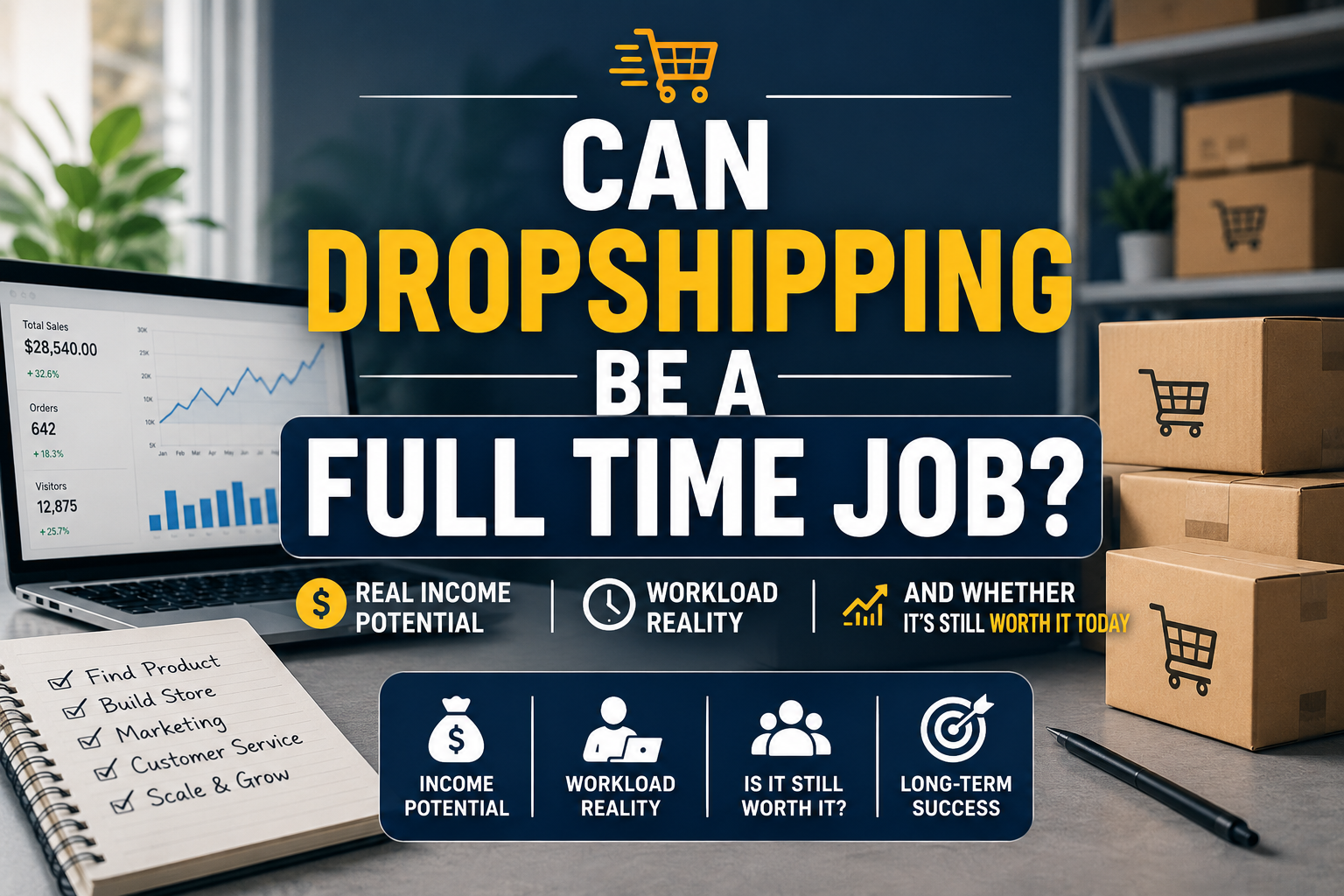
Can Dropshipping Be a Full Time Job? Revenue, Margins, and Monthly Income Potential
The question “can dropshipping be a full time job” usually comes from people who are not looking for side income anymore. They want to know whether an online store can replace a traditional salary and provide enough financial stability to cover living expenses, savings, and long-term goals. The answer is yes, but only under specific business conditions and with realistic expectations about revenue and profitability.
The Difference Between Revenue and Income
One of the biggest misunderstandings in dropshipping is confusing sales volume with personal income. A store generating $50,000 in monthly revenue may sound impressive, but revenue is not profit. Product costs, advertising expenses, payment processing fees, refunds, and software subscriptions all reduce the amount that eventually becomes take-home income.
For example, a store with a 20% net profit margin generating $50,000 in monthly sales would produce approximately $10,000 in net profit before taxes. On the other hand, a store operating with only a 5% net margin would require $200,000 in monthly sales to achieve the same result. This explains why profit margin is often more important than total revenue when evaluating whether dropshipping can become a full-time occupation.
How Much Income Is Needed to Replace a Traditional Job?
The amount of income required varies depending on the country and personal lifestyle. In many parts of North America and Europe, replacing a traditional full-time salary often requires a business producing between $4,000 and $8,000 in monthly net profit. After taxes and business reserves, this level of income provides a financial position similar to many middle-income jobs.
Assuming a net profit margin of 15%, achieving $5,000 in monthly profit requires approximately $33,000 in monthly revenue. If the average order value is $70, the store would need around 470 orders per month, or approximately 16 orders per day. While this may initially appear difficult, it becomes achievable once a store finds a product-market fit and develops a stable customer acquisition system.
Profit Margins Determine Sustainability
Not all dropshipping businesses operate under the same economic model. Generic products with intense competition often generate net margins below 10%, making it difficult to support a full-time income without very high sales volume.
In contrast, stores focusing on branding, customization, private labeling, or unique product positioning frequently achieve net margins between 20% and 30%. Higher margins reduce dependency on advertising efficiency and create more room for reinvestment and business growth.
This is one reason why many experienced operators eventually move away from purely transactional products and invest in building recognizable brands and customer loyalty.
Most Stores Fail Before Reaching Full-Time Income
While dropshipping can become a full-time job, most stores never reach that stage. The primary reason is not market saturation but unrealistic expectations. Many beginners expect profitability within a few weeks and stop investing after the first unsuccessful product test.
Successful full-time operators often test dozens of products before identifying a scalable opportunity. They treat dropshipping as a business rather than a shortcut to financial freedom. Product research, advertising optimization, supplier management, and customer service all require continuous improvement.
The barrier is not technical complexity but business persistence and capital management.
Can Dropshipping Be a Full Time Job Without Long Hours? The Truth About Workload and Automation
Many people are attracted to dropshipping because of the promise of flexibility and location independence. Social media often portrays the business model as a source of passive income that allows entrepreneurs to work only a few hours per week while generating substantial profits. This perception leads to an important question: can dropshipping be a full-time job without requiring the same time commitment as a traditional career?
The answer is more complicated than most beginners expect. Dropshipping can eventually provide flexibility, but reaching that stage usually requires a significant investment of time during the early growth phase.
The Startup Phase Often Requires More Time Than a Traditional Job
During the first few months, a dropshipping business is rarely passive. Entrepreneurs must spend time researching products, analyzing competitors, creating product pages, launching advertising campaigns, and testing different marketing strategies.
A beginner may spend several hours each day monitoring advertising performance, adjusting targeting settings, responding to customer inquiries, and communicating with suppliers. Unlike traditional employment where responsibilities are clearly defined, new store owners must handle every aspect of the business themselves.
In many cases, the workload during the launch phase can exceed the workload of a standard forty-hour work week.
Daily Operations Become More Efficient Over Time
Once a store identifies profitable products and establishes a stable customer acquisition process, the nature of the work changes significantly. The focus gradually moves away from constant product testing and toward optimization and management.
Instead of creating new campaigns every day, operators begin improving conversion rates, increasing average order values, and expanding successful marketing channels. Decision-making becomes more strategic and less reactive.
At this stage, a business generating consistent revenue may require only a few hours of direct involvement per day, depending on the complexity of operations and the size of the team.
Automation Reduces Repetitive Tasks but Does Not Replace Management
Automation is one of the main reasons dropshipping can become more flexible than many traditional businesses. Order synchronization, inventory updates, tracking number uploads, email notifications, and customer communication can all be partially automated using modern software.
However, automation does not eliminate the need for management. Advertising performance still requires regular monitoring. Suppliers occasionally encounter stock shortages or shipping delays. Customer complaints and refund requests still need human decisions.
Automation removes repetitive operational work, but strategic tasks remain essential for long-term profitability.
Scaling Often Creates New Responsibilities
Many entrepreneurs assume that business growth automatically leads to less work. In reality, scaling introduces new challenges that require attention.
Higher order volumes increase customer service requests, supplier coordination, quality control concerns, and financial management complexity. Expanding into multiple countries or marketing channels adds additional layers of decision-making.
As a result, many successful dropshipping businesses eventually hire virtual assistants, customer service representatives, media buyers, or operations managers. The owner’s role evolves from operator to manager rather than disappearing completely.
The Business Offers Flexibility Rather Than Less Work
Compared with traditional employment, dropshipping provides greater control over schedule and location. Business owners can often decide when they work, where they work, and how quickly they expand.
This flexibility should not be confused with reduced effort. Building a profitable store generally requires discipline, experimentation, and long periods of uncertainty before stable results appear.
The major advantage is not necessarily working fewer hours but having more control over how those hours are used.
Can Dropshipping Be a Full Time Job in 2026? Competition, Market Trends, and Future Opportunities
One of the most common concerns among aspiring entrepreneurs is whether dropshipping is already too competitive to become a full-time career. Stories of highly profitable stores from the early days of Facebook advertising have created the impression that the best opportunities have disappeared. As competition increases and customer acquisition costs rise, many people wonder whether dropshipping can still provide a sustainable full-time income in 2026.
The answer is yes, but the business model has changed significantly from what it was five or ten years ago.
Competition Has Increased, but So Has Market Size
There is no doubt that entering the market today is more difficult than it was during the early growth period of ecommerce. Millions of stores now compete for attention across social media platforms and search engines. Generic products that once generated strong returns often face price wars and shrinking profit margins.
However, global ecommerce spending continues to grow every year, creating larger markets despite higher competition. More consumers are comfortable purchasing from independent online brands, and social commerce platforms continue introducing new opportunities for customer acquisition.
Competition has increased because demand has increased as well. Mature industries rarely disappear simply because more businesses participate in them.
The Era of Generic Products Is Fading
One of the biggest changes in modern dropshipping is the decline of purely opportunistic product selling. In previous years, many stores succeeded by importing identical products and competing primarily on advertising speed.
This strategy has become increasingly difficult because competitors can quickly copy winning products and advertising creatives. Customers also have more tools to compare prices across multiple sellers.
As a result, long-term operators increasingly focus on branding, product differentiation, custom packaging, and customer experience. The business is evolving from simple arbitrage toward brand building.
The companies adapting to this transition are often the ones generating stable full-time income.
Short-Form Video Has Reduced Entry Barriers
While paid advertising costs have risen, new traffic sources have emerged. Short-form video platforms have changed how products are discovered and purchased.
Organic content on video-based platforms allows businesses to generate significant exposure without relying entirely on expensive advertising campaigns. Creative storytelling and product demonstrations can produce substantial traffic at relatively low cost.
This shift favors businesses that understand content creation rather than simply advertising budgets. In many cases, creativity now competes directly with capital.
For new entrepreneurs, this creates opportunities that did not exist during earlier stages of ecommerce development.
Artificial Intelligence Is Improving Operational Efficiency
Artificial intelligence is becoming an important competitive advantage for modern dropshipping businesses. Product descriptions, customer support responses, advertising creatives, and market research can now be completed faster and more efficiently than before.
Automation tools reduce the amount of manual work required to operate a store and allow smaller teams to manage larger order volumes.
While AI does not replace strategic decision-making, it lowers operational barriers and allows entrepreneurs to focus on higher-value activities such as brand positioning and customer acquisition.
Businesses that successfully combine automation with human creativity are likely to outperform competitors in the coming years.
Success Depends More on Business Quality Than Market Timing
Many people ask whether they are too late to start dropshipping. A more useful question is whether they are building a business that customers actually value.
Stores offering poor customer service, weak branding, and undifferentiated products face increasing pressure regardless of market conditions. In contrast, businesses that create trust, solve specific problems, and establish strong customer relationships continue to perform well.
The competitive landscape rewards professionalism rather than speed alone.
Can Dropshipping Be a Full Time Job Compared to a 9-to-5 Career? A Practical Comparison
For many aspiring entrepreneurs, the appeal of dropshipping is not simply earning additional income but replacing traditional employment altogether. The possibility of working independently, controlling schedules, and building an asset creates a strong contrast with conventional careers. However, before leaving a stable position, it is important to understand how a full-time dropshipping business compares with a traditional nine-to-five job in practical terms.
The two paths offer very different advantages, risks, and long-term outcomes.
Income Stability Versus Income Potential
The greatest advantage of traditional employment is predictability. Employees receive fixed salaries regardless of short-term market conditions, seasonal demand fluctuations, or advertising performance. This consistency makes financial planning easier and reduces uncertainty.
Dropshipping operates under a completely different structure. Monthly income can vary significantly depending on product performance, customer demand, competition, and marketing efficiency. A store may generate exceptional profits during one quarter and experience weaker results during another.
However, the upside potential is substantially higher. Traditional salaries generally increase gradually through promotions and annual reviews, while ecommerce businesses can scale revenue much faster if they discover successful products and efficient acquisition channels.
The trade-off is therefore clear: employment offers stability, while entrepreneurship offers scalability.
Career Growth Follows Different Rules
Most professional careers follow relatively predictable progression paths. Employees gain experience, receive promotions, and move into positions with greater responsibility and compensation over time.
Dropshipping growth is less structured but potentially more dynamic. Business owners develop skills across marketing, branding, negotiation, operations, customer psychology, and financial management simultaneously. These skills often transfer to other forms of entrepreneurship and digital business.
The learning curve is steeper, but the breadth of experience is significantly wider than many specialized corporate roles.
Risk Distribution Is Fundamentally Different
Traditional employment concentrates financial risk around a single employer. Losing a job can immediately eliminate the primary source of income, although salaries are generally protected while employment continues.
Dropshipping shifts risk toward market performance rather than employer decisions. Revenue depends on customer demand and operational execution rather than company restructuring or management decisions.
This does not necessarily make one option safer than the other. Instead, the sources of uncertainty are different. Employees rely on organizational stability, while entrepreneurs rely on market competitiveness and business quality.
Time Freedom Creates a Different Lifestyle
A major advantage of ecommerce businesses is flexibility. Business owners often decide when to work, where to work, and how aggressively to pursue growth.
Traditional jobs usually involve fixed schedules, commuting requirements, and geographical limitations. Even remote positions frequently require availability during specific hours.
Dropshipping owners may work longer hours during growth periods, but they retain greater control over their schedules. For many entrepreneurs, this autonomy is one of the most valuable benefits of business ownership.
The distinction is not necessarily fewer working hours but greater ownership over those hours.
Businesses Can Become Assets
One of the most overlooked differences between employment and entrepreneurship is asset creation.
A salary provides income only while work is being performed. If employment ends, income generally stops as well. A successful ecommerce business, however, can develop into an asset with independent value.
Established brands, customer lists, supplier relationships, organic traffic, and operational systems all contribute to business valuation. In some cases, online stores can eventually be sold for multiples of their annual profits.
This transforms the business from an income source into a financial asset capable of generating wealth beyond monthly cash flow.
Can Dropshipping Be a Full Time Job for Beginners? Budget Requirements and Growth Timeline
One of the biggest reasons people are attracted to dropshipping is the relatively low barrier to entry compared with traditional retail businesses. There is no need to purchase inventory in advance or invest heavily in warehousing and logistics. However, low startup costs do not mean zero startup costs. For beginners who hope to eventually turn dropshipping into a full-time career, understanding both capital requirements and realistic timelines is essential.
The question is not simply how much money is needed to start, but how much investment is required to reach sustainable full-time income.
Starting a Store Is Cheap, Growing a Business Is Not
Technically, a dropshipping store can be launched with only a few hundred dollars. Ecommerce platforms, domain registration, applications, and basic store design are relatively inexpensive compared with most traditional businesses.
The real expense comes from customer acquisition. Advertising campaigns, product testing, creative production, and optimization consume significantly more capital than store setup itself.
A beginner with a budget of $300 may successfully launch a store, but reaching profitability and maintaining consistent growth usually requires additional reinvestment. The difference between opening a store and building a business is often measured in marketing expenditure rather than technical setup costs.
Product Testing Is Where Most Budgets Are Spent
Dropshipping is fundamentally a testing business. Very few products become profitable immediately, and many advertising campaigns fail before a winning product is discovered.
New entrepreneurs frequently underestimate the amount of experimentation required. Testing multiple products, audiences, creatives, and pricing strategies requires both patience and financial discipline.
For many operators, the first profitable product appears only after several unsuccessful attempts. This explains why insufficient capital often becomes a larger obstacle than competition itself.
Businesses rarely fail because products do not exist. More often, they fail because the testing budget is exhausted before product-market fit is achieved.
Reinvestment Accelerates the Path to Full-Time Income
One of the defining characteristics of successful ecommerce businesses is aggressive reinvestment during early growth stages.
Many beginners withdraw profits too early in an attempt to replace their salaries immediately. In contrast, experienced operators often reinvest most profits into advertising, inventory optimization, branding, and customer acquisition.
This strategy temporarily delays personal income but dramatically increases long-term growth potential.
The businesses that scale fastest are often the businesses that prioritize expansion over short-term cash extraction.
Most Full-Time Stores Begin as Side Projects
Although stories of rapid success receive the most attention online, they are not representative of the average experience.
For most entrepreneurs, dropshipping begins as a secondary source of income while maintaining existing employment or other financial support. This arrangement reduces pressure and allows more objective decision-making.
Stable external income enables entrepreneurs to focus on learning and optimization rather than making desperate short-term decisions to cover immediate living expenses.
In many cases, businesses become more successful precisely because they were not forced to generate full-time income immediately.
How Long Does It Usually Take?
The timeline varies considerably depending on experience, budget, market selection, and execution quality.
Some entrepreneurs reach sustainable profitability within several months, while others require one or two years before generating reliable income. The process is rarely linear. Periods of rapid growth are often followed by plateaus and setbacks that require operational adjustments.
For many successful operators, the transition from side income to full-time business occurs gradually rather than through a single dramatic moment.
The decision to leave traditional employment often happens only after several consecutive months of stable profitability.
Can Dropshipping Be a Full Time Job Long Term? Sustainability, Branding, and Business Evolution
One of the biggest concerns surrounding dropshipping is whether it represents a sustainable business model or simply a temporary online trend. Critics often argue that increasing competition, rising advertising costs, and changing consumer expectations make long-term success impossible. As a result, many entrepreneurs wonder whether dropshipping can realistically support a full-time career for years rather than months.
The answer depends less on the business model itself and more on how the business evolves over time.
Traditional Dropshipping Models Face Increasing Pressure
The earliest versions of dropshipping relied heavily on speed and product discovery. Entrepreneurs identified trending products, launched advertising campaigns quickly, and generated profits before competitors entered the market.
This approach became increasingly difficult as ecommerce matured. Product information spreads rapidly across social media, and successful items can be copied by competitors within days or even hours.
At the same time, consumers have become more sophisticated. They compare prices across multiple websites, expect faster shipping, and place greater value on customer support and brand reputation.
As a result, purely transactional dropshipping businesses often struggle to maintain long-term profitability.
Branding Is Becoming the Main Competitive Advantage
The businesses that continue to grow are usually those that invest in differentiation rather than price competition.
Brand identity, custom packaging, consistent messaging, and memorable customer experiences create barriers that competitors cannot easily replicate. Customers may forget a generic product listing, but they often remember brands that communicate trust and professionalism.
Branding also improves customer acquisition efficiency over time. Returning customers reduce dependency on paid advertising, while positive reviews and word-of-mouth referrals lower marketing costs.
The transition from anonymous seller to recognizable brand is becoming one of the most important factors in long-term sustainability.
Customer Relationships Create Stability
Many short-term dropshipping stores focus exclusively on first-time purchases. While this approach can generate temporary revenue, it often creates constant pressure to acquire new customers.
Long-term businesses operate differently. They prioritize customer retention, repeat purchases, and lifetime customer value.
Email marketing, loyalty programs, subscriptions, and community building all contribute to stronger customer relationships and more predictable revenue streams.
A business supported by repeat customers is generally more resilient than one dependent entirely on continuous advertising performance.
Private Label and Product Customization Increase Margins
As businesses mature, many entrepreneurs move beyond standard supplier catalogs and begin developing exclusive products or private label versions of existing products.
Custom branding and unique product variations reduce direct competition and increase pricing power. Higher margins create additional resources for customer service improvements, product development, and marketing investment.
This evolution often represents the difference between operating a short-term store and building a durable ecommerce company.
Dropshipping frequently becomes the entry point rather than the final destination.
The Business Model Continues to Evolve
One reason dropshipping remains relevant is its ability to adapt to technological and market changes.
Automation tools continue reducing operational complexity, while artificial intelligence improves customer service, product research, and marketing efficiency. New traffic channels emerge regularly, creating opportunities for businesses willing to experiment and innovate.
The methods used to succeed in 2018 may no longer work in 2026, but this is true for almost every industry. Sustainable businesses survive by evolving alongside their markets rather than resisting change.



No Comments