


Amazon FBA vs Shopify Dropshipping: The Hybrid Scaling Strategy That Combines Testing Speed and Marketplace Power to Build Sustainable E-Commerce Growth

If I were starting over, I would not choose one model exclusively.
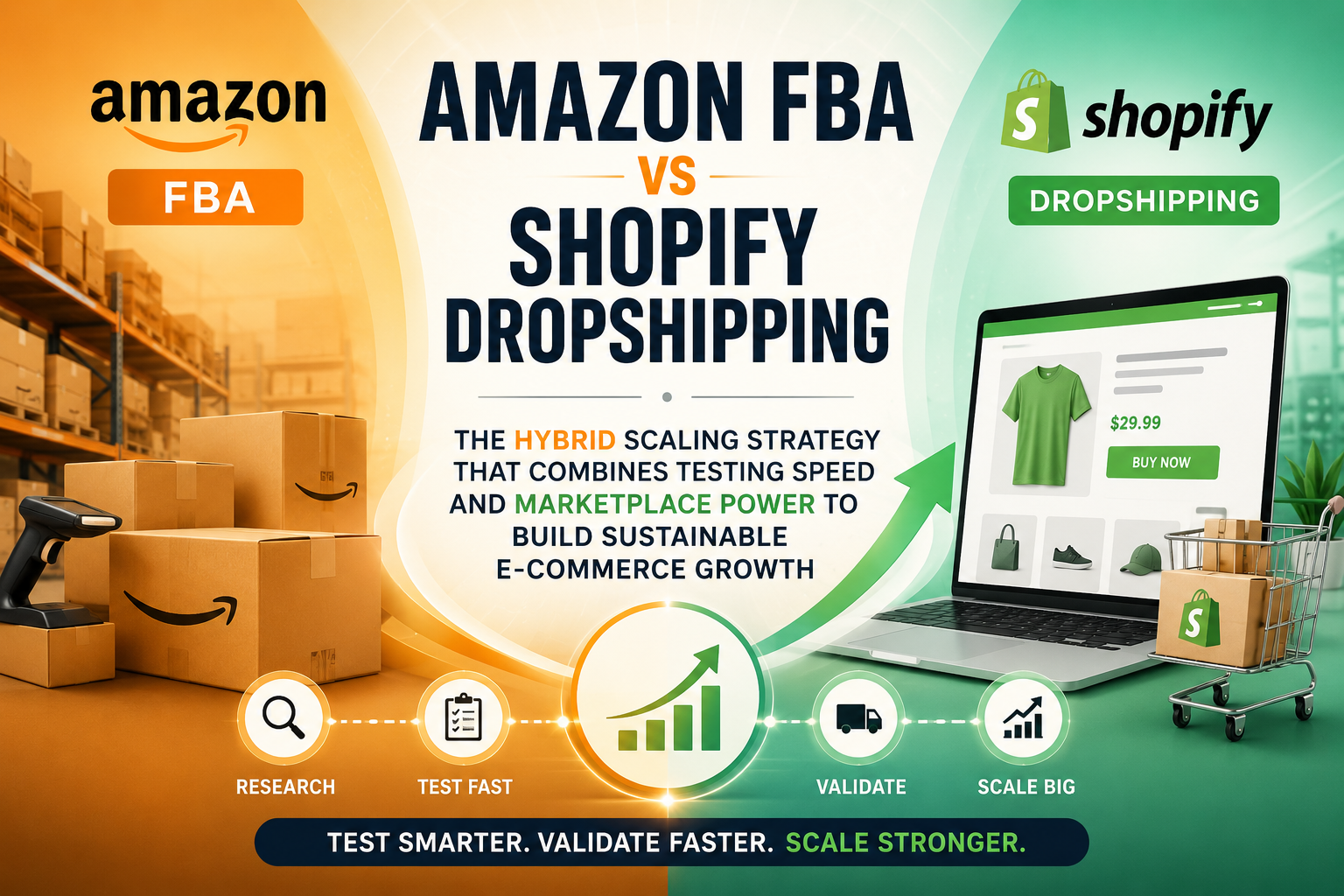
I would use Shopify dropshipping as a testing layer first, then move proven products into Amazon FBA once demand is stable and predictable. That hybrid approach avoids the biggest mistake I made: committing inventory before validating demand.
This combination also solves the biggest weakness of each model. Shopify gives speed and flexibility. FBA gives scale and trust. Separately, they are incomplete. Together, they are powerful.
Why Cash Flow Breaks Beginners in FBA but Shopify Lets You Start Lean and Scale Faster
When I first started comparing Amazon FBA and Shopify dropshipping, I honestly believed FBA was the safer path. The logic seemed simple: Amazon already has traffic, buyers trust the platform, and fulfillment is “handled for you.” I assumed that meant lower risk.
But that assumption completely broke down when I actually tried launching my first FBA product.
I picked a small home accessory item with decent margins and placed an initial inventory order of around $3,200. At that time, I didn’t fully calculate how many layers of cost were waiting after the product left the factory. I was focused only on unit cost and selling price, not the full cash cycle.
That was my first real lesson in cash flow reality.
The Hidden Cash Flow Pressure Behind Amazon FBA
What I didn’t expect was how fast money gets locked inside the FBA system.
Before the product even reached Amazon warehouses, I had already paid for manufacturing, international shipping, and inspection fees. Then Amazon added another layer: inbound placement fees, storage costs, and advertising spend just to get visibility.
The worst part wasn’t any single cost—it was timing.
My inventory sat in transit for weeks, then sat again in Amazon warehouses before generating consistent sales. During that period, my bank balance didn’t move upward at all, but expenses kept stacking.
At one point, I remember checking my account and realizing almost 70% of my working capital was already tied up in unsold inventory. That moment changed how I looked at “safe business models.”
FBA is not risky because it is complex—it is risky because your cash becomes trapped before validation.
Shopify Dropshipping Taught Me a Different Way to Think About Money
When I switched to testing Shopify dropshipping, the experience was almost the opposite.
Instead of buying inventory upfront, I started by listing products directly on a Shopify store and testing them with small ad budgets. I didn’t need to commit thousands of dollars before knowing if a product worked.
One specific example stands out. I tested a fitness accessory product with a $50 ad spend on the first day. It didn’t require inventory, warehouse shipping, or long-term commitment. I only placed orders after I saw actual customer purchases.
Even though the margins per order were slightly lower compared to FBA projections, the cash flow stayed flexible. Money came in first, and expenses followed—not the other way around.
That shift alone reduced my financial pressure dramatically.
The Real Difference Is Not Profit—It’s Financial Timing
After doing both models, I stopped thinking about which one is “more profitable” and started focusing on cash flow timing.
Amazon FBA is structured like a delayed return system. You invest early, wait for demand validation, and hope scale compensates for upfront risk.
Shopify dropshipping is closer to a real-time validation system. You test demand first, then allocate capital only when proof exists.
In my experience, beginners don’t fail in FBA because of bad products—they fail because their cash cycle collapses before they find winners.
How I Launched 5 Products in 7 Days and Discovered Why Speed Beats “Perfect Planning”
When I first started with Amazon FBA, I believed success came from careful planning. You research for weeks, source samples, negotiate suppliers, ship inventory to Amazon, and then finally launch a “perfect” product.
That mindset felt logical until I tried to compare it directly with Shopify dropshipping.
To make it a fair test, I ran a simple experiment: launch 5 products within 7 days using Shopify, and compare it with what I could realistically do using Amazon FBA in the same timeframe.
The result surprised me more than I expected.
The Amazon FBA Timeline Reality I Didn’t Want to Admit
For FBA, even the simplest product wasn’t “launch-ready” within a week.
One product alone required sampling, which took nearly 4 days just to get responses from suppliers. Then came negotiation, labeling requirements, packaging adjustments, and freight coordination.
Even if everything went smoothly, the earliest realistic timeline to get inventory into Amazon’s warehouse was closer to 3–5 weeks, not 7 days.
What struck me most wasn’t the complexity—it was the inability to test ideas quickly. Every decision felt permanent because money was already committed before any real market validation.
That made experimentation expensive and slow.
Shopify Dropshipping Let Me Compress Time in a Way FBA Couldn’t
On Shopify, I approached things differently. Instead of optimizing for perfection, I optimized for speed of validation.
I picked 5 products based on basic demand signals and competitor ads, then built simple product pages in a single day. No inventory, no warehouse coordination, no waiting for shipping samples to arrive from overseas.
By day 2, I already had traffic going through ads.
One product in particular—a simple lifestyle accessory—started getting clicks within hours. I didn’t know if it would become a winner, but I didn’t need to. The system itself was telling me what to do next based on real data.
That feedback loop is something FBA simply cannot replicate at early stage.
The Biggest Difference Was Not Effort, But Feedback Speed
What became obvious after 7 days was not just that Shopify was faster—it was that the entire learning cycle was compressed.
With Amazon FBA, you learn in weeks or months after money is already committed.
With Shopify dropshipping, you learn in hours or days before making major financial decisions.
I realized I wasn’t just testing products—I was testing market reactions. And the speed of that reaction completely changed how I evaluated business risk.
One product that looked promising on paper failed immediately in ads. Another product I almost ignored became the only one with consistent engagement.
If I had been using FBA, both of those outcomes would have taken weeks longer to discover—and at significantly higher cost.
Why Speed Is the Real Competitive Advantage in 2026
After this experiment, I stopped thinking of Amazon FBA as “better structured” and Shopify as “simpler.” Instead, I started seeing them as two different speeds of business execution.
FBA is built for scaling proven products.
Shopify dropshipping is built for discovering them.
The mistake many beginners make is using FBA to discover winners. That is where capital gets locked and time gets wasted.
In contrast, Shopify allowed me to iterate rapidly until signals became clear enough to justify scaling decisions later.
Where Your Money Actually Goes After Fees, Ads, and Real Operational Costs
When I first compared Amazon FBA and Shopify dropshipping, I made the same mistake most beginners make: I looked at product cost and selling price, then assumed the difference was my profit.
On paper, it looked simple. A $29.99 product bought for $8 meant “easy profit.”
But once I actually ran both business models, I realized profit margin is not a static number—it is a moving system shaped by fees, timing, and customer acquisition costs.
That realization came after I tracked every dollar across both Amazon FBA and Shopify for the same type of product category: small home and lifestyle accessories.
The Amazon FBA Profit Illusion I Experienced Firsthand
In my first FBA product, I listed a home gadget priced at $29.99. The unit cost from supplier was around $7.80, which already looked like a healthy margin.
But after going live, the real structure looked very different.
Amazon took its referral fee, fulfillment fee, and storage fee. Combined, those costs reduced my per-unit profit significantly before I even considered advertising. Then came PPC campaigns, which I initially underestimated.
To get consistent sales, I had to spend aggressively on ads. My ACoS (Advertising Cost of Sale) started hovering around 25%–35% in the early phase.
By the time I calculated everything properly, my actual profit per unit was closer to $3–$5, not the $20+ I had mentally projected.
What shocked me most wasn’t that Amazon charged fees—it was how invisible those fees felt until sales started happening at scale. The margin erosion only becomes clear after you commit inventory.
Shopify Dropshipping Margins Look Smaller—But Behave Differently
When I switched to Shopify dropshipping, the margin structure looked worse at first glance.
The same product category had higher supplier pricing per unit because I wasn’t buying in bulk. Shipping costs were also more variable. On paper, my gross margin per order was lower than Amazon FBA.
However, the cost structure behaved differently.
Instead of upfront inventory investment, my biggest cost was advertising. I typically spent $12–$18 in ad spend to generate a $30–$40 order. After product cost and shipping, my net profit per order sometimes landed around $4–$8.
Interestingly, even though the per-unit profit wasn’t dramatically higher than FBA, the cash flow timing changed everything. I wasn’t waiting weeks to recover investment, and I wasn’t locked into inventory that might not sell.
That flexibility allowed me to cut losing products immediately instead of carrying losses.
The Real Difference Is Cost Timing, Not Cost Amount
After running both models side by side, I realized something most profit breakdown charts miss.
Amazon FBA concentrates costs upfront and distributes profit later. Shopify distributes costs alongside revenue.
In FBA, I had moments where I was technically profitable per unit but still cash-negative overall because of inventory sitting in storage or slow turnover.
In Shopify dropshipping, I had thinner margins per order but a much faster feedback loop on profitability. If a product wasn’t profitable, I knew within days instead of months.
This changed how I think about “margin quality.” A high margin that takes months to realize is very different from a lower margin that returns cash immediately.
The Hidden Factor Nobody Talks About: Scaling Friction
One of the most important differences I experienced was scaling friction.
In Amazon FBA, scaling meant buying more inventory, increasing warehouse exposure, and risking unsold stock. That meant every scaling decision carried financial weight.
In Shopify dropshipping, scaling was purely a question of increasing ad spend on proven products. If a product was profitable at $100/day in ads, I could attempt $500/day without waiting for production cycles.
However, this also came with its own limitation: ad platform volatility. A profitable product could suddenly become unprofitable if CPMs increased or creatives fatigued.
So both models have margin risk—but the source of risk is completely different.
Who Really Owns the Customer? My First-Hand Experience Losing (and Keeping) Buyers Across Platforms
When I first started with Amazon FBA, I thought I was building a real business. Orders were coming in, Amazon was handling fulfillment, and everything looked stable on the surface.
But one day, I tried to understand my customer base more deeply—and I hit a wall.
I couldn’t really see who my customers were.
No meaningful email list, no direct communication channel, no long-term relationship data I could control. That’s when I started questioning something most beginners ignore: who actually owns the customer?
That question became the turning point in how I compare Amazon FBA and Shopify dropshipping.
The Amazon FBA Experience—High Traffic, Low Ownership
On Amazon, I had access to massive traffic. That part was undeniable. Products could get exposure quickly if they ranked well or performed in ads.
But the trade-off became clear after my first few months.
Even when customers bought my product, I didn’t “own” them in any real sense. Amazon controlled the checkout experience, the communication, and even the post-purchase relationship.
I once had a product that performed well for weeks. It had repeat buyers, solid reviews, and stable rankings. But when I tried to scale it beyond Amazon—there was nothing to transfer. No customer list, no email funnel, no retargeting base I could bring outside the platform.
It felt like building revenue inside a system that didn’t allow me to take anything with me.
That realization hit harder when one of my listings got suppressed temporarily. Sales stopped immediately, and I had no alternative way to reach those customers.
Shopify Dropshipping Gave Me Something Amazon Never Did—Direct Access
When I moved into Shopify dropshipping, the first major difference wasn’t profit—it was visibility.
From day one, I could see who was visiting my store, what they were clicking, and whether they were abandoning carts. More importantly, I could collect emails and build a direct communication channel.
I remember one specific product test where I didn’t immediately convert a visitor on their first visit. Instead of losing that traffic forever like on Amazon, I was able to retarget them through email and ads later.
One customer actually purchased on their third interaction with my store. That single behavior made me realize something important: on Shopify, I wasn’t just selling products—I was building an audience asset.
That audience didn’t depend on a single marketplace algorithm.
The Moment I Lost an Amazon Listing and Understood the Risk
There was a moment during my Amazon journey that completely changed my perspective.
One of my listings was suddenly flagged due to a compliance review. Sales dropped to zero overnight. I contacted support, fixed the issue, and eventually restored the listing—but during that downtime, I realized something uncomfortable.
Even though I “owned” the product, I didn’t own the distribution channel. I didn’t control visibility, ranking, or customer access.
If Amazon changes a policy or suspends a listing, the customer relationship disappears instantly.
That experience made me rethink what “building a brand” actually means.
Shopify Isn’t Perfect Either—But Ownership Is Real
To be fair, Shopify dropshipping doesn’t automatically solve everything. Traffic has to be generated, and advertising platforms like Meta or TikTok still control visibility.
But the key difference is this: I still control the data layer.
Even if ads get expensive or traffic fluctuates, I can still reach my past customers. I can build email campaigns, SMS flows, and retargeting audiences. That control gives me something Amazon never offered—compounding value over time.
One of my Shopify stores eventually built a small returning customer base that I could activate whenever I launched a new product. That alone reduced my dependency on cold traffic.
Risk Factors: Account Bans, Inventory Loss, and the Hidden Business Killers I Personally Experienced
When I first compared Amazon FBA and Shopify dropshipping, I thought risk was simple: bad products lose money, good products make money.
But after actually running both models, I realized the real risk isn’t just profit loss—it’s system dependency. You can be doing everything “right” and still lose your business overnight because of platform decisions, policy changes, or supply chain breakdowns.
That realization came from two very different experiences—one on Amazon, and one on Shopify.
My Amazon FBA Wake-Up Call—When a Listing Disappeared Overnight
I still remember checking my Amazon dashboard one morning and seeing one of my best-performing listings marked as “inactive.”
No warning that made sense to me. No gradual decline. Just sudden suppression.
That product was generating consistent sales, had decent reviews, and was part of my core revenue stream at the time. Within hours, revenue dropped to zero.
I contacted support, submitted documents, adjusted compliance details, and eventually got it reinstated—but the damage had already been done.
What shocked me wasn’t just the downtime—it was how fragile the entire structure was. I didn’t control visibility. I didn’t control policy enforcement speed. And I definitely didn’t control how quickly my income could be paused.
In that moment, I realized Amazon FBA risk isn’t gradual. It can be instant.
The Inventory Trap I Didn’t Fully Understand at First
Another major risk I experienced with FBA wasn’t sudden—it was slow and silent.
I had ordered inventory based on early sales momentum. At first, everything looked promising. Products started moving, reviews came in, and I assumed scaling was the logical next step.
So I increased inventory.
But demand didn’t scale the way I expected. Some products slowed down after initial ad spikes, while others became seasonal without me realizing it.
The result was simple but painful: inventory sitting in Amazon warehouses while storage fees continued to accumulate.
At one point, I was technically “in business,” but a large portion of my capital was locked in unsold stock that was slowly eating into margins.
The risk wasn’t just losing money—it was losing liquidity.
Shopify Dropshipping Looked Safer—Until Ads Became the Weak Point
When I moved into Shopify dropshipping, I initially felt like I had escaped those FBA risks. No inventory upfront, no warehouse fees, no long-term capital lock.
But I quickly discovered a different kind of risk: platform dependency on advertising systems.
One of my products started performing well through Meta ads. For a few days, everything looked stable—profitable ROAS, consistent orders, scalable signals.
Then, suddenly, CPMs increased and ad delivery became unstable. My winning product turned unprofitable almost overnight, not because the product changed, but because the traffic cost structure changed.
I didn’t lose inventory—but I lost predictability.
That was the hidden risk in Shopify: your business is only as stable as your ad performance.
The Most Dangerous Risk Is Overconfidence in One Model
After running both systems, I realized something most beginners miss: both Amazon FBA and Shopify dropshipping have “silent risk zones.”
FBA hides risk inside inventory and compliance systems that are outside your control.
Shopify hides risk inside advertising platforms and supplier consistency.
I once made the mistake of believing Shopify was “safer” because there was no inventory. But in reality, I was just shifting risk from capital exposure to traffic volatility.
Neither model is risk-free. They just fail in different ways.
When I first compared Amazon FBA and Shopify dropshipping, I thought risk was simple: bad products lose money, good products make money.
But after actually running both models, I realized the real risk isn’t just profit loss—it’s system dependency. You can be doing everything “right” and still lose your business overnight because of platform decisions, policy changes, or supply chain breakdowns.
That realization came from two very different experiences—one on Amazon, and one on Shopify.
My Amazon FBA Wake-Up Call—When a Listing Disappeared Overnight
I still remember checking my Amazon dashboard one morning and seeing one of my best-performing listings marked as “inactive.”
No warning that made sense to me. No gradual decline. Just sudden suppression.
That product was generating consistent sales, had decent reviews, and was part of my core revenue stream at the time. Within hours, revenue dropped to zero.
I contacted support, submitted documents, adjusted compliance details, and eventually got it reinstated—but the damage had already been done.
What shocked me wasn’t just the downtime—it was how fragile the entire structure was. I didn’t control visibility. I didn’t control policy enforcement speed. And I definitely didn’t control how quickly my income could be paused.
In that moment, I realized Amazon FBA risk isn’t gradual. It can be instant.
The Inventory Trap I Didn’t Fully Understand at First
Another major risk I experienced with FBA wasn’t sudden—it was slow and silent.
I had ordered inventory based on early sales momentum. At first, everything looked promising. Products started moving, reviews came in, and I assumed scaling was the logical next step.
So I increased inventory.
But demand didn’t scale the way I expected. Some products slowed down after initial ad spikes, while others became seasonal without me realizing it.
The result was simple but painful: inventory sitting in Amazon warehouses while storage fees continued to accumulate.
At one point, I was technically “in business,” but a large portion of my capital was locked in unsold stock that was slowly eating into margins.
The risk wasn’t just losing money—it was losing liquidity.
Shopify Dropshipping Looked Safer—Until Ads Became the Weak Point
When I moved into Shopify dropshipping, I initially felt like I had escaped those FBA risks. No inventory upfront, no warehouse fees, no long-term capital lock.
But I quickly discovered a different kind of risk: platform dependency on advertising systems.
One of my products started performing well through Meta ads. For a few days, everything looked stable—profitable ROAS, consistent orders, scalable signals.
Then, suddenly, CPMs increased and ad delivery became unstable. My winning product turned unprofitable almost overnight, not because the product changed, but because the traffic cost structure changed.
I didn’t lose inventory—but I lost predictability.
That was the hidden risk in Shopify: your business is only as stable as your ad performance.
The Most Dangerous Risk Is Overconfidence in One Model
After running both systems, I realized something most beginners miss: both Amazon FBA and Shopify dropshipping have “silent risk zones.”
FBA hides risk inside inventory and compliance systems that are outside your control.
Shopify hides risk inside advertising platforms and supplier consistency.
I once made the mistake of believing Shopify was “safer” because there was no inventory. But in reality, I was just shifting risk from capital exposure to traffic volatility.
Neither model is risk-free. They just fail in different ways.
The Scaling Strategy I Wish I Knew—Why Winners Use Both Instead of Choosing One
When I first started comparing Amazon FBA and Shopify dropshipping, I treated them like a choice I had to get right.
Either I go all-in on Amazon FBA for “stability,” or I build a Shopify dropshipping store for “freedom.” I assumed one model had to be superior, and my success depended on choosing correctly.
But after running both models for a while, I realized something more important: the real advantage is not in choosing one—it’s in sequencing them correctly.
That shift in thinking completely changed how I scale products now.
Where Amazon FBA Actually Wins—But Only at the Right Stage
Amazon FBA looks powerful because it gives access to built-in traffic and trust. When a product is already validated, FBA can scale it faster than almost any other system.
I experienced this firsthand when one of my products started getting consistent sales on Shopify first. Once I had real data—clicks, conversions, and repeat interest—I moved it into Amazon FBA.
The difference was immediate. Instead of spending weeks figuring out demand, Amazon amplified something that already worked.
That’s when I understood FBA is not a discovery tool—it’s an acceleration tool.
The mistake I made early on was trying to use it for discovery.
Shopify Dropshipping Is Not “Temporary”—It’s a Testing Engine
In contrast, Shopify dropshipping played a completely different role in my workflow.
It wasn’t about building a final business—it was about building a decision system.
I remember testing multiple products in a short time frame using Shopify. Some failed within days, some showed early traction, and only a few demonstrated consistent conversion patterns.
One product in particular didn’t look special at first. But after running multiple ad variations and observing customer behavior, I noticed a stable conversion trend.
That product never would have been selected using Amazon FBA alone, because FBA forces you to commit before you fully understand demand.
Shopify gave me something more valuable than profit: clarity.
The Scaling Problem Most Beginners Don’t See
The biggest mistake I see beginners make is scaling too early on Amazon FBA or staying too small on Shopify.
On FBA, scaling too early means ordering inventory based on assumptions instead of validated demand. That leads to cash being locked in slow-moving stock.
On Shopify, staying too small means never escaping the testing phase. Many people find winning products but never scale aggressively enough to reach meaningful revenue.
I personally made both mistakes at different stages.
At one point in FBA, I over-ordered inventory because early sales looked promising. At another point in Shopify, I hesitated to scale ads even when I had positive signals, simply because I wasn’t confident in stability.
The truth is, both models require timing—not just strategy.
The System I Eventually Built (And Still Use)
After enough trial and error, I stopped thinking in terms of “Amazon vs Shopify” and started thinking in terms of a product lifecycle system.
Now my approach is simple:
I use Shopify dropshipping as the front-end testing layer. I launch multiple products quickly, observe real customer behavior, and identify consistent winners based on data—not intuition.
Once a product proves itself, I transition it into Amazon FBA to scale with stronger infrastructure, higher trust conversion, and more predictable fulfillment.
This hybrid approach solved a problem I didn’t even realize I had: wasting resources on unvalidated scale.
Instead of betting big early, I now earn the right to scale.




No Comments