


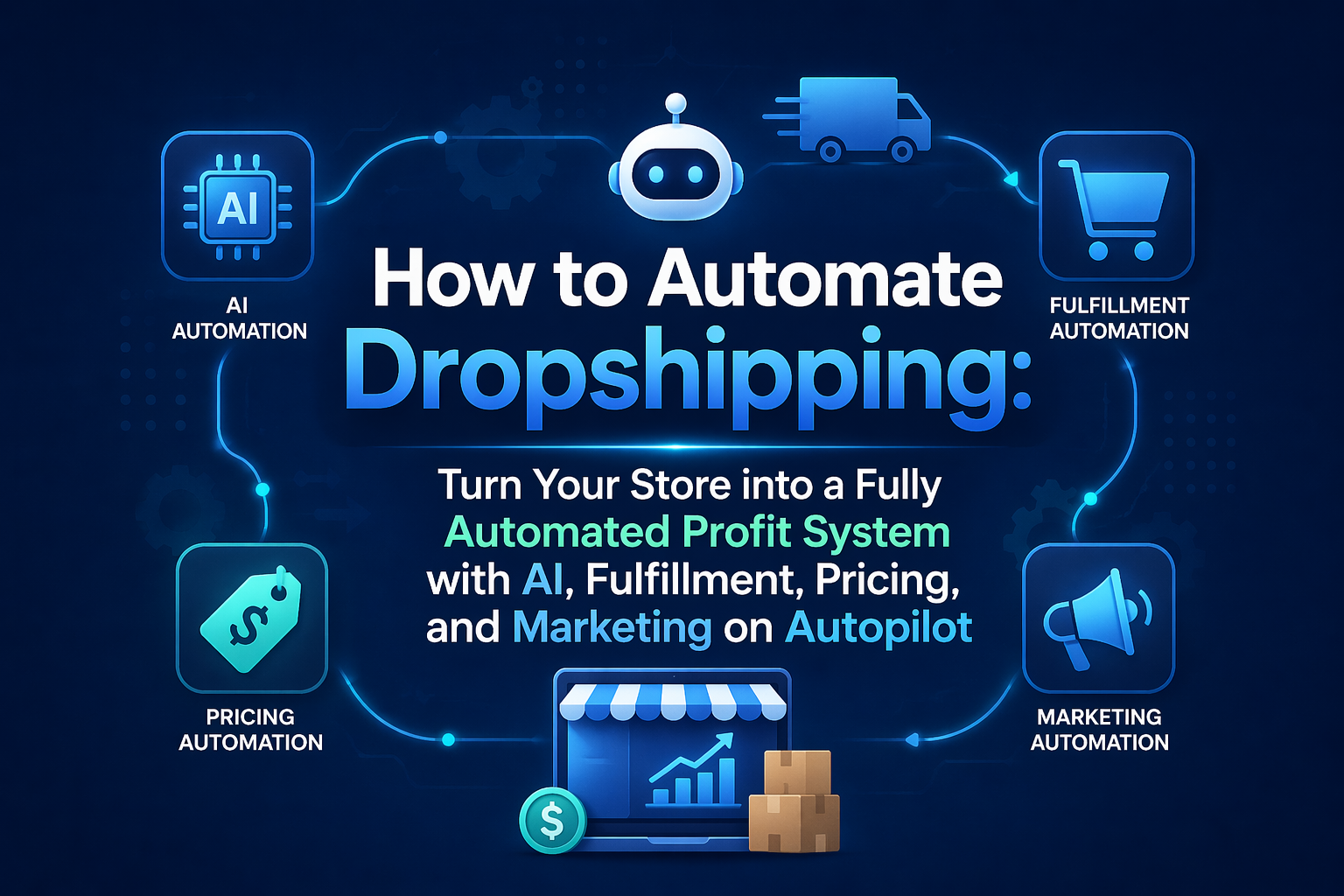
How to Automate Dropshipping: Turn Your Store into a Fully Automated Profit System with AI, Fulfillment, Pricing, and Marketing on Autopilot

The ultimate goal of automation is not a one-time product win, but a continuous discovery pipeline. By combining data aggregation, AI filtering, competitor analysis, and supplier validation, sellers can create a system that consistently generates new product opportunities.
This approach transforms dropshipping from a reactive business model into a data-driven operation. Rather than chasing trends manually, the system surfaces them automatically, allowing sellers to focus on execution, branding, and scaling.
How to Automate Dropshipping Product Research Using AI and Data Tools
In dropshipping, the difference between a profitable store and a failing one often comes down to product selection. Traditionally, product research has been manual, time-consuming, and highly subjective. Sellers scroll through marketplaces, analyze competitors, and test products blindly. This approach no longer scales in a competitive environment where trends emerge and fade within weeks.
Automating product research fundamentally changes this dynamic. Instead of relying on intuition, automation leverages real-time data, algorithmic filtering, and predictive signals to identify products with higher probability of success. The goal is not just speed, but consistency—building a repeatable system that continuously surfaces viable opportunities without manual effort.
Using Data Aggregation to Identify Trends Early
The first layer of automation focuses on collecting and structuring data from multiple marketplaces. Platforms such as Amazon, eBay, and TikTok Shop generate massive volumes of product activity signals, including sales velocity, customer engagement, and ranking fluctuations.
Automation tools aggregate this data and convert it into actionable insights. For example, instead of manually browsing categories, a system can track:
- Rapid increases in sales rank
- Sudden spikes in customer reviews
- Viral engagement patterns on short-form video platforms
This allows sellers to detect early-stage trends before saturation occurs. More importantly, it reduces the lag between trend emergence and product launch, which is critical for maintaining profit margins.
AI-Driven Product Filtering for Profitability
Raw data alone is not enough. The next step is filtering products based on predefined profitability criteria. Automation systems can apply rules such as minimum margin thresholds, acceptable competition levels, and supplier availability.
AI models further enhance this process by identifying patterns that are not immediately visible. For instance, products with moderate competition but high repeat purchase potential may outperform short-lived viral items. Similarly, AI can detect niches where demand is stable but underserved, which is often more sustainable than chasing trends.
By automating this filtering layer, sellers eliminate emotional decision-making and focus only on statistically viable products.
Automating Competitor Analysis at Scale
Competitor analysis is another area where automation provides a clear advantage. Instead of manually reviewing stores, automated systems can scan thousands of listings and extract key metrics such as pricing strategies, product positioning, and customer feedback.
This enables a more objective understanding of market saturation. For example, if a product has many sellers but low review quality, it may still present an opportunity for differentiation. Conversely, a highly optimized competitor landscape signals diminishing returns.
Automation also allows continuous monitoring, meaning sellers can react quickly when competitors adjust pricing or introduce new variations.
Integrating Supplier Data for Real-Time Validation
A common failure point in dropshipping is selecting products that appear promising but lack reliable supply. Automation solves this by integrating supplier data directly into the research process.
Instead of evaluating demand in isolation, systems can simultaneously verify:
- Supplier stock levels
- Processing times
- Shipping costs and delivery regions
This ensures that only products with operational feasibility move forward. It also reduces the risk of scaling a product that cannot sustain fulfillment demand.
How to Automate Dropshipping Fulfillment and Supplier Management for Faster Scaling
While product research determines what you sell, fulfillment determines whether your business can actually scale. Many dropshipping stores fail not because of poor demand, but because of operational bottlenecks—manual order placement, supplier miscommunication, inventory mismatches, and delayed shipping.
Automation addresses these inefficiencies by turning fulfillment into a structured, system-driven process. Instead of reacting to orders one by one, sellers can build a workflow where supplier selection, order routing, and shipping updates happen with minimal human intervention. This shift is essential for handling volume without increasing operational complexity.
Automating Supplier Matching and Selection
One of the most overlooked aspects of dropshipping is supplier selection. Many sellers rely on a single source, which creates risk in terms of stock availability, pricing volatility, and shipping delays.
Automation allows dynamic supplier matching. Instead of manually choosing a supplier, systems can automatically assign orders based on predefined criteria such as product cost, warehouse location, processing time, and delivery speed. For example, an order from a European customer can be routed to a local warehouse rather than a supplier in Asia, reducing shipping time and improving customer satisfaction.
This level of flexibility not only improves efficiency but also creates a more resilient supply chain.
Auto-Ordering: Eliminating Manual Workflows
Manual order placement is one of the biggest bottlenecks in traditional dropshipping. Logging into supplier platforms, entering customer details, and confirming orders introduces delays and increases the risk of human error.
Auto-ordering systems solve this by directly connecting your store to supplier networks. Once a customer places an order, the system automatically forwards all necessary information to the supplier, including product specifications, shipping address, and preferred delivery method.
This process reduces fulfillment time significantly and ensures consistency across all orders. More importantly, it allows sellers to handle higher order volumes without increasing labor costs.
Real-Time Inventory and Price Synchronization
Inventory mismatches are a common issue in dropshipping. Selling a product that is out of stock or mispriced can lead to cancellations, refunds, and negative customer experiences.
Automation mitigates this risk by continuously syncing supplier data with your store. Stock levels, pricing changes, and product availability are updated in real time, ensuring that your listings reflect current conditions.
This synchronization also enables smarter decision-making. For instance, if a supplier increases prices, the system can automatically adjust your store pricing or temporarily pause the product listing to protect margins.
Automating Shipping, Tracking, and Notifications
Customer expectations around shipping transparency have increased significantly. Buyers expect timely updates and accurate tracking information, regardless of the business model.
Automation ensures that once an order is fulfilled, tracking numbers are automatically generated and sent to customers. Shipping status updates can also be triggered without manual input, keeping customers informed throughout the delivery process.
This reduces the burden on customer support while improving overall user experience. It also minimizes disputes and refund requests caused by uncertainty around order status.
Building a Multi-Warehouse Fulfillment Strategy
As a dropshipping business grows, relying on a single supplier or warehouse becomes increasingly risky. Automation enables a distributed fulfillment model, where inventory is sourced from multiple locations.
Systems can intelligently route orders to the nearest warehouse, balancing cost and delivery speed. This is particularly important for targeting international markets, where shipping time can significantly impact conversion rates.
A multi-warehouse approach also provides redundancy. If one supplier experiences delays or stock shortages, orders can be redirected automatically without disrupting operations.
How to Automate Dropshipping Pricing and Maximize Profit Margins
Pricing is one of the most sensitive variables in dropshipping. Set prices too high and you lose conversions; set them too low and you erode margins. The challenge becomes more complex as competition increases and supplier costs fluctuate. Manual pricing simply cannot keep up with real-time market dynamics.
Automation introduces a structured way to manage pricing decisions. Instead of reacting manually, sellers can define rules, thresholds, and triggers that continuously adjust prices based on market conditions. This ensures that pricing remains competitive while protecting profitability over time.
Dynamic Pricing Based on Market Conditions
At the core of pricing automation is dynamic pricing. Rather than using static markups, systems can adjust product prices based on variables such as competitor behavior, demand fluctuations, and seasonal trends.
For example, if multiple competitors lower their prices on a similar product, an automated system can respond immediately by adjusting your price within a predefined range. Conversely, if demand increases and competition decreases, the system can raise prices to capture higher margins.
This responsiveness is essential in dropshipping, where market conditions can shift rapidly and unpredictably.
Automating Profit Margin Protection
One of the biggest risks in dropshipping is margin compression. Supplier price increases, currency fluctuations, and rising shipping costs can quickly turn a profitable product into a loss-making one.
Automation allows sellers to set minimum profit thresholds. If costs increase beyond a certain point, the system can automatically raise the selling price, reduce ad spend allocation, or even pause the product listing.
This creates a safeguard against hidden losses, ensuring that every sale contributes positively to the business rather than eroding capital over time.
Integrating Cost Variables in Real Time
Accurate pricing requires a complete understanding of cost structure. In addition to product cost, factors such as shipping fees, transaction costs, and exchange rates all influence final profitability.
Automated pricing systems integrate these variables in real time. For instance, if international shipping costs rise or currency exchange rates shift, the system recalculates prices accordingly. This eliminates the need for constant manual updates and reduces the risk of outdated pricing.
By maintaining alignment between costs and pricing, sellers can operate with greater financial precision.
Competitor Monitoring at Scale
Manual competitor analysis is not scalable, especially when managing multiple products across different markets. Automation enables continuous monitoring of competitor pricing, promotions, and positioning.
Instead of checking listings manually, systems can track price changes across dozens or even hundreds of competitors. This data can then trigger automatic adjustments to maintain competitiveness without engaging in destructive price wars.
More importantly, automation allows for strategic positioning. Sellers can choose to remain slightly above competitors if they offer better branding or faster shipping, rather than blindly undercutting prices.
Rule-Based and AI-Driven Pricing Strategies
Pricing automation can be implemented through rule-based systems or enhanced with AI-driven models. Rule-based approaches rely on predefined logic, such as maintaining a fixed margin or staying within a percentage range of competitor prices.
AI-driven systems go further by analyzing historical data and predicting optimal price points. These models can identify patterns in customer behavior, such as price sensitivity and conversion likelihood, allowing for more refined pricing strategies.
Over time, this leads to more efficient revenue optimization, as pricing decisions are informed by data rather than assumptions.
Turning Pricing Into a Scalable System
Automating pricing transforms it from a reactive task into a strategic system. Instead of constantly adjusting prices manually, sellers can rely on a framework that continuously optimizes for both competitiveness and profitability.
This not only reduces operational workload but also creates a more resilient business model. In a landscape where margins are often tight, the ability to maintain pricing discipline through automation becomes a key differentiator.
How to Automate Dropshipping Store Operations and Eliminate Daily Manual Tasks
In the early stages of dropshipping, managing orders, updating inventory, and sending tracking information manually may seem manageable. However, as order volume increases, these repetitive tasks quickly become bottlenecks. Errors accumulate, response times slow down, and operational inefficiencies begin to impact customer experience.
Automation shifts store operations from manual execution to system-driven workflows. Instead of handling each task individually, sellers build an infrastructure where processes run continuously in the background. This is what allows a store to scale without a proportional increase in workload or staffing.
Automating Order Processing and Routing
Order processing is the first critical step in store operations. Without automation, every order requires manual verification, forwarding, and confirmation, which introduces delays and increases the likelihood of mistakes.
With automation, orders are processed instantly after purchase. The system verifies payment status, organizes product details, and routes the order to the appropriate supplier or warehouse based on predefined logic. This routing can consider factors such as customer location, product availability, and shipping speed.
As a result, fulfillment begins immediately, reducing handling time and improving delivery performance.
Real-Time Inventory Synchronization Across Channels
Inventory inconsistency is a common issue in multi-product or multi-supplier stores. Selling items that are out of stock leads to cancellations and damages brand credibility.
Automation ensures that inventory levels are continuously synchronized between your store and suppliers. When stock changes on the supplier side, your product listings are updated automatically. This reduces overselling and allows for more accurate demand management.
For stores operating across multiple sales channels, such as marketplaces and independent websites, centralized inventory automation becomes even more important. It ensures that all platforms reflect the same availability in real time.
Automating Shipping Workflows and Tracking Updates
Shipping is not just about delivery—it is also about communication. Customers expect timely updates and clear visibility into their orders.
Automated systems handle shipping workflows by generating tracking numbers as soon as orders are fulfilled. These tracking details are then pushed directly to customers through email or integrated notification systems. Status updates can be triggered automatically at each stage of the delivery process.
This reduces customer uncertainty and significantly lowers the volume of “Where is my order?” inquiries, which are a major burden on support teams.
Centralizing Operations with ERP and WMS Systems
As operations grow more complex, relying on disconnected tools becomes inefficient. Enterprise Resource Planning (ERP) and Warehouse Management Systems (WMS) provide a centralized layer for managing all operational data.
Automation within these systems connects order management, inventory tracking, supplier coordination, and logistics into a single interface. This allows sellers to monitor performance, identify bottlenecks, and make data-driven decisions without manually compiling information from different sources.
More importantly, these systems enable scalability by standardizing processes across the entire operation.
Exception Handling and Workflow Optimization
No system is perfect, and exceptions will always occur. Orders may fail, suppliers may run out of stock, or shipping delays may arise. The difference lies in how these situations are handled.
Automation can be configured to detect anomalies and trigger predefined responses. For example, if an order cannot be fulfilled by the primary supplier, the system can automatically reroute it to an alternative source. If a delay is detected, customers can be notified proactively.
This reduces the need for constant manual oversight while ensuring that issues are addressed quickly and consistently.
How to Automate Dropshipping Customer Service Without Losing Personalization
Customer service is often underestimated in dropshipping, yet it directly impacts retention, refunds, and brand perception. In the early stages, handling emails and messages manually may be manageable. However, as order volume grows, the number of inquiries increases disproportionately—covering order status, shipping delays, product questions, and returns.
Without automation, response times slow down and consistency declines. This leads to negative reviews and reduced customer trust. Automation does not eliminate customer service; it restructures it into a system that can handle high volumes efficiently while maintaining a controlled level of personalization.
Automating First-Level Support with AI and Chatbots
A significant portion of customer inquiries are repetitive. Questions about shipping times, order tracking, and basic product details account for the majority of support tickets. Automating these responses is the most immediate efficiency gain.
AI-powered chatbots can handle these first-level interactions instantly. By integrating with order and tracking systems, they can provide real-time answers without human intervention. This reduces response time from hours to seconds and ensures availability across different time zones.
More importantly, automation standardizes answers, preventing inconsistencies that often occur with manual responses.
Intelligent Ticket Routing and Prioritization
Not all customer inquiries are equal. Some require immediate attention, such as payment issues or failed deliveries, while others are informational.
Automation allows incoming messages to be categorized and prioritized based on content. Urgent issues can be routed to human agents, while low-priority questions are handled automatically. This ensures that critical problems are resolved quickly without overwhelming support teams.
By structuring support workflows in this way, businesses can maintain service quality even as volume increases.
Automating Email Responses and Follow-Ups
Email remains a primary communication channel in dropshipping. However, manually responding to every message is inefficient and difficult to scale.
Automated email systems can handle common scenarios such as order confirmations, shipping updates, delay notifications, and refund acknowledgments. These responses can be triggered based on specific events, ensuring timely and relevant communication.
Follow-up sequences can also be automated. For example, after a product is delivered, the system can request feedback or offer support if needed. This not only improves customer experience but also increases engagement and repeat purchases.
Streamlining Returns and Refund Processes
Returns and refunds are one of the most time-consuming aspects of customer service. Without automation, these processes involve multiple back-and-forth interactions, increasing workload and delaying resolution.
Automation simplifies this by creating structured workflows. Customers can submit return requests through predefined forms, and the system can automatically validate eligibility based on policies. Once approved, instructions and updates are sent without manual intervention.
This reduces friction for both the business and the customer, leading to faster resolutions and improved satisfaction.
Balancing Automation with Personalization
A common concern is that automation reduces the human element of customer service. In reality, effective automation enhances personalization by freeing up human agents to focus on complex or high-value interactions.
For example, instead of spending time answering repetitive questions, support teams can handle nuanced cases that require empathy and problem-solving. Automated systems can also incorporate customer data, such as order history and preferences, to deliver more relevant responses.
The goal is not to replace human interaction but to allocate it more effectively.
How to Automate Dropshipping Marketing and Increase Conversions on Autopilot
Traffic generation and conversion optimization are the primary drivers of revenue in dropshipping. However, managing advertising campaigns, email flows, and customer journeys manually becomes inefficient as complexity increases. Each channel requires constant monitoring, testing, and adjustment, which quickly exceeds human capacity.
Marketing automation solves this by transforming fragmented efforts into a cohesive system. Instead of manually launching campaigns and reacting to performance, sellers can build automated funnels that continuously attract, convert, and retain customers. This shift allows for predictable growth rather than inconsistent results driven by manual intervention.
Automating Paid Advertising Optimization
Paid advertising platforms such as Facebook and TikTok operate on algorithmic learning. Manual optimization—adjusting bids, audiences, and creatives—is often reactive and limited in scale.
Automation leverages machine learning to optimize campaigns in real time. Systems can automatically allocate budget to high-performing ad sets, pause underperforming creatives, and test variations without manual input. This reduces wasted ad spend and improves overall return on investment.
More importantly, automation enables continuous testing. Instead of running isolated experiments, multiple variations can be tested simultaneously, accelerating the identification of winning combinations.
Building Automated Email Marketing Flows
Email remains one of the highest ROI channels in ecommerce, but its effectiveness depends on timing and relevance. Sending manual campaigns limits both frequency and personalization.
Automation allows for behavior-driven email flows. For example, when a user abandons their cart, a sequence of reminder emails can be triggered automatically. Similarly, post-purchase flows can include order confirmations, product usage tips, and cross-sell recommendations.
These flows operate continuously, ensuring that every customer interaction is followed by a relevant message. Over time, this significantly increases conversion rates and customer lifetime value.
Recovering Lost Revenue with Abandoned Cart Automation
Cart abandonment is a major source of lost revenue in dropshipping. Without automation, most of these potential sales are never recovered.
Automated systems can re-engage users through multiple channels, including email, SMS, and retargeting ads. Timing plays a critical role—messages sent within the first few hours are far more effective than delayed follow-ups.
In addition to reminders, automation can include incentives such as limited-time discounts or free shipping offers. These strategies are triggered conditionally, ensuring that incentives are used strategically rather than applied universally.
Automating Upsell and Cross-Sell Strategies
Increasing average order value is often more cost-effective than acquiring new customers. However, manually managing upsell and cross-sell offers is impractical at scale.
Automation integrates these strategies directly into the customer journey. During checkout, relevant product recommendations can be displayed automatically based on the items in the cart. After purchase, follow-up emails can suggest complementary products.
This approach ensures that every customer interaction becomes an opportunity to increase revenue, without requiring manual intervention.
Creating a Data-Driven Marketing Funnel
Automation is most effective when all marketing activities are connected within a unified funnel. Data from ads, email campaigns, and customer behavior can be integrated to provide a complete view of performance.
This allows systems to make informed decisions, such as adjusting ad targeting based on customer segments or refining email content based on engagement metrics. Over time, the funnel becomes more efficient as it continuously learns from user behavior.
Rather than managing isolated campaigns, sellers operate a system that optimizes the entire customer journey from acquisition to retention.


No Comments